
Beer Tap Handles Australia: A Complete Buyer's Guide
Sep 30, 2026
You've got the lines flushed, the kegs are cold, and the bare tap wall is staring back at you. At six in the morning on the Gold Coast, with summer moisture already hanging in the air, choosing handles can feel like a finishing touch. It isn't. The wrong handle can loosen, corrode, become difficult to clean, or make a strong beer brand look like an afterthought.
Beer tap handles in Australia sit where hardware, hospitality and brand identity meet. They're the part of the dispensing system a customer reaches for, so the design needs to suit the beer, the faucet, the venue and the conditions around it. It also needs to stay within Australia's alcohol marketing rules when the handle is visible to the public.
Choosing Beer Tap Handles in Australia
The best tap wall I've worked on hasn't been the one with the fanciest shapes. It's been the one where every handle makes sense. A lager handle is easy to identify at a busy service station, a stout handle suits the way the beer is poured, and the material still looks sharp after repeated cleaning and contact with wet hands.
A tap handle carries more responsibility than its size suggests. It tells the customer what's available, reinforces the brewery's visual identity and gives staff a reliable point of contact during every pour. If you run a coastal venue, you're also asking it to cope with humidity, salt air, splashes and constant handling.
My rule: choose the handle as part of the dispense system, not as a decoration bought after the system is installed.
Start with the practical questions:
- What tap body are you using? A free-flow faucet is generally used for lagers, ales and most craft beers, while a stout faucet is designed for nitrogenous beers and a different pouring action. Andale Micro Matic's tap guidance explains why the faucet type affects flow, foam and sanitation.
- What will the venue do to the handle? A high-turnover bar needs a surface that tolerates frequent wiping. A home keg setup may allow more room for timber or a detailed custom piece.
- What does the brand need to communicate? A clean badge can support a restrained brewery identity. A tactile timber handle can suit a taproom built around local character. Neither choice works if the artwork is hard to read from the customer side.
- Who will use it? Staff should be able to operate the faucet without yanking the top of an oversized novelty handle. The handle should support a controlled snap-open and snap-close movement at the base.
A good handle helps a customer choose confidently, especially when the tap list includes unfamiliar styles. That decision should be based on the beer's character and the venue's offer, not pressure to drink quickly or consume more than intended. Your prospects may want discovery, local connection and a better-quality pour. The responsible way to support that choice is to make the information clear and the hardware dependable.
Parts, Threads and Standard Australian Fitments
Before you compare colours and finishes, understand the parts. A beer tap handle is a small assembly, not one mysterious block of branded plastic.
The lever is the section the operator grips. The ferrule or top cap joins the lever to the base and often carries the visual finish. The badge panel or medallion presents the brewery or beer artwork. Underneath, the threaded stud screws into the tap hardware, while a base collar helps the handle sit squarely. Some designs also use a seal washer to reduce movement and protect the connection.
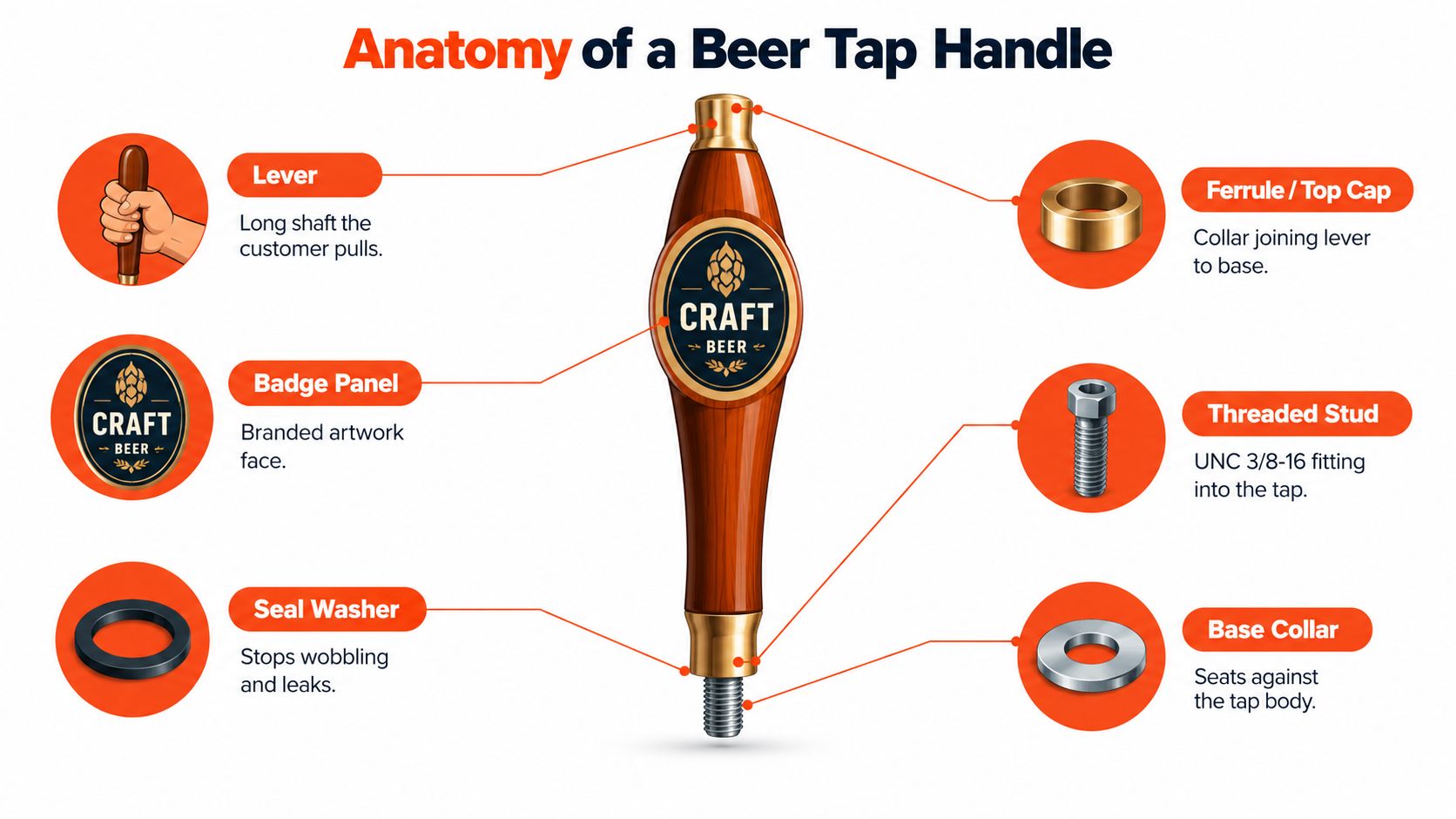
The common Australian fitment is a UNC 3/8"-16 threaded insert, as shown in Australian beer tap handle specifications. In plain terms, the handle has a threaded connection that mates with the corresponding thread on the tap fitting. That standard is why many replacement handles can be swapped without replacing the tower or faucet.
How to check the fit
- Ask for the thread specification. Don't rely on a product photograph or the phrase “standard fitting”. Get confirmation that the handle uses UNC 3/8"-16.
- Inspect your existing handle. Remove it by hand if possible and check whether the stud is damaged, bent or carrying old adhesive.
- Check the seating surface. The handle should meet the tap hardware squarely. A crooked seat often means cross-threading, a damaged washer or an incompatible base.
- Test by hand first. If the thread doesn't engage smoothly, stop. Forcing it can damage the insert or the tap fitting.
Small-format handles listed for the Australian market can be compact, while longer ergonomic designs offer more grip. Those dimensions affect how the handle feels during service, but they don't replace the need to confirm the thread.
If you're fitting a product display to a tap wall, keep the hardware and the beer story aligned. For example, Code Cracker XPA '26 is tied to a South East Queensland beer hunt that united seven independent breweries, with the final XPA made using Cryer Malt, Clayton Hops Nelson Sauvin, Rakau and Motueka, and Neumaker Yeast AY04. A handle for that beer should make the discovery theme easy to understand without turning the tap into a cluttered sign.
Materials That Survive Humid Coastal Venues
Queensland humidity exposes weak finishes quickly. Water sits in joints, salt air attacks scratched plating and ultraviolet light works on exposed artwork. A handle that looks good in a showroom can become a maintenance nuisance on a Gold Coast bar if the material doesn't match the venue.
304 stainless steel is my first choice for high-turnover coastal bars. It offers strong corrosion resistance, a smooth surface that's straightforward to sanitise and a professional appearance that works across different beer brands. Australian listings specifically highlight 304 stainless steel for corrosion resistance, making it a sensible option when the bar is exposed to moisture or sea air. Stainless steel plaque and signage guidance from Evright Industrial is also useful when you're comparing how durable metal finishes behave in commercial environments.
Chrome-plated brass gives you a classic shine, but the plating needs care. Once the chrome is scratched, moisture and salt can reach the brass underneath, and pitting becomes a real concern. Timber brings warmth and local character, though hardwood needs a properly sealed finish and shouldn't be left sitting wet around a drip tray. Resin and acrylic offer the most freedom for unusual shapes, but an inexpensive resin can yellow under strong Queensland sun.
| Material | Humidity and corrosion resistance | Hygiene and cleaning | Typical lifespan | Approx. price AUD | Best suited to |
|---|---|---|---|---|---|
| 304 stainless steel | Strong resistance to coastal moisture and corrosion | Smooth, easy to wipe and sanitise | Not established in the verified data | Not established in the verified data | High-turnover coastal bars |
| Chrome-plated brass | Good while plating remains intact, vulnerable at scratches | Needs gentle cleaning to protect the finish | Not established in the verified data | Not established in the verified data | Indoor bars seeking a traditional shine |
| Sealed hardwood | No corrosion, but vulnerable to water ingress and swelling | Requires careful wiping and drying | Not established in the verified data | Not established in the verified data | Indoor, image-led taprooms |
| Resin or acrylic | Depends heavily on resin and coating quality | Usually simple to wipe, but inspect edges and artwork | Not established in the verified data | Not established in the verified data | Custom shapes and distinctive brand displays |
Material choice is also a hygiene decision. Forward-sealing tap bodies can help keep wild yeast and bacteria out of the tap interior, but that advantage belongs to the faucet design, not the handle alone. The handle still needs a surface that staff can clean without lifting artwork or trapping residue.
For a home keg setup, timber may be perfectly practical if it's sealed, kept dry and handled with care. For a venue near the coast, I'd spend the money on stainless steel first, then put the branding on a replaceable badge or insert. That approach protects the expensive part of the installation while allowing artwork to change as the beer list changes.
Custom Branding With Local Australian Makers
Custom work starts with the artwork, not the mould. Send a maker a flattened image pulled from a can label and you'll often get soft edges, poor type and artwork that disappears around the curve. Prepare a clean vector file, define the colour references, allow bleed where the process needs it and keep important text inside a safe area.
Ask the maker how the artwork will be applied. A printed badge, engraved timber, poured resin and moulded silicone each handle colour, texture and small lettering differently. Your tap handle should be readable from the customer side at a normal standing distance, not only when someone holds it close to their face.
A practical custom workflow
- Prepare the brand assets. Supply vector artwork where possible, include the brewery mark and label elements, and identify the parts that must remain legible.
- Select the silhouette. Standard, slimline and novelty shapes create different handling and cleaning demands. A shape that looks clever in a render may collect dried beer around the ferrule.
- Approve a physical sample. Screen approval isn't enough for curved surfaces, translucent resin or textured timber. Check the grip, balance, colour and badge placement in person.
- Confirm the replacement plan. Ask whether the maker can reproduce a single damaged handle or badge later. That matters more than a small saving on the first order.
- Record the final artwork. Keep the approved version, material specification and thread detail with your bar maintenance records.
Local makers are useful when you need conversation, sample review and quick artwork changes. A Brisbane resin specialist, a Gold Coast timber turner or a Melbourne mould maker may each suit a different brief, but you'll need to confirm their current process, order requirements and production schedule directly. Don't assume every maker uses the same insert or can reproduce a previous run exactly.
| Maker type | Typical lead time | Minimum order | Per-handle price band AUD |
|---|---|---|---|
| Australian resin specialist | Confirm with the maker | Confirm with the maker | Not established in the verified data |
| Gold Coast timber turner | Confirm with the maker | Confirm with the maker | Not established in the verified data |
| Melbourne silicone mould maker | Confirm with the maker | Confirm with the maker | Not established in the verified data |
| Stocked local supplier | Confirm with the supplier | Confirm with the supplier | Not established in the verified data |
A handle is a brand asset because customers see and touch it while making a purchase decision. It can reinforce a sense of local discovery and independent production, but it shouldn't use childish imagery, reckless drinking cues or unsupported product claims. Keep the visual language adult, accurate and easy to understand.
If you're developing the wider beer identity around the handle, the custom label beer guide can help you think about how the tap badge relates to packaging and the rest of the customer experience.
ABAC Rules Every Brewery Must Check First
A tap handle visible in a licensed venue can function as alcohol marketing. That means the artwork and any accompanying copy need a compliance check before production, not after the handles arrive.
ABAC is Australia's national alcohol marketing scheme. Its code applies to marketing communications across traditional, digital and social media, and the scheme provides for internal checks, external pre-vetting, consumer complaints through Ad Standards and compliance action. A brewery should treat a tap handle, venue display, social post and Facebook advert as connected parts of the same responsibility.
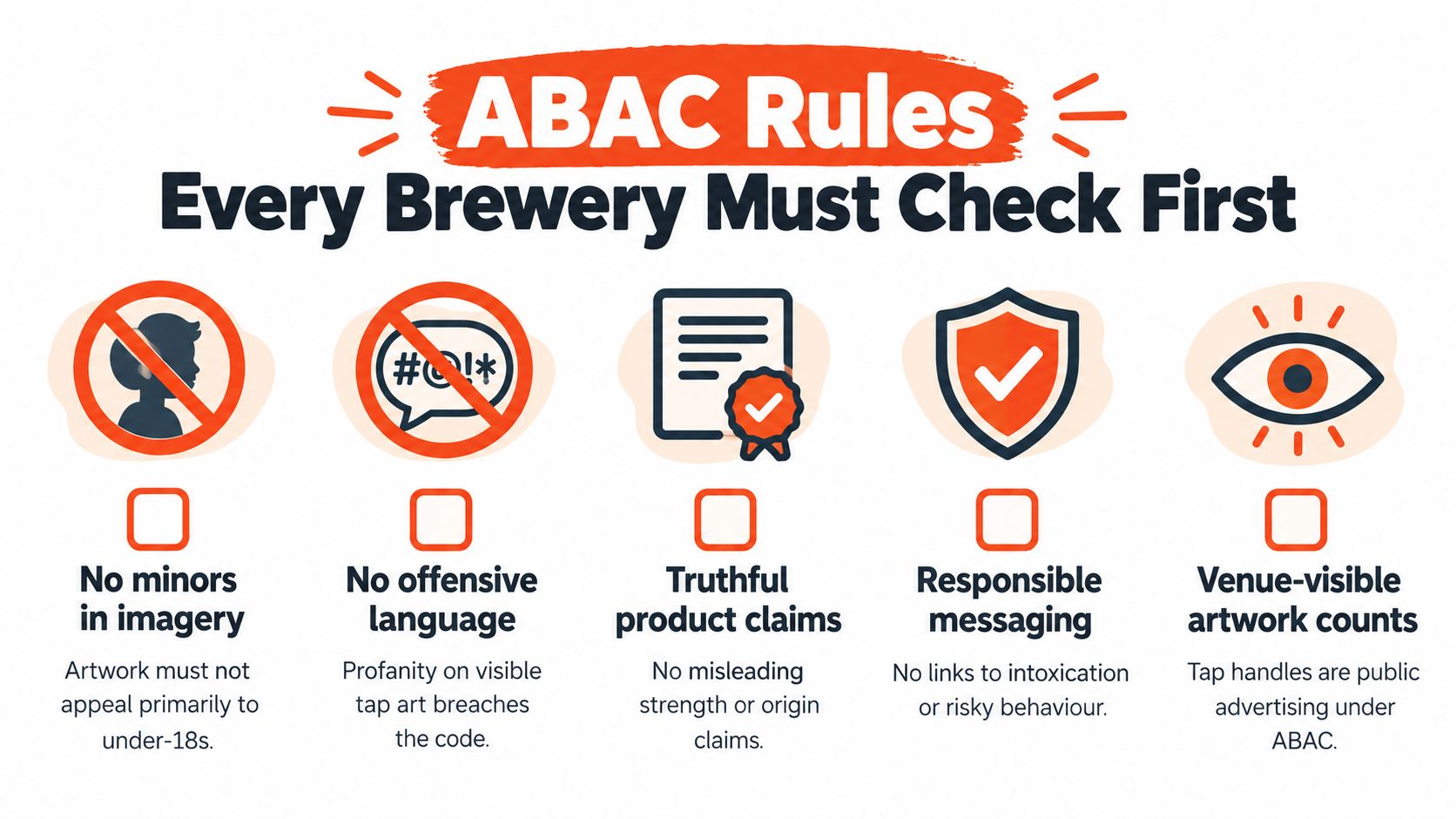
The ABAC Code and its application should be part of your approval process. Queensland guidance says alcohol advertising must not show or encourage excessive or rapid drinking, irresponsible or offensive behaviour, strong appeal to minors, people under 25 years old, drinking around safety-critical activities, or claims that alcohol creates success or a major mood change.
What to remove before printing
- Rapid-drinking cues: Don't use imagery or wording that celebrates speed, intoxication, drinking contests or loss of control.
- Youth appeal: Avoid cartoons, toys, school-like visual language and characters that strongly attract minors. An adult craft aesthetic can still be playful without looking designed for children.
- Performance and health claims: Don't suggest that beer improves athletic ability, guarantees recovery or delivers a health benefit. A product description must remain truthful and restrained.
- Offensive or suggestive content: A busy tap wall is public-facing. Profanity, sexualised imagery or offensive jokes can create a compliance and venue-management problem.
- Misleading product statements: Strength, origin, ingredients and style descriptions need to be accurate. Don't imply a beer has qualities it doesn't have.
For a Facebook advert, write for adult beer drinkers without targeting people by intoxication, youth, vulnerability or risky behaviour. Check the platform's current alcohol advertising terms as well as ABAC, and keep the advert focused on an accurate product experience, responsible choice and lawful availability. The same discipline applies if you discuss electrolyte beer in Australia, because a health-related framing can create extra risk if it implies alcohol improves hydration, recovery or physical performance.
Before the artwork goes to print, record a sign-off confirming the intended audience is adult, no minors appear, the language is not offensive, the claims are supportable and the design doesn't encourage rapid or excessive drinking. Queensland liquor licensing requirements may also affect venue signage and promotions, so check the current state guidance before installation.
Australian-Made Versus Imported Tap Handles
Imported handles can look cheap on a quote and expensive once you account for the whole job. Freight, delays, minimum order requirements, adapters and an artwork change can erase the initial saving, especially when you're fitting out a small tap wall or replacing a handful of damaged pieces.
Australian-made handles give you a closer feedback loop. You can confirm the UNC 3/8"-16 fitment, review a physical sample, correct artwork before production and ask for a replacement without dealing with an overseas factory's full production cycle. Local sourcing also makes sense when a brewery wants to support independent Australian makers and keep its visual identity consistent across venues.
The imported market still has a place. It can offer a wider range of novelty forms, including elaborate figures and illuminated designs, and bulk production may suit a large venue that needs identical handles. The catch is that the thread, coating and artwork process must be verified rather than assumed. Vintage imports can use a different base thread, so a handle that looks right may not fit the tap hardware without an adapter or modification.
| Factor | Australian-made | Imported |
|---|---|---|
| Fitment | Easier to confirm and correct with the maker | Thread mismatch is a known risk, particularly with vintage or unusual designs |
| Artwork changes | More responsive during proofing and reorders | Iteration can be slower once production or freight has started |
| Order size | More suitable when you need a small run or individual replacement | More attractive when a venue needs a large quantity of identical pieces |
| Shape range | Strong choice for practical branded designs | Broad range of novelty and illuminated shapes |
| Freight exposure | Domestic delivery and communication | International freight, customs and possible tariff costs affect the final price |
| Compliance changes | Easier to update artwork with a local supplier | Existing stock can be difficult to change if regulations or brand guidance shift |
| Serviceability | Replacement conversations are generally simpler | Reordering a single matching unit may be difficult |
I'd choose Australian-made when brand integrity, ABAC responsiveness, local support or a smaller order matters most. I'd consider imported stock when the brief specifically requires a large run of identical novelty handles and the supplier has confirmed the thread, material and artwork specifications in writing.
Don't buy a container of handles before testing one on the actual tap. A sample reveals wobble, grip problems, poor clearance and cleaning issues that a product listing won't show.
Installation, Cleaning and Troubleshooting
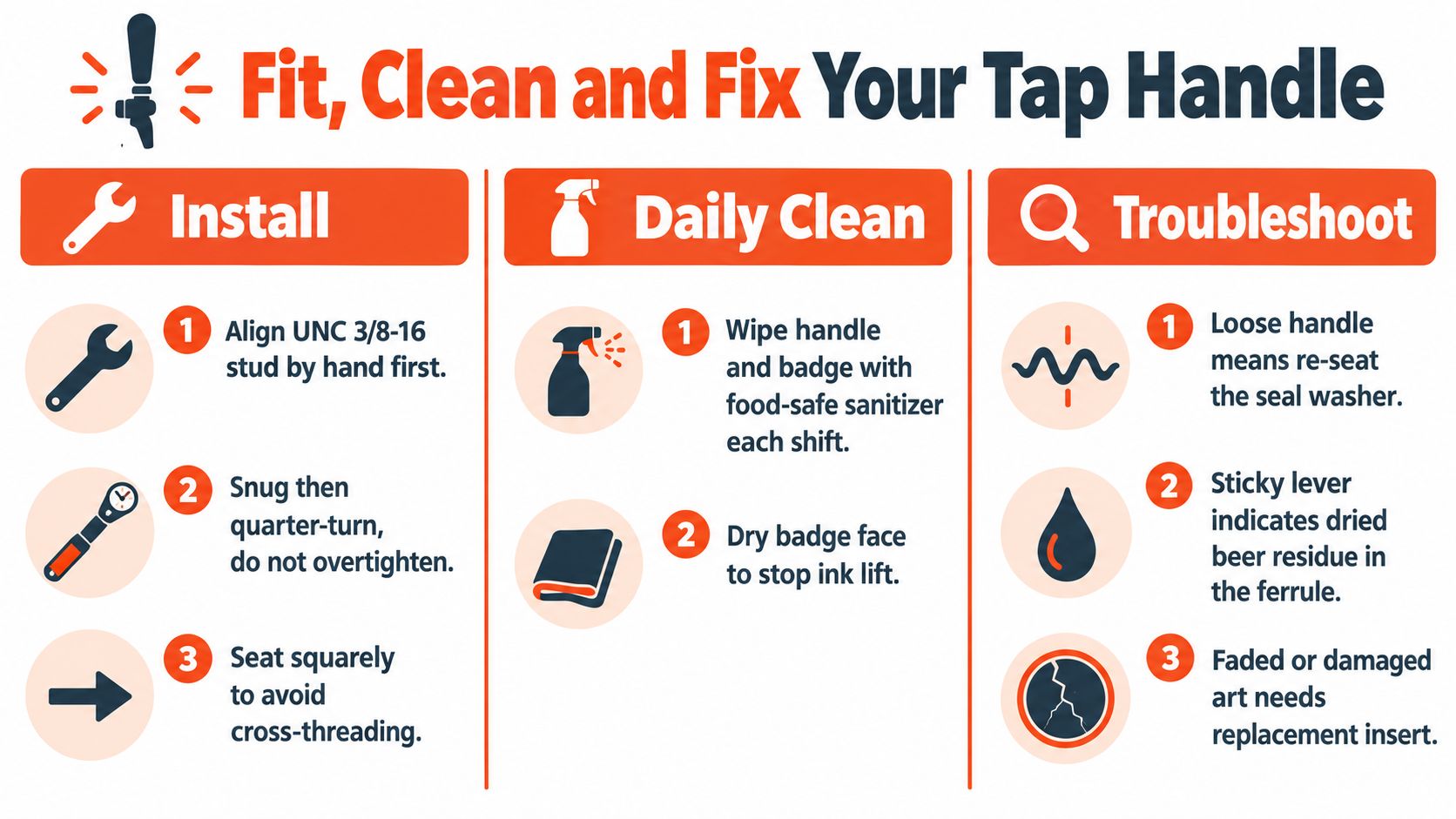
A correct thread can still fail if the operator starts it crooked. Turn the handle onto the tap fitting by hand, keep the stud aligned and stop immediately if it binds. The common Australian connection is UNC 3/8"-16, but the handle should still seat squarely against the tap hardware rather than hanging on a partial thread.
Don't overtighten a branded handle. Excess force can damage the insert, crush a washer or make later removal difficult. Tighten it firmly by hand, check that the handle faces the right direction and test the lever with a controlled movement from the base.
Cleaning without wrecking the finish
Use a food-safe, pH-neutral detergent or sanitiser suited to the material. Wipe the lever, ferrule and badge with a clean microfibre cloth, then dry the face so moisture doesn't sit around printed edges. Avoid abrasive pads, harsh scouring products and bleach on chrome, brass, coated finishes and printed artwork unless the manufacturer specifically approves them.
A daily wipe removes beer residue before it dries in the ferrule. During a deeper clean, inspect the surrounding tap body as well. The handle can look spotless while the faucet interior, coupling area or seal needs attention. For a broader equipment routine, use this Australian brewer's sanitising guide alongside the instructions for your specific dispense system.
Cleaning check: if the cloth comes away sticky, don't just add more fragrance or polish. Remove the residue with a suitable food-safe cleaner, dry the surface and inspect the joint.
Troubleshooting at the bar
- Wobbly handle: Remove it, inspect the seal washer and threaded insert, then reseat it squarely. A damaged washer won't stabilise a crooked connection.
- Sticky lever: Dried beer may have collected around the ferrule or operating area. Clean the residue and check that the faucet action is smooth.
- Leak near the tap: The handle itself may not be the source. Isolate the faucet, shank and seal, then have the dispense hardware inspected before returning the tap to service.
- Faded badge: Strong light and aggressive cleaning can damage printed artwork. Replace the insert rather than covering it with an improvised sticker.
- Handle faces sideways: Remove it and restart the thread by hand. Don't force the handle around to achieve alignment.
If you're working on a broader beverage installation, resources about carbonated tap systems can provide useful context for the surrounding dispense equipment, although the handle's own fitment and cleaning requirements still need separate attention.
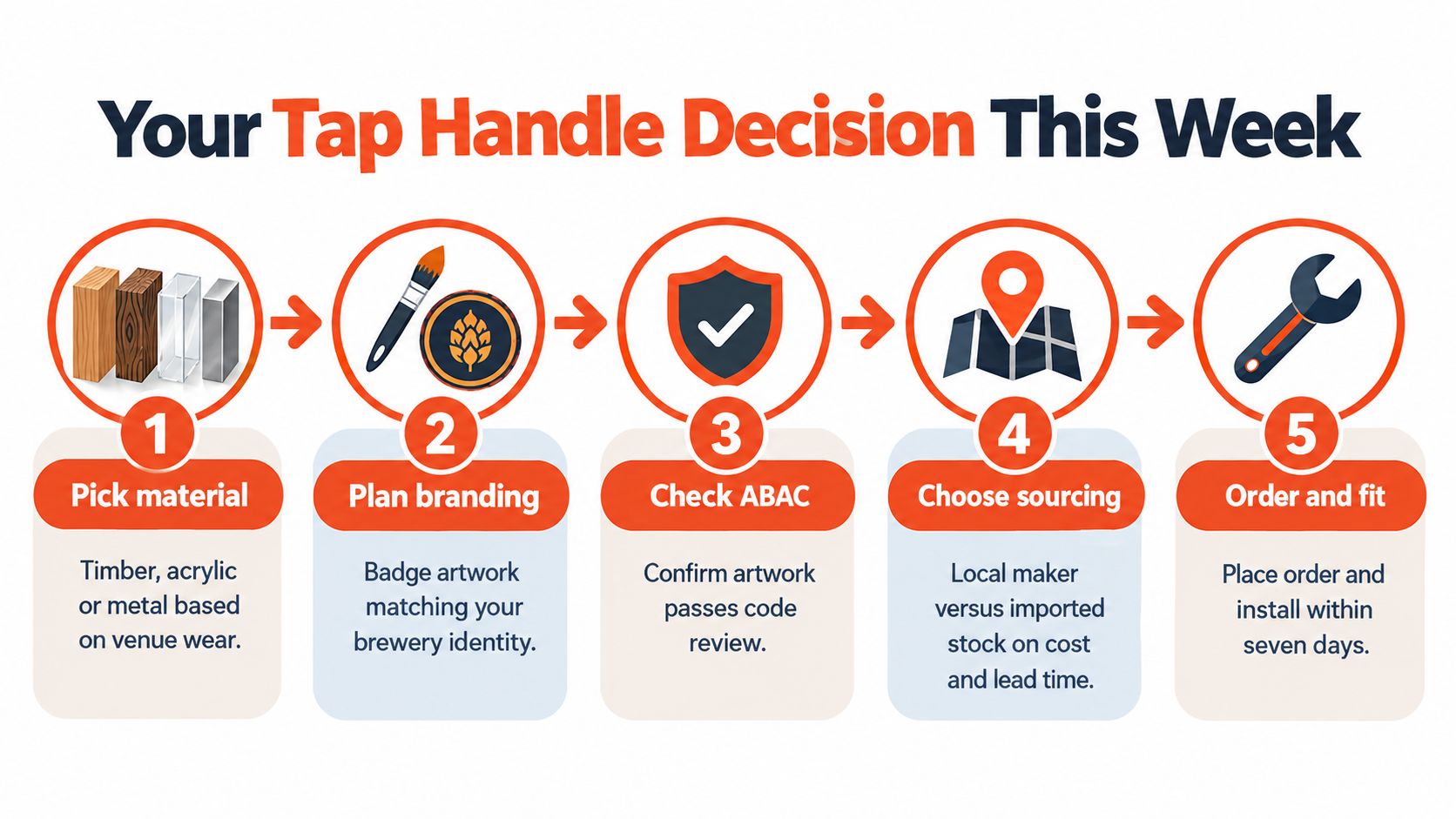
Your Tap Handle Decision This Week
You don't need a six-month branding project to make a sound handle decision. You need a short sequence that prevents the expensive mistakes: buying the wrong thread, choosing a finish that can't cope with the venue, printing artwork that creates compliance problems, and ordering a full run before testing one sample.
A practical five-step path
1. Confirm the fitment. Write down the tap hardware you're using and verify that the replacement handle has a UNC 3/8"-16 threaded insert. If the supplier can't confirm the specification, don't place the order.
2. Match the material to exposure. Choose stainless steel for a wet, busy coastal bar where cleaning and corrosion resistance lead the decision. Consider sealed timber for a protected taproom where the tactile appearance matters. Use resin only when the maker can explain the finish and ultraviolet stability.
3. Finalise the brand system. Make the beer name, style and brewery identity readable. Keep the badge uncluttered, design for the actual handle curve and create a replacement plan for future wear.
4. Check ABAC before production. Review imagery, wording, claims and audience appeal. The Queensland Government alcohol advertising guidance should sit beside your internal sign-off, particularly if the handle will appear in venue photography or paid social advertising.
5. Request samples and compare makers. Ask at least two Australian suppliers for a written specification, sample process and reorder terms. Fit the sample to the tap, clean it as staff will clean it and check the artwork under venue lighting before approving a wider run.
Keep your measurements in metric units in product sheets, bar plans and commercial writing. Australia uses the modern metric system and the International System of Units, as set out in the Australian Government Style Manual's measurement guidance. Clear specifications reduce misunderstandings when local makers, installers and venue staff work from the same document.
The purchase decision isn't only about the price of a handle. It's about how long the finish stays presentable, how quickly you can replace a damaged piece, whether the thread fits without improvisation and whether the artwork remains compliant when customers see it in the venue or online. Treat the handle as a durable part of the brand, not a disposable accessory.
Carbon 6 Brewing Pty Ltd makes and supplies independent craft beer for direct customers and local wholesale distribution from Stapylton on Queensland's northern Gold Coast. Visit Carbon 6 Brewing Pty Ltd to explore the current range and connect your tap-wall hardware choices with beer that reflects local independent brewing.