
Session India Pale Ale: A Complete Brewer's Guide
Sep 04, 2026
You've finished a swim, surf, coastal walk or long lunch on the Gold Coast, and you're standing at the brewery fridge looking for something with proper hop character. A full-strength IPA can feel like too much for the afternoon, while a mainstream mid-strength may leave your palate wanting more. Session India pale ale sits in that useful middle ground, bringing aromatic hops and a crisp finish without the weight of a bigger IPA.
It's a style shaped by Australian conditions as much as brewing fashion. The country's 0.05 blood alcohol limit for drivers, warm climate and growing interest in lighter beers helped create demand for beer that could deliver flavour at a gentler strength, as documented in Australian beer coverage from the mid-2010s (Brews News' Australian IPA coverage). For a Queensland drinker, that makes session IPA more than “small IPA”. It's a beer built around pace, refreshment and hop expression.
What a Session India Pale Ale Actually Is
A Saturday arvo at a Gold Coast brewery usually presents a simple choice. You've got mates beside you, the surf has done its work, and you want a beer that tastes of citrus, tropical fruit or resinous hops. You also don't want the heavy sweetness, warming alcohol or palate fatigue that can arrive with a larger IPA.
Session IPA solves that brewing problem by reducing strength without removing the IPA identity. It uses a smaller fermentable base to keep alcohol lower, then leans on hop selection and timing to preserve aroma and flavour. The result should feel light enough for a longer social occasion, but expressive enough to remind you that you're drinking an IPA.
Two types of DNA in one glass
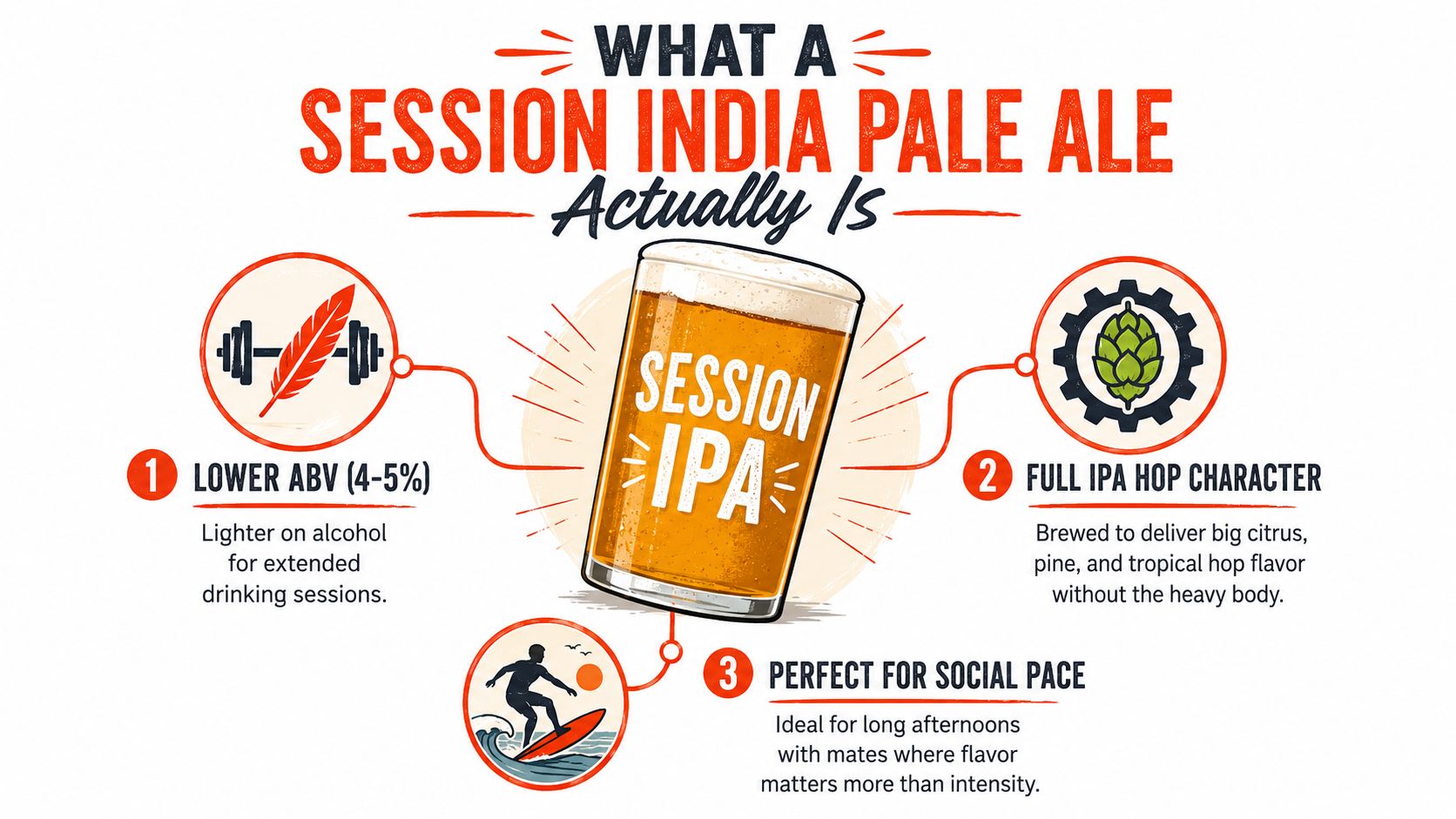
The first part is sessionable strength. Australian examples are commonly described around 3.5% ABV, while broader style references place Session India Pale Ale at 4.2% to 6.2% ABV, with 20 to 45 IBU and a low-to-medium body in the Brewers Association guidelines (Great American Beer Festival style guidelines). Those ranges show why labels can vary. Brewers use “session” to signal drinkability, but the technical boundaries aren't identical across every brewery or judging system.
The second part is IPA hop character. Expect citrus, tropical fruit, pine, spice or resin, depending on the varieties and process. A session IPA shouldn't taste like a plain lager with a few extra hops. It should have a noticeable aromatic centre, even if the body is lean and the finish is dry.
You might also see sessionable IPA, small IPA or mid-strength IPA on a tap list. These labels often point in the same direction, but the recipe still matters more than the name. Beer style guidance places Session India Pale Ale inside the IPA family, rather than treating it as a pale ale variation.
At the bar, judge it by what arrives in the glass:
- Strength: Lower than a standard IPA, with the exact target varying by brewer.
- Aroma: Clearly hop-led, often showing citrus, tropical fruit, pine or resin.
- Body: Light to medium, without a thick or sugary finish.
- Purpose: Easy to enjoy at a social pace while retaining flavour.
The rest of the guide follows that glass from Australian history to brewing numbers, ingredients, comparisons, food, storage and Gold Coast positioning.
How the Style Took Root in Australia
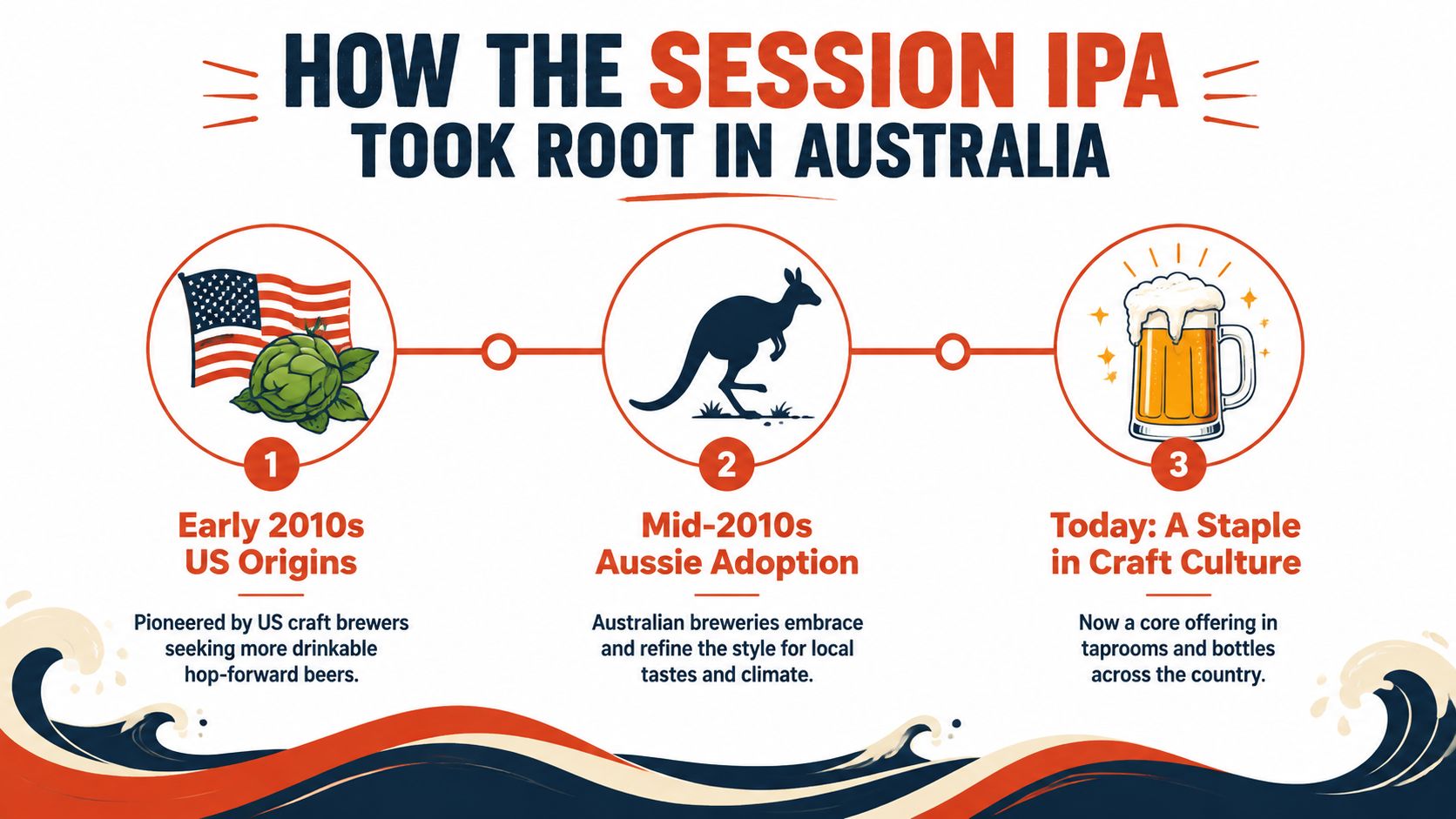
The Australian version of session IPA developed because local brewers had a practical problem to solve. Drinkers wanted the aroma and flavour associated with modern IPA, but the country's climate, driving laws and social drinking habits made lower-strength beer particularly relevant. Australian coverage described “sessionability” as important to the market and reported that session IPA had grown by 200% in the previous year, while IPA still represented under 8% of total craft beer in Dan Murphy's stores (Brews News).
The style also connected with an existing local preference for refreshing, flavourful beers. Australian industry reporting described the craft segment as holding an 8% dollar share of total beer and growing at 14.4% in value, while session and summer styles delivered triple-digit growth and represented close to half of craft dollar growth. That reporting credited those styles with more than A$43 million in retail sale value (The Shout's coverage of Australian craft growth).
From summer ale to session IPA
Australian drinkers already had a reference point for hop character without high alcohol. Mountain Goat Summer Ale, released in 2009 at 4.7% ABV, helped popularise the idea that a beer could remain bright and aromatic without becoming a heavyweight pour, according to the same Australian industry context.
By the mid-2010s, breweries including BrewCult, Pirate Life, Modus Operandi and Bridge Road were part of a broader craft scene exploring session ale and session IPA formats. Their importance isn't that they created one uniform recipe. It's that Australian brewers showed the format could work in cans, on tap and in venues where drinkers wanted another beer after the first.
Queensland adds another layer. Heat and humidity make a lean, dry beer appealing, particularly during long afternoons outside. The 0.05 driving limit also makes strength a relevant part of the occasion, not a minor technical detail. A lower-ABV beer doesn't remove the need for responsible choices, but it explains why sessionable formats have a strong local logic.
That history gives a Gold Coast brewery a useful foundation. A brewery serving locals, visitors, beach crowds and taproom regulars doesn't need to present session IPA as an imported novelty. It can present the style as an Australian answer to a familiar question: how do you keep the hops bright when the afternoon is long and the weather is warm?
Reading the Numbers Behind the Pour
Numbers help you read a tap list, but they shouldn't replace tasting. Start with alcohol, then look at bitterness, colour, aroma and finish. Each figure tells you something about balance.
The Australian brewing context commonly places session IPA around 3.5% to 4.5% ABV, with bitterness around 25 to 40 IBU, while standard IPA is commonly 5.5% to 7.5% ABV (Beer Cartel's IPA guide). The Brewers Association guideline uses a broader Session India Pale Ale range of 4.2% to 6.2% ABV and 20 to 45 IBU (style guidelines). The sensible takeaway is that session IPA should be noticeably lighter than full-strength IPA, but still hop-forward.
A practical tasting checklist
| Attribute | Typical Range | What It Means |
|---|---|---|
| Alcohol | 3.5% to 4.5% ABV in Australian examples | A lighter strength designed around drinkability |
| Bitterness | 25 to 40 IBU in Australian examples | Enough bitterness for IPA character without dominating the lean body |
| Colour | 6 to 28 EBC under Brewers Association guidance | Pale gold through light amber, depending on the malt bill |
| Body | Low to medium | Light on the palate, but not watery |
| Finish | Dry and refreshing | A clean close that encourages another sip |
If IBU is unfamiliar, the Carbon 6 guide to IBU in beer explains how the measurement relates to perceived bitterness. Remember that IBU isn't the whole experience. A lean beer can make bitterness feel sharper because there's less malt sweetness and alcohol warmth to soften it.
Aroma should arrive before the first sip. Look for citrus, pine, tropical fruit and resin, often shaped by American or Australian hops such as Citra, Mosaic, Galaxy and Vic Secret. In the mouth, the beer should stay lively rather than thick, with moderate carbonation and a finish that clears quickly.
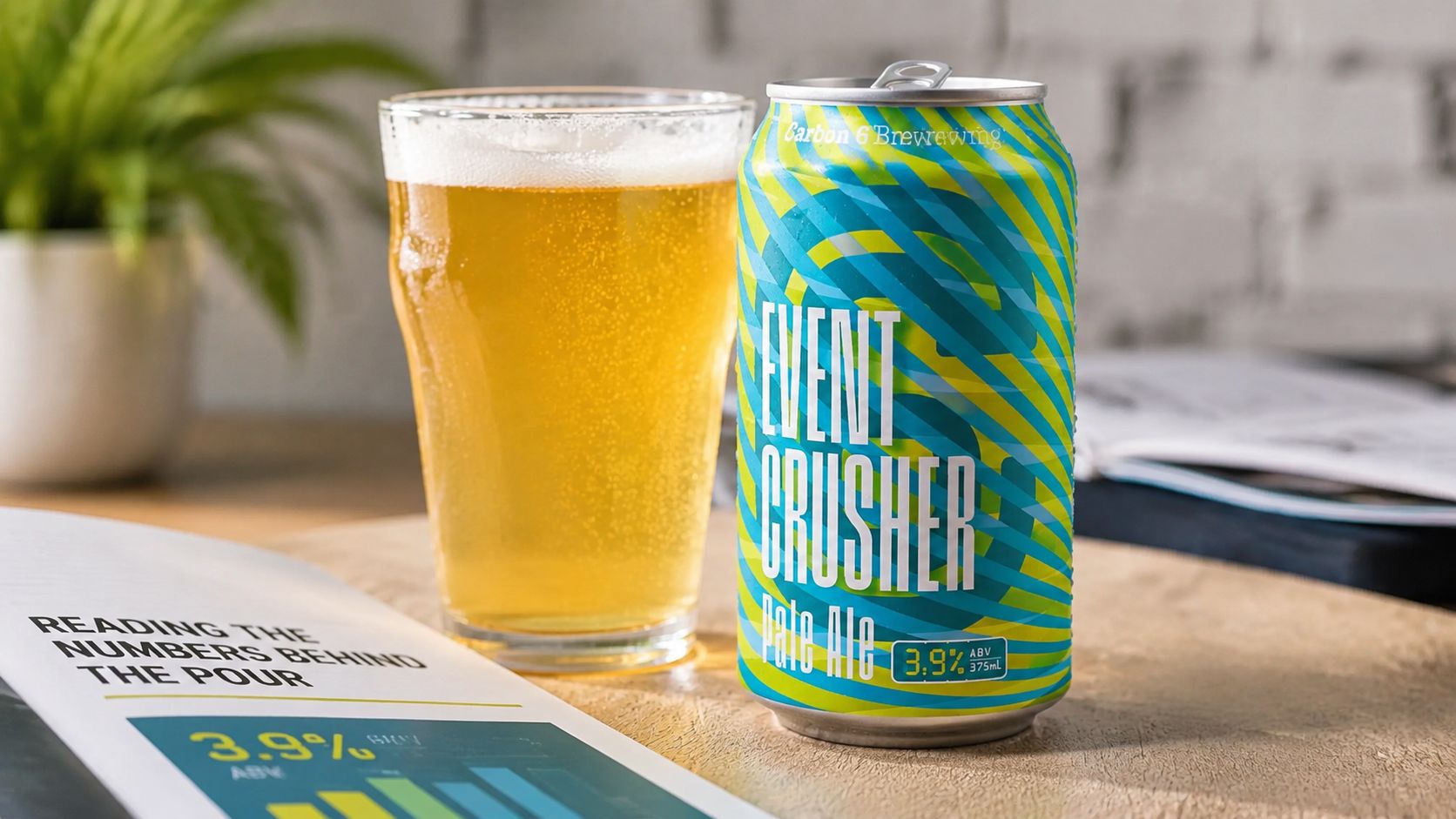
A useful nearby reference is Event Crusher Pale Limited Edition 375ml, a 3.9% ABV pale ale with light colour, bright citrus and fresh lime from Motueka, white wine and gooseberry lift from Nelson Sauvin Amplifire, a lean malt base and a dry finish. It isn't a session IPA by label, but it demonstrates how a lower-strength beer can keep aroma, structure and refreshment in balance.
Ingredients and Brewing Choices That Make It Work
A session IPA isn't made by reducing a full-strength IPA recipe. Reduce the malt too far and the beer becomes thin. Add bittering hops too aggressively and the lean body makes the bitterness feel harsh. The brewer's job is to create flavour density without excessive weight.
Malt creates the frame
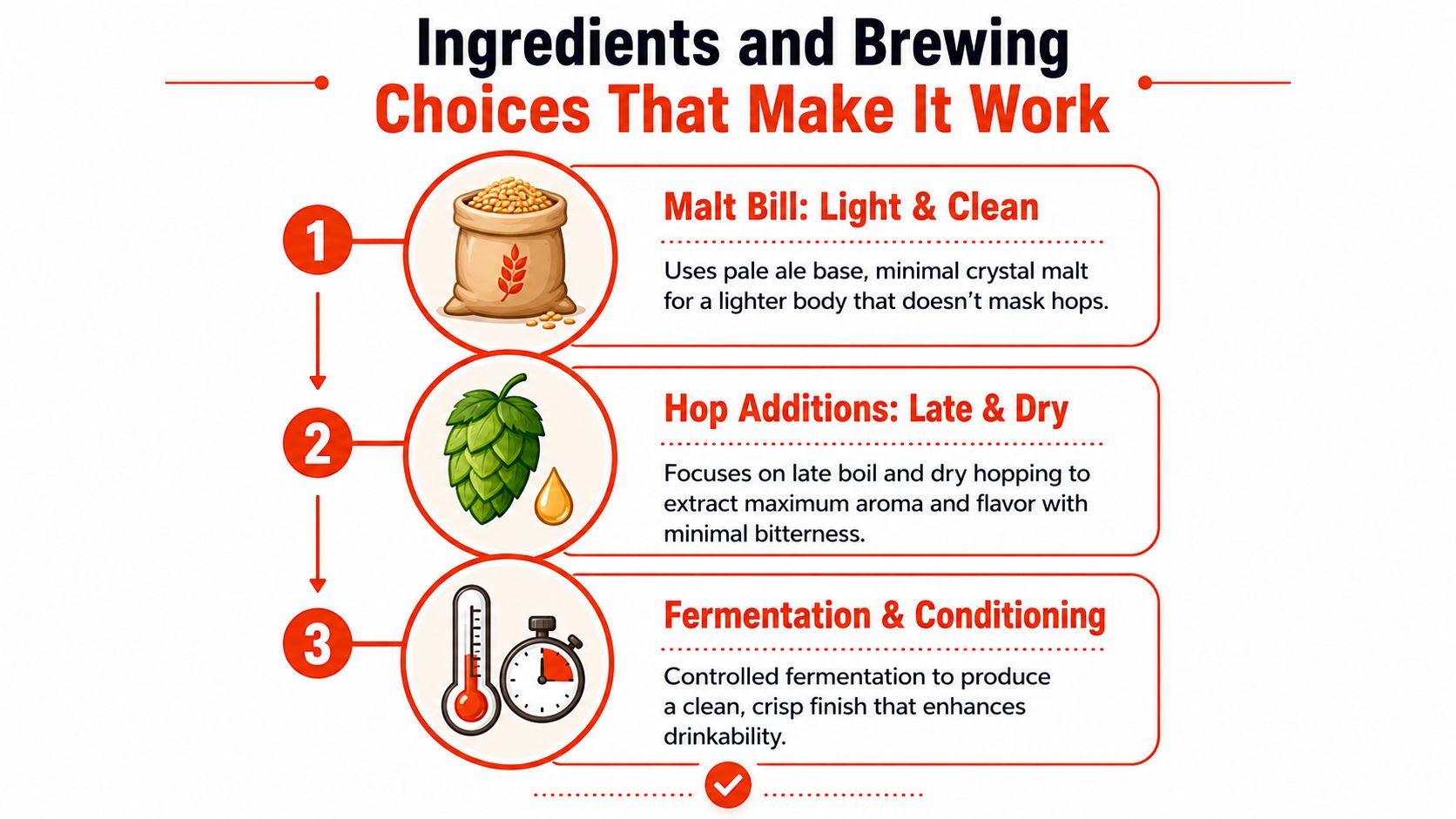
A pale ale or pale malt base keeps colour and flavour clean. Crystal malt needs restraint because caramel sweetness can make a low-ABV beer feel heavier than intended. Brewers may adjust the mash to leave enough structure, but the finish still needs to remain crisp.
Water matters because hop bitterness becomes more obvious in a lighter beer. A Gold Coast brewery may begin with a soft water profile and adjust mineral balance to support hop utilisation, mouthfeel and fermentation performance. Small changes can affect whether the same hop schedule tastes rounded, sharp or muted.
Hops do the expressive work
The most effective session IPA recipes shift emphasis away from a large early bittering charge and towards late-boil, whirlpool and dry-hop additions. Late additions preserve volatile aroma compounds, while dry hopping builds the nose without adding the same level of kettle bitterness.
Citra and Mosaic can bring citrus and tropical fruit. Galaxy and Vic Secret add distinctly Australian hop character, while a brewer might choose Ekinox or another lower-alpha option for a controlled bittering contribution. The aim isn't to avoid bitterness. It's to make bitterness support the aroma rather than bury it.
For a clear explanation of the raw material at the centre of this style, see what hops are in beer.
Fermentation controls the finish
A clean yeast strain helps the hops stay recognisable. Temperature control matters because excess fermentation character can make a light beer seem sweet, fruity in the wrong way or less refreshing. Brewers also need to watch dry-hop duration, hop creep and the timing of any diacetyl rest. Too much contact time can create unwanted extraction or fermentation changes, while too little may leave the aroma underdeveloped.
Scaling a recipe to a 1,200L batch adds a commercial layer. Hop cost, tank capacity, packaging losses, dissolved oxygen and consistent dry-hop distribution all affect the final beer. A small brewery must choose whether the extra aroma from a heavier dry-hop load justifies the ingredient cost and yield loss, then confirm the decision with sensory checks rather than relying on the recipe sheet alone.
Brewer's rule: At session strength, a clean finish and well-timed aroma additions usually matter more than simply adding more bittering hops.
Session IPA, Pale Ale or Mid-Strength
The best choice depends on what you want the beer to do. Pale ale usually offers approachable malt and hop balance. Mid-strength lager prioritises clean refreshment and familiar drinkability. Full-strength IPA brings more alcohol, body and intensity. Session IPA occupies the space between them, but it isn't automatically superior.
Australian consumer polling places pale ale as the preferred style for 32% of respondents and lager at 31%, while IPA sits at 9%. In Queensland, pale ale preference rises to 34%, according to Independent Brewers Association consumer polling. That matters because session IPA can appeal to people who want more hop aroma than lager without asking them to become committed IPA drinkers.
| Style | ABV | IBU range | Hop aroma | Body | Best occasion |
|---|---|---|---|---|---|
| Session IPA | 3.5% to 4.5% in Australian examples | 25 to 40 in Australian examples | Clear citrus, tropical, pine or resin character | Light to medium | Long lunches, taproom visits and warm afternoons |
| Pale ale | Varies by recipe | Varies by recipe | Noticeable but often more balanced | Light to medium | A broadly approachable craft pour |
| Mid-strength beer | Often lower-strength, depending on the beer | Varies by recipe | Usually restrained to moderate | Light | Easy refreshment and familiar occasions |
| IPA | Commonly 5.5% to 7.5% in Australian context | Varies by recipe | More forceful and intense | Medium to full | Focused tasting and occasions where intensity is the point |
A mid-strength lager can be the better option when you want a clean, familiar beer with minimal hop emphasis. Pale ale may win when you want balance rather than a pronounced aromatic hit. Full-strength IPA suits drinkers who enjoy a stronger malt and alcohol presence.
Session IPA earns its place when hop aroma is essential but heaviness isn't welcome. That makes it a natural fit for Queensland brewery visits, beachside gatherings and long social occasions where the beer needs to remain refreshing from the first sip to the last.
Serving, Pairing and Storing at Its Peak
Serve session IPA at 6 to 8°C. Colder isn't always better. Excessive chilling suppresses hop aroma, while a warmer pour can expose the beer's lean body and make any rough edges more obvious.
A shaker pint works well for a casual brewery serve. A stemmed tulip or nonic glass gives aroma more room and helps you assess the beer before drinking. Pour with enough movement to release aroma, but don't knock all the carbonation out of the glass.
Food that makes the hops useful
Session IPA has enough bitterness and carbonation to cut through salt, fat and spice, but its lighter body won't overpower delicate food. Try it with:
- Spicy Thai dishes: Citrus and tropical hop notes can sit comfortably beside chilli, herbs and aromatic sauces.
- Nashville-style fried chicken: Bitterness and carbonation refresh the palate after crisp coating and heat.
- Grilled prawns: A dry finish supports sweet seafood and char without covering it.
- Ripe brie: The beer's hop lift can prevent the creamy cheese from becoming cloying.
- Salt and vinegar chips: Salt amplifies refreshment, while acidity gives the hops a lively contrast.
Storage makes a bigger difference with hop-forward beer than many drinkers realise. Keep cans upright, away from light and in a cool place. For the freshest hop expression, aim to drink them within 90 days of canning. The exact experience depends on packaging quality and cold-chain handling, but heat, light and oxygen generally work against bright hop aroma.
For a Gold Coast beach day, chill the cans before leaving, transport them in an esky and keep them shaded. Avoid rattling them around, and open only when the beer is properly cold. If the cans warm up, let them settle before pouring so you keep the carbonation that gives the style its snap.
Positioning a Session IPA from a Gold Coast Brewery
A Gold Coast session IPA should be positioned around flavour and occasion, not as a licence to drink more. The most useful customer is the explorer drinker, someone who wants to try a local beer with bright hop character, understand how it was made and choose a format that suits a warm afternoon.
The local story has three clear anchors. The first is the 0.05 blood alcohol limit for drivers, which makes responsible planning relevant to any drinking occasion. The second is Queensland's hot, humid weather, where a dry and refreshing beer can feel more appropriate than a dense, warming pour. The third is a preference for bright, juicy tropical-hop expression among many modern craft drinkers, rather than bitterness for its own sake.
That messaging must remain responsible. ABAC's Responsible Alcohol Marketing Code applies to brand advertising, digital communications, competitions, packaging, point-of-sale material, retailer advertising and marketing collateral. A lower-strength beer doesn't sit outside those requirements.
Copy that explains rather than overpromises
A direct-to-consumer product page could focus on:
- Hop character: Describe the citrus, tropical, pine or resin notes the recipe delivers.
- Brewing method: Explain late hopping, whirlpool additions or dry hopping in plain language.
- Format: State whether the beer comes in a single-serve can or a four-pack, using only confirmed pack information.
- Occasion: Talk about a taproom visit, a meal or a planned afternoon, without implying that alcohol guarantees social success.
- Responsible choice: Encourage customers to plan transport and follow Australian health guidance, without presenting the beer as a health product.
ABAC prohibits marketing with strong or evident appeal to children or adolescents, associations between alcohol and personal, social, sporting or sexual success, vehicle operation, dares or excessive consumption (ABAC content restrictions). The updated Code also requires an 80% adult audience before an alcohol ad can be placed with a programme and restricts messaging that frames alcohol as a coping mechanism or abstinence negatively (AdNews' Code coverage).
For Carbon 6, the Gold Coast breweries guide can sit alongside a session IPA product page that connects style credentials with local discovery. The strongest positioning is specific: pale colour, controlled bitterness, aromatic Australian hops, a dry finish, food compatibility and a clear ABV. That gives shoppers useful reasons to choose the beer without making risky promises.
Carbon 6 Brewing Pty Ltd produces independent craft beer from Stapylton on Queensland's northern Gold Coast, with taproom, online and local wholesale pathways. Visit Carbon 6 Brewing Pty Ltd to explore the current range and find a locally brewed, hop-forward option that suits your next planned meal or afternoon.