
Small but Mighty: Australian Breweries Win Big
Sep 11, 2026
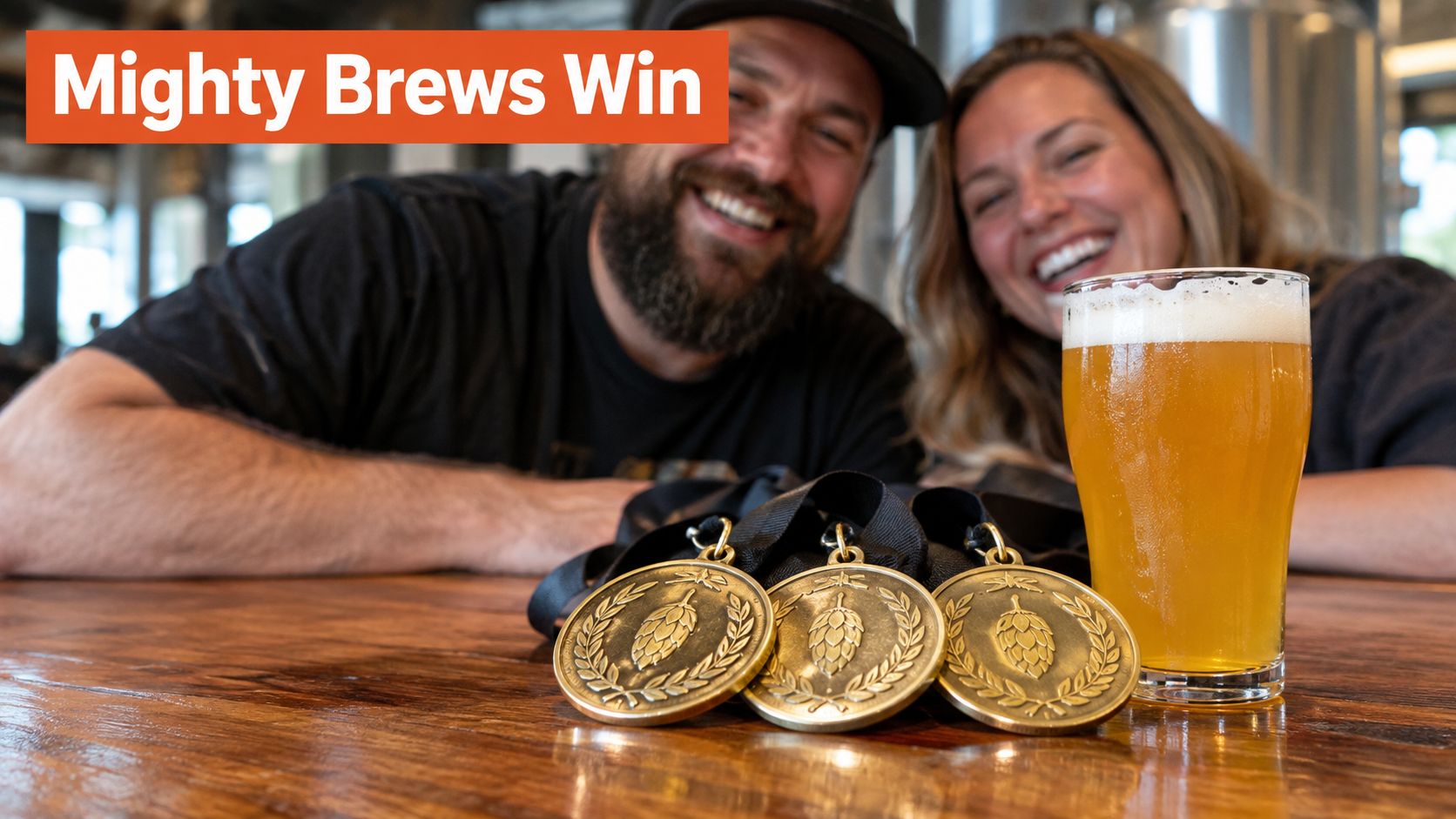
The medals were still clinking on the bar when the first post-work crowd arrived at Carbon 6 Brewing. Fresh beer hissed from the tap, a cab from the awards night had barely cooled outside, and the can stack behind the counter kept growing.
A Gold Coast Brewery That Could Not Stop Winning
At the centre of the fuss was Carbon 6 Brewing, the new kid on the northern Gold Coast, based in Stapylton and closely tied to the Mermaid Waters taproom scene. The crew had the sort of night independent brewers dream about, then spend the next day checking was real. Best New Brewery 2025 sat alongside recognition for the quality of the beers themselves, turning a local awards result into something the regulars could taste in the room.
Head brewer Zach took it in with the slightly stunned look of someone who'd spent more time watching fermentations than standing under ceremony lights. Behind him, the taproom crew leaned across the bar, reading the judges' notes, comparing impressions and pointing towards the fresh pours. The reaction wasn't corporate victory theatre. It was relief, pride and the happy disbelief of a small team whose work had travelled beyond its own postcode.
The details mattered. The judges' comments focused attention on balance, aroma, finish and drinkability, the unglamorous parts of brewing that become obvious when a beer is poured beside serious competition. Each medal gave the team another reason to revisit the recipe, the process and the decisions that got it into the glass.
The Gold Coast advantage
Gold Coast beer culture rewards places that feel close to the people drinking there. A customer can ask what was brewed this week, talk through a pale ale with the person behind the bar, then watch a new release disappear into a local crowd. That feedback loop is harder to create when a product travels through a national chain before anyone meets the brewer.
Carbon 6's award haul is captured in this account of its Royal Queensland Awards wins, but the more interesting story sits underneath the medals. How does a small Gold Coast operation keep earning attention beside much larger Australian breweries?
The answer starts with focus. A small team can't make every beer for every drinker, so it has to make deliberate choices, protect quality and build trust one pour at a time. That's the first clue to why independent breweries can be small but mighty.
What Small But Mighty Really Means in Australian Craft Beer
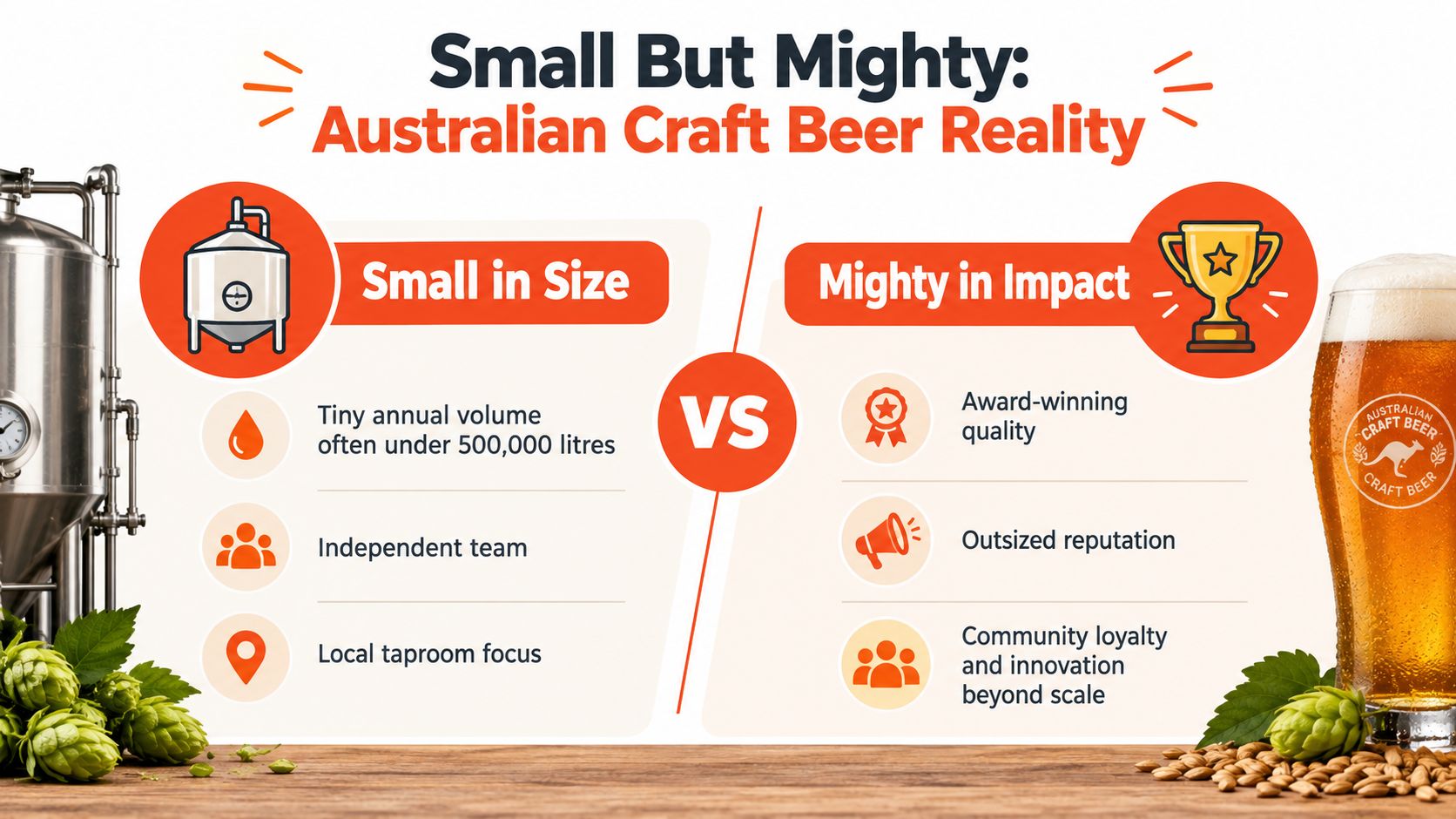
“Small but mighty” isn't a claim about being tiny for its own sake. In Australian independent brewing, it describes a business that may produce modest volumes while creating a much larger presence through quality, hospitality, local employment and personality.
A brewery such as Carbon 6 can matter to a neighbourhood in ways that don't show up on a national shelf. The taproom becomes a meeting point. A new release gives local venues something to talk about. A brewer's decision to change a hop addition can become a conversation at the bar rather than a confidential adjustment inside a distant production department.
Queensland's government strategy recorded nearly 90 independent craft breweries, around 1,700 jobs and an estimated $62 million annual contribution to the state economy as at September 2018 in its Craft Beer Strategy. The same strategy traced breweries across Queensland, from Port Douglas to Burleigh Heads, a useful reminder that independent brewing isn't confined to capital-city laneways.
Measuring might at the bar
Moffat Beach and Green Beacon illustrate the wider pattern. Their significance isn't only the amount of beer leaving the brewhouse. It's the number of drinkers who seek them out, the venues that want their kegs, the staff who build careers around them and the ideas they introduce to the local beer conversation.
A useful measure of might includes:
- Quality recognised publicly: Awards give drinkers an independent signal when they're choosing an unfamiliar can.
- Community presence: Taprooms and local accounts turn beer into a place-based experience.
- Brewing agility: Smaller teams can test ideas, taste them with customers and adjust without navigating a huge product pipeline.
- Economic reach: Jobs, suppliers, hospitality shifts and visitor spending extend beyond the brewery gate.
The Independent Brewers Association described Queensland's sector as approximately 97 independent breweries, supporting 6,715 jobs and contributing $588 million to the Queensland community in the 2023–24 financial year in a 2024 parliamentary inquiry submission. That combination captures the phrase neatly. Individual operators can stay small while the collective footprint becomes impossible to dismiss.
The Numbers Behind the Outsized Impact
The economic case becomes sharper when employment is compared with market share. Independent breweries employ 51% of people directly working in Australia's brewing industry while holding less than 8% of market share, according to the Independent Brewers Association's Australian-owned brewing businesses submission.
That isn't a volume victory. It's an intensity story. Independent brewing needs more hands across brewing, packaging, hospitality, sales and distribution for each slice of market presence, while its local model keeps more of those roles connected to particular suburbs and regions.
Queensland's earlier strategy also found craft-brewing revenue grew at an annual rate of 9.7% between 2013 and 2018, compared with 2.1% growth for beer manufacturing overall, and recorded an increase of more than 9 percentage points in Queensland's share of the Australian craft beer market during that period in the same government document. Those figures describe a sector expanding faster than the broader manufacturing base at the time, not a promise that every brewery will grow smoothly.
A different value equation
The table below separates what can be measured from what can't be fairly inferred. The verified industry evidence gives us the employment and market-share contrast. It doesn't provide comparable macro-brewer litre data, award totals or per-litre figures, so those cells should stay honest rather than padded with guesses.
| Metric | Small independents | Macro brewers |
|---|---|---|
| Direct share of Australian brewing jobs | 51% Independent Brewers Association | The cited source doesn't provide a comparable figure |
| Market share | Less than 8% Independent Brewers Association | The cited source doesn't provide a comparable figure |
| Queensland independent breweries | Approximately 97 Independent Brewers Association | Not provided in the cited data |
| Queensland jobs and community contribution | 6,715 jobs and $588 million in 2023–24 Independent Brewers Association | Not provided in the cited data |
The implication is practical. A small brewery needs freshness, premium positioning, taproom traffic, direct orders and reliable local wholesale relationships because it can't rely on sheer volume to carry every decision. Its strength comes from turning a smaller output into a richer connection between beer, place and person.
Inside the Brew Kettle at Carbon 6 Brewing
A brew day starts with a whiteboard, a grain bill and a set of decisions that will eventually be judged by the first person who takes a sip. At Carbon 6, the process feels less like pressing a button and more like following a trail of small checkpoints.
Pale and crystal malts are milled before the mash begins. The first hot strike lands at 67°C, bringing the grain bed into the range where the brewer can shape the beer's body and fermentability. From there, every choice has a consequence, from the water profile to the timing of the hop additions during a Gold Coast summer.
The water matters because the palate notices structure even when it can't name the reason. The brewer adjusts for the local Burleigh water profile, tastes through transfers and watches for any sign that the beer has drifted away from the intended style. Dry-hopping happens in the fermenter, where aroma can be built without losing sight of balance.
A beer built for the finish
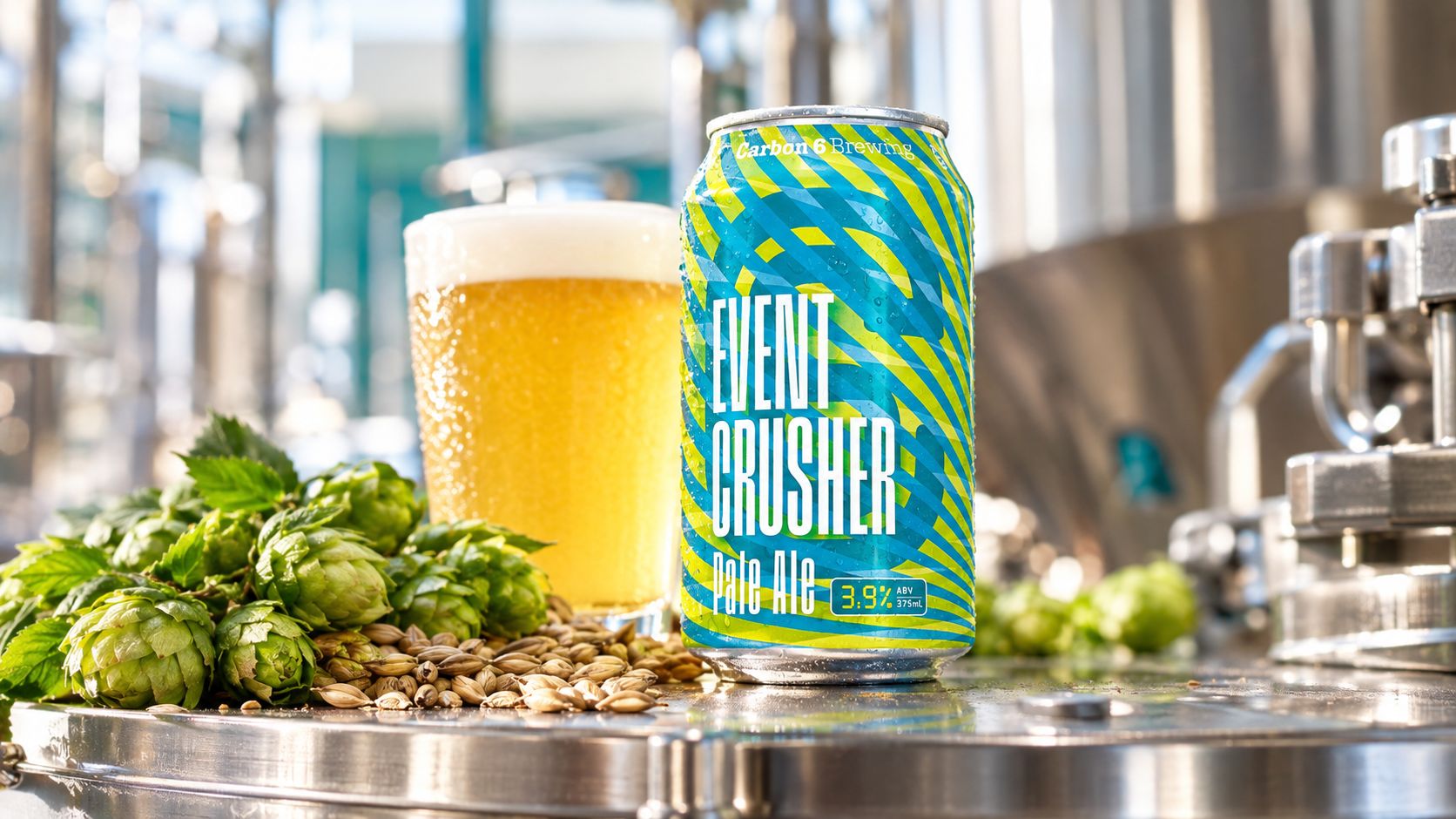
The Event Crusher Pale Limited Edition 375ml is 3.9% ABV, light in colour and crisp on the palate. Motueka brings bright citrus and fresh lime, while Nelson Sauvin Amplifire adds a white wine and gooseberry lift. Its lean malt base and ultra-low mash temperature support a dry, refreshing finish, with subtle bitterness providing shape without heaviness.
That description tells only half the story. The other half is the patience after fermentation, when cool conditioning gives the beer a clean finish and the team decides whether the batch is ready to move. A small operation can stop, taste and reject a transfer that doesn't meet the brief. The constraint is output, but the benefit is attention.
Canning adds another set of controls. Carbon 6's explanation of its beer canning process shows why packaging isn't an afterthought. The can is the final handoff between the tank and the drinker's fridge, so cleanliness, timing and handling all matter.
Brewer's discipline: A limited batch isn't automatically good. It earns its place when the flavour, aroma and finish survive every transfer.
Independent brewing earns its reputation through scale and automation, delivering remarkable technical consistency. A small brewer delivers a different kind of control, one rooted in repeated tasting, traceability and the knowledge that the next pint may be poured for someone who watched the batch take shape.
Why Backing Small Local Producers Pays Off for Drinkers
Buying independent beer isn't charity. The drinker gets something concrete in return: a more distinctive flavour, a fresher connection to the producer and a reason to care where the money goes after the card terminal beeps.
Cost-of-living pressure makes that choice more complicated. The fantasy version of craft beer says drinkers will always pay more for quality. The everyday version asks whether that preference survives freight, bulk-buy thresholds and the temptation of a cheaper mainstream multipack.
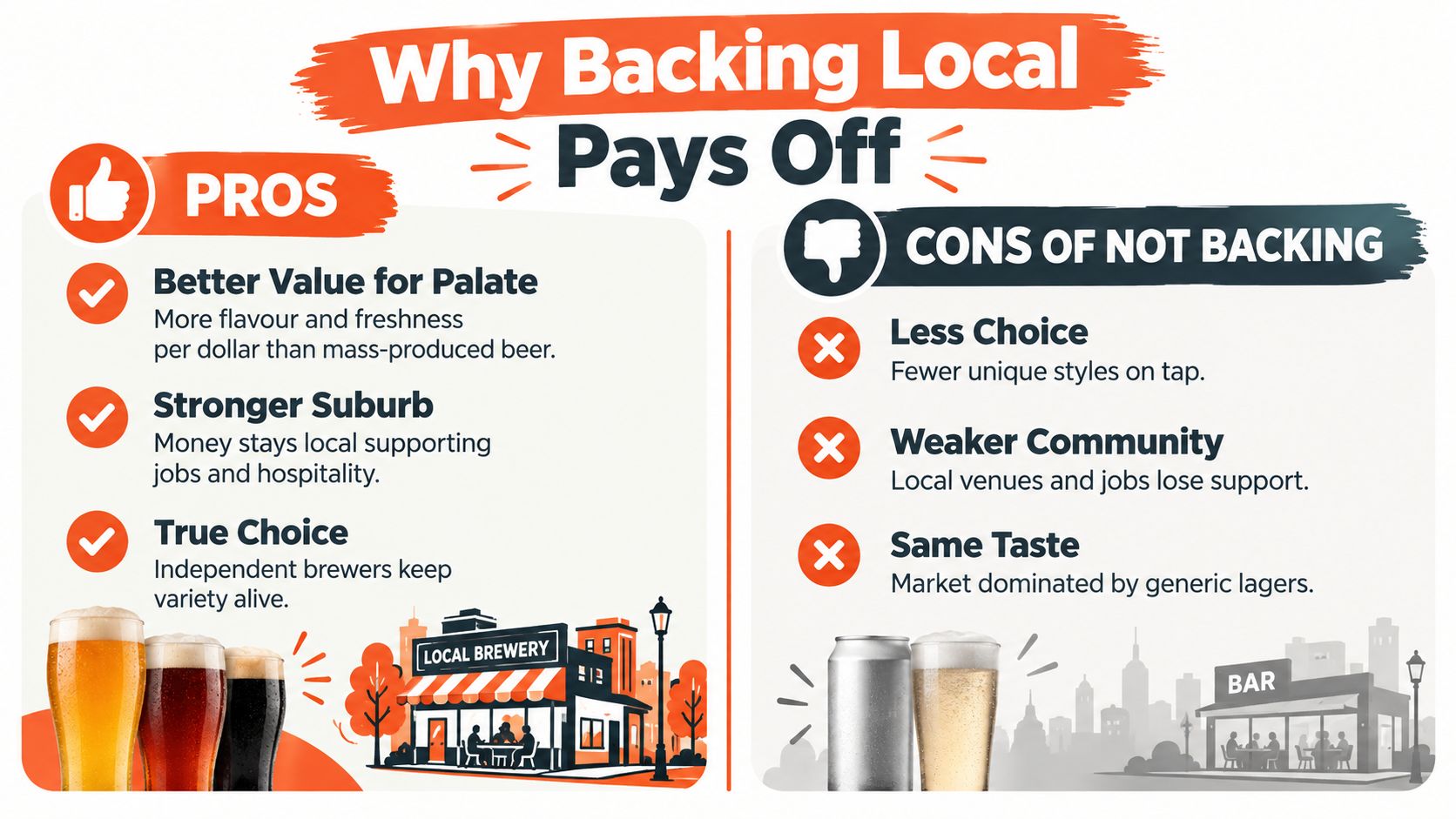
The value is more than the liquid
A four-pack of premium beer gives the drinker variety, aroma and a deliberate occasion. It can also support the taproom, the local delivery route, the venue pouring the keg and the people who keep the brewery operating. That doesn't make every independent beer the right purchase, but it does make the decision more meaningful than a simple shelf-price comparison.
Recent Australian spending commentary describes consumers shifting discretionary spending towards smaller treats and experiences, while pubs, cafés and smaller indulgence categories remain relatively steady in this Experian-related coverage. The useful question for craft beer isn't whether budgets are tight. They are. It's whether a smaller, memorable purchase can still feel worthwhile when a larger, cheaper basket is available.
- For the palate: Freshness, hop character and a clean finish can make fewer beers feel more satisfying.
- For the suburb: Independent breweries keep work, hospitality and supplier relationships connected to local places.
- For the drinker: An award-winning can gives you a story to share at the barbecue, not just a familiar label.
Online orders add a practical twist. Freight makes a single small order difficult to justify, so mixed packs and larger baskets often make more sense, provided the order follows the relevant delivery rules. That encourages customers to plan a beer purchase rather than add an anonymous six-pack on autopilot.
The strongest reason to buy local is still simple. You know what you're drinking, who made it and why the beer tastes the way it does. That knowledge is part of the value, especially when independent breweries use each release to keep experimentation alive.
How Direct-to-Consumer Craft Beer Actually Works in Australia
Ordering direct sounds simple, but alcohol e-commerce has more moving parts than a standard parcel. A responsible brewery needs the right licence, an age-checking process and a delivery system that hands the order to an adult rather than leaving it unattended.
The Victorian guidance on off-premises alcohol delivery illustrates the compliance environment Australian operators must account for. It specifies valid licensing, age checks, adult delivery, a prohibition on same-day unattended delivery in that guidance and delivery windows capped at 11 pm. Queensland customers should still check the rules that apply to their order and destination, because alcohol access varies by jurisdiction.
The buying path
A sound direct order usually follows this sequence:
- Choose the beer and pack format. A mixed pack or larger order can make freight more workable, but the retailer must still observe any applicable quantity caps and delivery restrictions.
- Complete the age and delivery details. The checkout needs accurate customer information so the carrier can complete an adult handover.
- Receive the order confirmation. The brewery or delivery partner should provide the relevant order and tracking information.
- Accept the parcel responsibly. Someone of legal drinking age needs to receive it. If that can't happen, a failed delivery may create extra handling or redelivery costs.
- Raise damage issues promptly. Keep the packaging and contact the seller with clear details if a can or bottle arrives damaged.
For Gold Coast locals, pickup from a taproom or brewery can remove freight from the equation altogether. For customers farther away, direct ordering can provide access to limited releases that don't reach every supermarket or bottle shop.
Practical rule: Treat shipping, age verification and postcode eligibility as part of the beer purchase, not as checkout annoyances added afterwards.
The broader online category is substantial, with IBISWorld forecasting Australian online beer, wine and liquor sales revenue at around $2.5 billion in 2026 in its industry profile. Growth doesn't remove friction, though. Some delivery services exclude Queensland postcodes, particularly in regional and remote areas, so postcode-level availability remains a real part of the small-brewery challenge.
Busting the Myth That Small Brewers Cannot Deliver Consistency
Small doesn't mean hit-and-miss. It means the brewery has fewer layers between the person brewing the beer and the person deciding whether it should leave the building.
Carbon 6's awards provide a useful counter-example. Recognition for the new brewery and repeated attention to beer quality show that a young Gold Coast operation can meet a public standard rather than rely only on local goodwill. The medals don't prove that every batch is perfect, but they do challenge the lazy idea that a small brewhouse can't build repeatable quality.
The quality system is often human and visible. Brewers taste wort, monitor fermentation, check carbonation, inspect packaging and decide whether a beer is ready. Each step can catch a problem before a keg reaches a venue or a can reaches a customer's fridge.
Consistency has different machinery
A national lager producer can use enormous production runs, specialised laboratories and automated controls. A small independent brewery works with a narrower range of beers and a team that can connect sensory checks with the exact tank, transfer and packaging run.
| Metric | Small indie, such as Carbon 6 | Mass-market lager |
|---|---|---|
| Production approach | Focused batches with direct brewer oversight | High-volume production designed for broad distribution |
| Quality feedback | Taproom customers, venues and brewer tasting | Formal systems operating across a large supply chain |
| Product identity | Recipes can be distinctive and release-led | Core products prioritise familiarity and scale |
| Value conversation | Flavour, freshness, provenance and occasion | Accessibility, familiarity and pack convenience |
The table avoids pretending that one model has no strengths. Scale can make a familiar beer widely available and technically controlled. Independence can make a beer more responsive, more local and more expressive.
Price needs an honest reading
A single craft can won't usually compete with a mainstream carton on sticker price. That's not the right comparison by itself. Ingredients, packaging, cold storage, labour, freight and the smaller production base all shape the final price, while the drinker also receives a different flavour profile and a product with a traceable local story.
A cheaper beer can be the sensible choice for a particular occasion. A small-batch beer can be the better choice when the drinker wants character, freshness or a new release. Consistency isn't identicality, and value isn't always measured by the lowest cost per litre.
The punchline is straightforward. Small is not a synonym for sloppy or overpriced. It's an operating philosophy where reputation travels from the brewhouse to the bar, and every batch gives the team another chance to protect it.
Choosing Your Next Independent Drop
Start with the beer, then look for the evidence around it. An award can help you choose an unfamiliar release, but freshness, transparency and the setting where you'll drink it often matter just as much.
A practical decision framework looks like this:
- Read the release details: Check the style, flavour description, pack format and any stated alcohol information before ordering.
- Ask about freshness: A brewery that shares packaging or release information gives you a clearer sense of what will arrive.
- Look for real contact: Taproom conversations, brewing events and meet-the-brewer sessions reveal whether the producer welcomes questions.
- Compare the route to your fridge: Direct ordering may offer the clearest path from producer to drinker, while local pickup can make sense for Gold Coast customers.
- Choose the glass with intention: If you're setting up a home tasting, a well-made set of custom pint beer glasses can give each pour a proper place at the table.
Carbon 6's award run matters because it connects a specific Gold Coast brewery to a broader Australian pattern. Independent breweries can employ heavily, create local hospitality energy and build reputations that extend far beyond their production scale. Their strength comes from focus, proximity and the courage to put a real beer in front of real drinkers.
When you choose an independent drop, check the label, consider the release, ask where it was made and decide whether the beer gives you a reason to come back. Pour from the producer, not the platform, and the small but mighty story keeps writing itself one glass at a time.
Carbon 6 Brewing Pty Ltd makes independent craft beer in Stapylton on the northern Gold Coast, with direct online ordering and local wholesale distribution for Australian customers. Visit Carbon 6 Brewing Pty Ltd to explore the current range, find direct ordering options and choose a fresh local drop for your next gathering.