

Best Craft Beer Making Kit for Aussie Home Brewers
Oct 07, 2026
You've bought a promising kit, followed the instructions, waited patiently, and poured the result into a glass. It looks the part, but the aroma is a bit sweet, the flavour is rough around the edges, and your mate politely reaches for something from the fridge instead. Around the Gold Coast, that outcome often has less to do with your recipe than with the equipment's ability to handle heat, sanitation and measurement.
The best craft beer making kit isn't necessarily the biggest box or the flashiest stainless-steel package. It's the setup that gives you control over fermentation, lets you validate what's happening inside the fermenter, suits your available space and supports the kind of beer you want to drink. It also needs to match Australian law, particularly if your ambitions extend beyond brewing for yourself.
| Kit category | Best suited to | Main strength | Main trade-off |
|---|---|---|---|
| Basic extract kit | New brewers and simple repeat batches | Quick entry with low process complexity | Limited control over the recipe |
| Partial-mash setup | Curious brewers moving beyond pre-made extract | More grain and flavour flexibility | More equipment and technique to manage |
| All-grain system | Serious flavour explorers and repeat brewers | Full control over the grain bill and process | Higher cleaning, space and temperature demands |
Why Crafting Your Own Beer Beats the Bottle Shop
The first brew often starts with disappointment. You crack open a can from the bottle shop, pour a beer that promised citrus, toast or tropical character, and find something flat and forgettable instead. That's usually the moment the idea of making your own starts to feel less like a novelty and more like a proper project.
Home brewing gives you control over decisions a mass-market beer can't make for you. You choose whether the malt leads or the hops do. You can build a clean pale ale, a rich amber beer or a hazy, aromatic recipe that suits your own palate rather than a broad market brief. The reward isn't only the finished glass. It's knowing why that glass tastes the way it does.
The pride is part of the product
There's a particular satisfaction in handing a mate a beer and saying you made it yourself. It turns a drink into a conversation about ingredients, process and the small decisions that shaped the result. A rushed or poorly controlled brew can be humbling, but a clean, balanced batch gives you a sense of ownership that a bottle-shop purchase can't provide.
That emotional pull matters because home brewing takes patience. Fermentation doesn't care how keen you are to taste the result, and cleaning equipment properly is never glamorous. The brewers who stick with it usually want more than cheap alcohol. They want to understand flavour, improve their technique and make something independent from the standard shelf.
Practical rule: Buy equipment for the beer you want to learn to make, not only for the first recipe printed on the box.
From casual drinker to flavour explorer
A basic kit can open the door, but the appeal develops when you start asking better questions. What happens if you change the yeast? Does a different grain combination give the beer more body? Can you make a modern pale ale without losing drinkability? Which hop character works in the humid Queensland climate?
Those questions turn brewing into a craft rather than a one-off kitchen experiment. They also explain why cheap shortcuts become frustrating. A bucket with an airlock may produce beer, but it won't tell you whether fermentation has finished, whether the temperature has drifted or whether your sanitation routine is reliable.
The best setup supports gradual progress. You might begin with extract, move into steeped grains, then adopt all-grain brewing when you're ready for deeper control. That path lets you build skill without buying equipment you won't use, while leaving room for the independent, flavour-first beers that attracted you to brewing in the first place.
Legal Boundaries for Australian Home Brewers
The first legal question is simple: is the beer for personal, non-commercial use? The Australian Taxation Office states that home-brewed beer made for non-commercial purposes, using non-commercial facilities and equipment, isn't subject to beer excise duty and doesn't require an excise licence. The same exemption means you can't sell or offer that beer for sale, as set out in the ATO guidance on beer made for personal use.
That boundary applies even if the beer is excellent. You can brew to refine recipes, make small personal batches and share privately, but the exemption doesn't authorise sales through an online shop, local wholesale account, market stall or hospitality venue.
Hobby brewing and commercial production are different activities
A home kit can be ideal for learning, but it isn't a shortcut to a commercial brewery. Once your intention changes from personal consumption to selling beer, the equipment, premises, record-keeping and licensing questions change with it. Buying a larger fermenter doesn't turn personal production into a licensed operation.
The ATO also distinguishes home brewing from a brew-on-premises shop. Customers may be making beer for personal use in that setting, but commercial facilities or equipment mean the beer is excisable, and the operator needs an excise manufacturer licence and must pay the applicable duty. That's why a kit review should discuss intended use, not just capacity and accessories.
If you're seriously considering selling beer in Queensland, read the relevant guide to obtaining a Queensland liquor licence and obtain current professional advice before spending heavily on production equipment. A home setup can teach you valuable process discipline, but it doesn't replace commercial compliance.
Buy according to your actual ambition
For personal brewing, prioritise a repeatable process. A manageable fermenter, accurate instruments, thorough sanitation and temperature-control compatibility will serve you better than volume for its own sake. A smaller batch that you can monitor properly is usually more useful than an oversized system that lives untouched in the garage.
For commercial aspirations, treat the kit as training equipment rather than a production solution. You'll need to separate your personal brewing decisions from the regulatory requirements that apply to beer made for sale. That distinction should be clear before you choose a system, not after you've built a customer base around an exemption that doesn't allow selling.
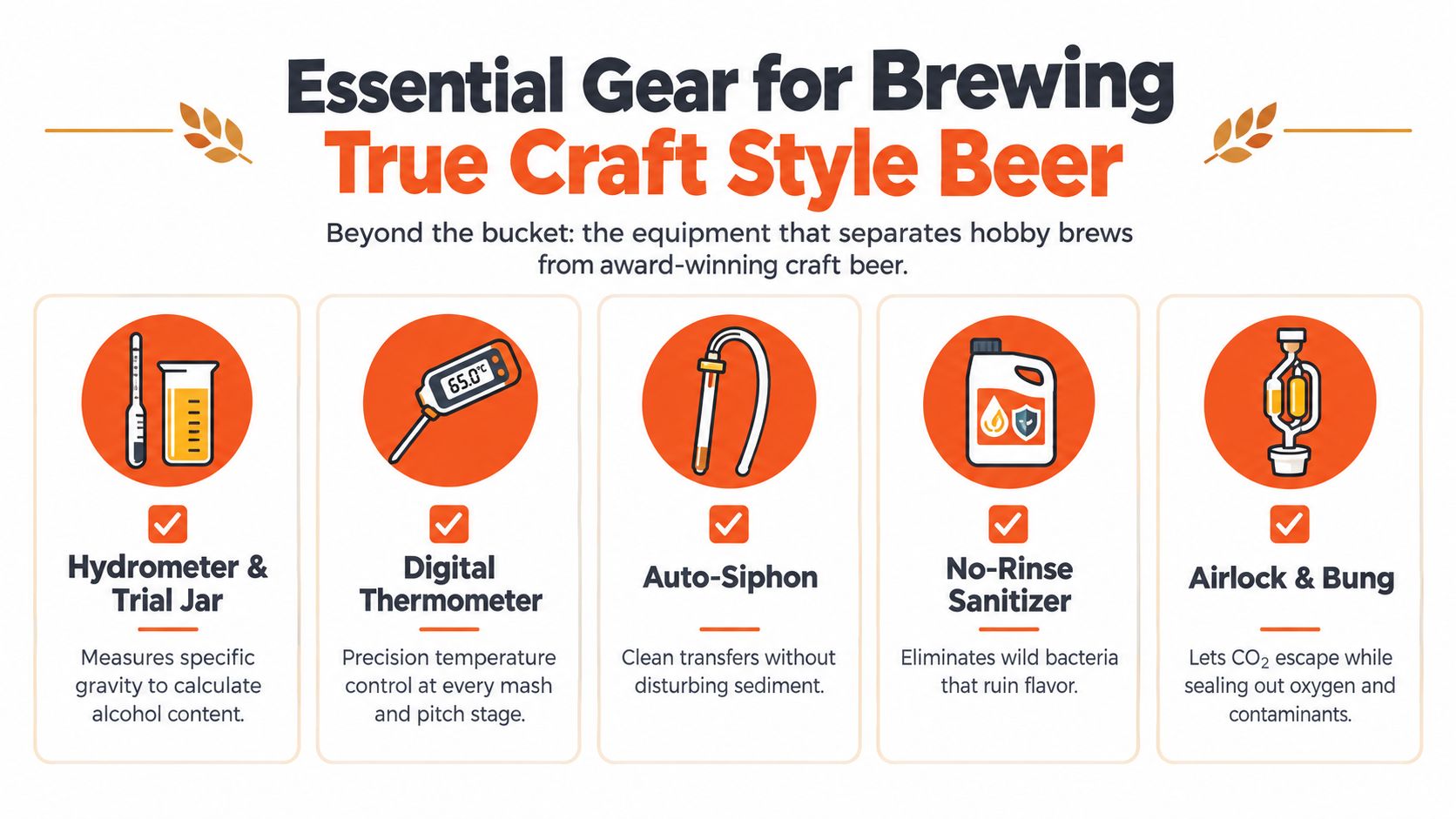
Essential Gear for Brewing True Craft Style Beer
A plastic fermenter and airlock can start the process, but they don't provide enough information to brew consistently. The most useful kit includes tools that show you what the yeast and wort are doing, rather than asking you to guess from bubbles, smell or appearance.
Measure fermentation instead of guessing
A hydrometer is one of the clearest signs that a kit has been designed for learning rather than novelty. It measures specific gravity, helping you record the wort's starting point, check whether fermentation has finished and estimate alcohol content. A trial jar gives you a clean, controlled sample so the hydrometer can float away from the fermenter wall.
The recommended process is straightforward. Take an original-gravity reading before pitching yeast, then take final-gravity readings 48 hours apart at the same temperature. Identical readings indicate that fermentation has finished, according to Australian brewing guidance on hydrometer readings and fermentation checks.
Temperature affects the reading. A sample at 30°C may require an approximate +0.002 specific-gravity correction, so a thermometer belongs beside the hydrometer rather than in a different drawer. Keep the sample free from carbon-dioxide bubbles and make sure the trial jar and hydrometer are sanitised before use.
The equipment that earns its space
Look for these tools before paying extra for cosmetic features:
- Hydrometer and trial jar: They turn fermentation progress into a record you can compare from batch to batch.
- Reliable thermometer: It helps you assess wort, pitching and fermentation conditions rather than relying on how warm the vessel feels.
- Auto-siphon: It supports cleaner transfers and reduces the temptation to splash beer across open containers.
- No-rinse sanitiser: It helps you sanitise equipment without leaving a strong rinse-water taste, provided you follow the product directions.
- Airlock and bung: They allow gas to escape while limiting exposure to oxygen and contaminants.
An airlock bubbling less frequently doesn't prove fermentation has stopped. Temperature, pressure and vessel seals can all affect visible activity. Bottling because the airlock looks quiet is a poor substitute for gravity readings, particularly when warm conditions make fermentation unpredictable.
For a practical cleaning routine, follow an Australian-focused guide to sanitising brewing equipment. Clean gear removes residue, while sanitising reduces the organisms that can spoil a batch. You need both.
Mastering Fermentation Temperatures in Queensland
A fermenter can sit in the coolest corner of a Queensland home and still run too warm. During a Gold Coast summer, the surrounding air may already push the beer beyond the range your recipe and yeast are designed to handle. A warm room is not temperature control.
For many ale recipes, a practical benchmark is 18–20°C. Lager yeast generally works at approximately 10–15°C, according to Australian brewing guidance on fermentation temperature control. Active fermentation can raise the wort to 2–4°C above the surrounding air, so setting the room to a seemingly reasonable temperature may still leave the beer too hot. For a deeper walkthrough, see our guide to fermentation temperature control.
Why the fermenter size isn't the main decision
A larger fermenter can appear to offer better value, but extra capacity does nothing for yeast exposed to uncontrolled heat. Fermentation temperature affects yeast performance and can produce harsh, solvent-like or otherwise unwanted flavours. A smaller system that fits inside a controlled space will usually produce more repeatable beer than a larger vessel left at the mercy of summer conditions.
Choose a kit that includes temperature-control equipment or works comfortably with it. Measure the fermenter's height and width against the refrigerator you intend to use. Check that the vessel fits without blocking the door, stressing the lid or leaving the temperature probe positioned where it only measures warm air.
Gold Coast reality: A kit that fits a second-hand bar fridge may be more useful than a larger kit that gives you no practical way to manage summer fermentation.
Build a cooling system that you can actually use
A second-hand bar refrigerator paired with an aftermarket controller is a practical year-round option for Australian brewers. The indicative equipment cost is approximately $50–$150 for the refrigerator and about $50 for the controller, as outlined in the same Australian temperature-control guidance. Treat those figures as planning references, because condition and availability affect the final shopping total.
Check the details that rarely appear in product photos:
- Controller resolution: Small temperature changes matter when you are trying to hold a stable fermentation.
- Probe placement: Position the probe so it reflects the beer's temperature, not merely the air beside the fermenter.
- Fermenter clearance: Measure before buying. A vessel that technically fits may still be difficult to load, clean or remove.
- Cooling hysteresis: Set the controller so the refrigerator does not cycle constantly around the target temperature.
A fridge and controller cannot compensate for poor yeast, dirty equipment or weak pitching technique. They create the stable conditions those choices need. For Queensland brewers, cooling compatibility should sit near the top of the buying checklist, especially when scaling from occasional batches to more ambitious craft beer.
Calculating the True Cost of Your Brewing Setup
The checkout price tells you what the kit costs today. It doesn't tell you what brewing will cost once you include ingredients, packaging, cleaning products, replacement parts, electricity, water, failed batches and the time required to manage the process.
A fair comparison starts with your intended beer. A low-strength extract recipe brewed occasionally has a different cost profile from a hop-heavy beer that needs fresh ingredients, careful oxygen management and controlled fermentation. Batch volume matters too. Bigger batches can spread some equipment effort across more beer, but they also demand more storage, packaging and handling.
A practical cost model
Before buying, write down the costs that will recur:
- Ingredients: Malt extract, grain, hops, yeast and any specialty additions.
- Packaging: Bottles, caps, labels or kegging hardware, depending on your chosen method.
- Quality control: Hydrometer, thermometer, trial jar and replacement consumables.
- Process support: Sanitiser, cleaning products, tubing and seals.
- Utilities: Water, cooling and electricity.
- Risk allowance: Ingredients and packaging lost when a batch is contaminated, oxidised or bottled too early.
- Growth costs: A temperature-controlled space, larger vessels and better transfer equipment if your ambitions expand.
The alcohol strength also changes the commercial picture. Australian excise rules state that beer is generally excisable, with duty calculated on alcohol content above 1.15% ABV. A commercial manufacturer may qualify for an alcohol-manufacturer remission scheme, but eligibility requires a manufacturer licence, production at licensed premises and at least 70% of the alcohol content to be fermented or distilled there, as explained in the ATO remission guidance for alcohol manufacturers.
| Factor | Hobbyist home brewing | Commercial / licensed production |
|---|---|---|
| Purpose | Personal, non-commercial batches | Beer made for sale |
| Equipment priority | Repeatability, cleaning and process control | Licensed production capability and documented controls |
| Alcohol-cost question | Ingredient and packaging cost per batch | Excise exposure, eligibility and compliance costs |
| Scale decision | Choose a volume you can store and manage | Choose capacity alongside premises, licence and distribution needs |
| Failure cost | Lost ingredients, time and packaging | Lost production, stock, labour and commercial obligations |
| Best-value purchase | Equipment you'll use regularly | A compliant system that supports the intended production model |
The cheapest kit can be poor value if it lacks a hydrometer, forces you to ferment at room temperature or makes cleaning awkward. Conversely, an advanced system can waste money if you're only interested in occasional personal batches. Buy for your next realistic stage, not for a fantasy brewery that has no space, licence or operating plan behind it.
Comparing Top Kit Categories for Craft Enthusiasts
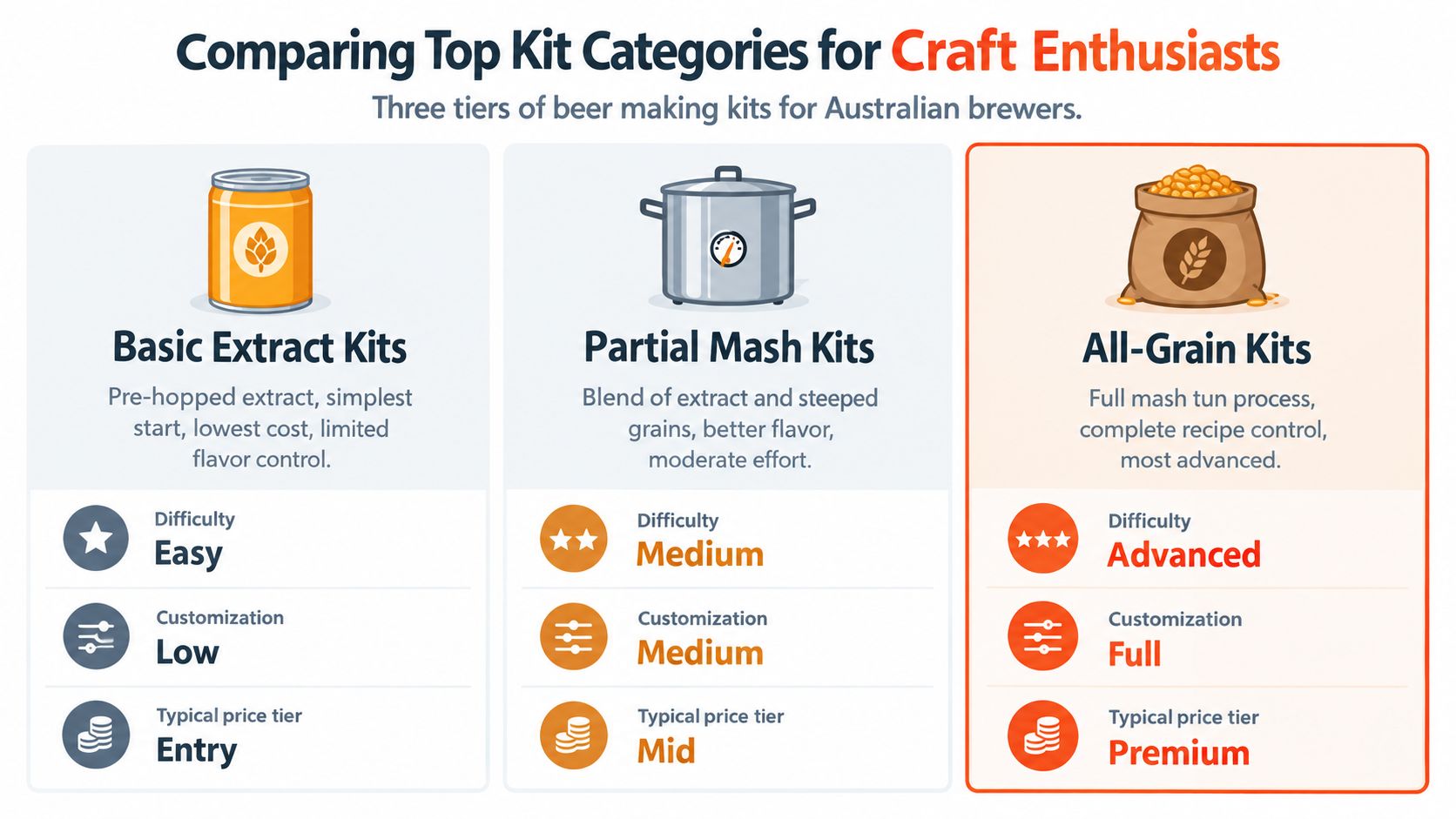
There are three sensible entry points for Australian home brewers. Basic extract kits reduce the number of decisions. Partial-mash systems add grain character and flexibility. All-grain systems give you control over the full recipe, but they also demand more preparation and more disciplined process management.
Basic extract kits
Extract kits are the easiest way to learn the sequence of brewing, fermentation, sanitation and packaging. The malt has already been processed, so you can focus on clean handling and yeast management rather than running a full mash.
That simplicity is a strength, not a flaw. Extract can make a perfectly enjoyable beer when the ingredients are fresh and the brewer controls fermentation properly. The trade-off is recipe flexibility. Pre-hopped extract limits your ability to shape bitterness, colour and hop timing, which can become restrictive once you want to build a specific hazy pale ale or a beer with a more individual malt profile.
Choose this category if you want a low-friction introduction or you're happy to repeat dependable recipes. Don't choose it because you expect the box alone to solve temperature, sanitation or measurement.
Partial-mash kits
Partial mash sits between convenience and control. You'll use extract for part of the fermentable material while steeping or mashing selected grains to add colour, body and flavour. That gives you more influence over the finished beer without requiring the full equipment and time commitment of all-grain brewing.
This category suits the brewer who has made clean extract batches and wants to understand how grain choices affect the glass. It can support richer malt-forward beers, more expressive pale ales and experimental recipes with specialty grains. It also introduces more variables, including water temperature, grain handling and the risk of a less efficient process if the equipment is poorly matched.
All-grain systems
All-grain brewing gives you the most control over the recipe. You select the grain bill, mash process, hop schedule and water approach rather than relying on a pre-built extract base. That makes the category attractive to brewers chasing modern hazy beers, layered malt profiles and recipes that need precise adjustment.
The learning curve is steeper. You need room for more vessels, a reliable way to heat and measure water, and enough time to clean everything properly. All-grain won't automatically taste better than extract. It gives you more ways to make decisions, which also gives you more ways to make mistakes.
Choose the least complicated system that still lets you make the beer you want to drink.
For most flavour-focused beginners, partial mash is a sensible bridge. For someone already committed to recipe development and repeat brewing, all-grain may be the better long-term purchase. A basic extract kit remains the right choice when convenience and process confidence matter more than maximum flexibility.
Sourcing Quality Ingredients and Final Recommendations
Good hardware can't compensate for tired hops, poorly stored malt or yeast that has lost its vitality. Buy ingredients from reputable Australian suppliers that can explain storage, freshness and intended use. Direct-to-consumer purchasing can also give you a clearer connection to the supplier and a better chance of selecting ingredients for a specific recipe rather than accepting whatever has been sitting on a general retail shelf.
The same principle applies to the kit itself. Look for a seller that provides clear equipment specifications, replacement parts and practical support. A fermenter is only useful if you can clean it properly, measure inside it and control its temperature. A shiny kettle that doesn't fit your space is an expensive ornament.
The buying decision
Choose a basic extract kit if you want a straightforward introduction and already know you'll value simplicity. Choose partial mash if flavour experimentation is pulling you beyond pre-made recipes. Choose all-grain if you're ready to manage the extra preparation and want full control over grain, mash and recipe design.
Whichever category you choose, insist on a hydrometer, trial jar, thermometer and proper sanitising equipment. Make temperature-control compatibility a priority in Queensland, then spend the remaining budget on fresh ingredients rather than decorative extras. The best setup is the one you'll use repeatedly, clean carefully and improve with each batch.
If your content or advertising promotes an alcoholic product or a purchasing pathway, review both the wording and the audience. The ABAC Responsible Alcohol Marketing Code prohibits marketing with strong or evident appeal to minors, including youth-oriented colours, cartoon characters, gaming mechanics and confectionery-like presentation. Marketing should stay focused on lawful adult interests such as flavour development, learning and responsible home use.
People who are, or appear to be, under 18 should only appear incidentally in alcohol marketing, with no suggestion that they consume or serve alcohol, as explained in the ABAC guidance on minors in alcohol marketing. That means adult-only brewing and tasting imagery is the safe practical choice. Placement matters as well as copy, so check the article, product page, social promotion and audience settings together, consistent with the ABAC quarterly report guidance on responsible alcohol marketing.
Carbon 6 Brewing Pty Ltd offers independently made craft beer with a focus on fresh, flavour-led production for Australian drinkers. Visit Carbon 6 Brewing Pty Ltd to explore its range and support a local northern Gold Coast brewery.