
Coffee Stout Beer: What It Is and How to Enjoy It
Nov 05, 2026
You crack a dark can after dinner because the label says coffee, then the first sip tastes like burnt toast and nothing else. The chocolate you expected never shows up, and the bitterness hangs around long after the glass is empty. That gap is the whole point of learning coffee stout beer properly. The word coffee on the can is a claim. Strength, roast, body and the way the coffee went in are the checks that tell you whether the beer will taste like the one you wanted.
What a Coffee Stout Is and Where It Came From
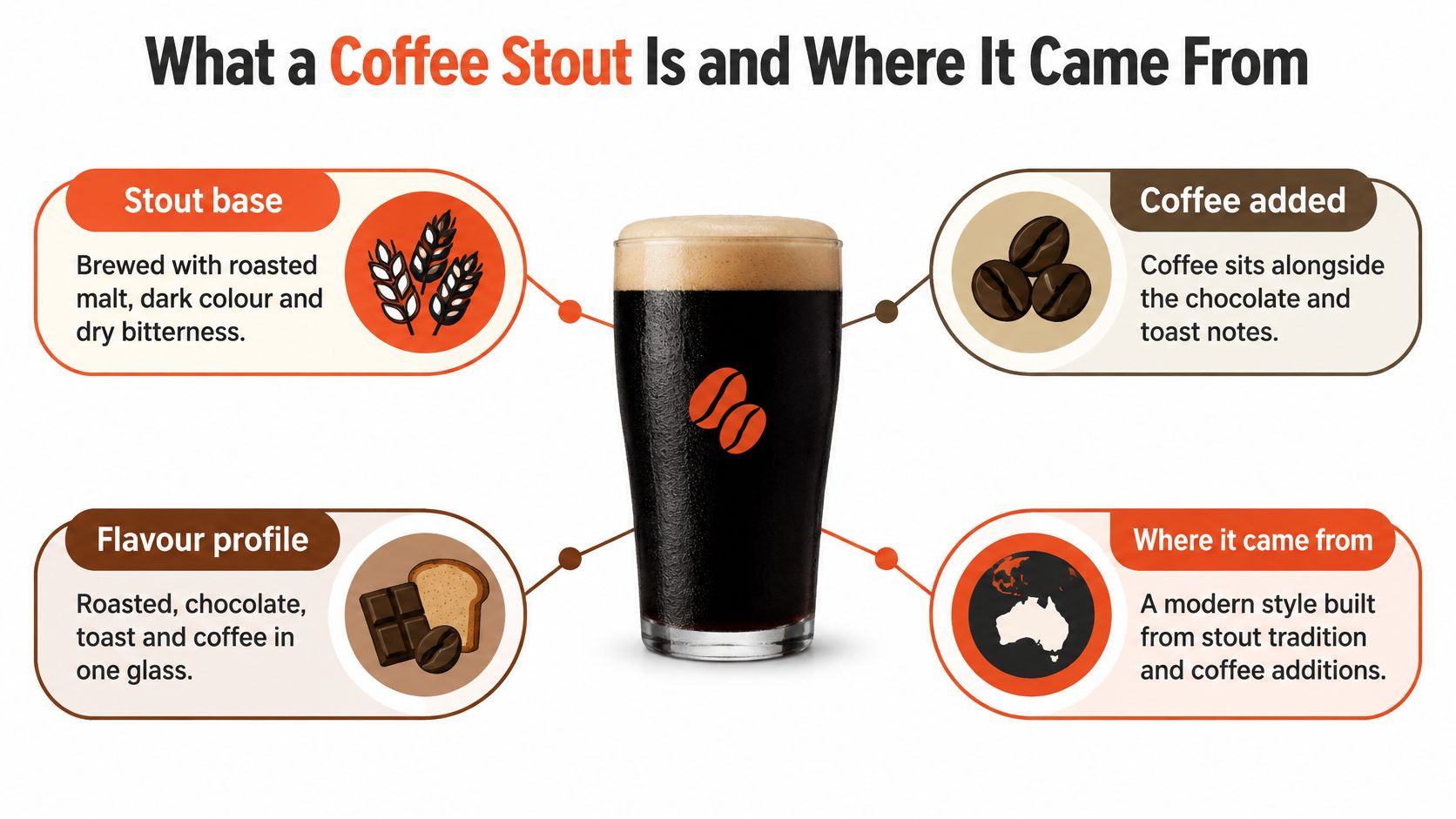
At a tasting, a stout with coffee on the label may show coffee aroma, roasted malt, or both. A coffee stout is a stout with coffee added to its dark, roasted malt base. The coffee works like seasoning: it can lift chocolate and toast notes, or overwhelm them if used heavily.
These four styles offer a useful map. Dry Irish stout provides a comparison, with roast character but no added coffee. The others combine a dark base with different coffee roles and body.
| Style | Typical ABV | Coffee Role | Body |
|---|---|---|---|
| Dry Irish stout | 4.0-4.5% | None or roast character only | Light to medium |
| Standard coffee stout | 5.0-6.5% | Ground or cold-brew coffee | Medium to full |
| Milk coffee stout | 4.5-6.0% | Coffee with lactose sweetness | Creamy and full |
| Imperial coffee stout | 8.0-10.0% | Espresso or cold-brew concentrate | Heavy and warming |
Porters developed as dark, roasted ales, and stout grew from the same family of beers, often with more roast and body. In modern brewing, coffee is a familiar deliberate addition to stout. Cold coffee can complement the roast already contributed by malt.
Coffee is already a familiar flavour in Australia. The Australian Bureau of Statistics reported that in 2023 coffee and coffee substitutes were consumed by 62.7% of adult men and 60.3% of adult women, and coffee accounted for 73.7% of adult caffeine intake. Those figures describe coffee drinking, not beer, but help explain why coffee's roasted flavour feels familiar in a stout.
Before choosing one, check the style, ABV and ingredient list. The style gives a clue to body, the ABV indicates strength, and the ingredients show whether coffee was added or is only a tasting note. For a broader guide, see stout styles available in Australia.
How Brewers Add Coffee to Stout
Where the coffee goes in, and how long it stays there, decides whether you get aroma, bitterness, or both. The same beans can taste smooth in one beer and ashy in the next because the contact was different.
| Method | When Coffee Goes In | Flavour Result | Main Risk |
|---|---|---|---|
| Cold brew steeped in finished beer | After fermentation, before packaging | Smooth coffee aroma, light roast | Thin body if overdone |
| Hot-steeped ground coffee | Final minutes of the boil or whirlpool | Sharper roast bitterness | Burnt notes if overheated |
| Whole beans dry-added in fermenter | During or after primary fermentation | Fresh, bright coffee aroma | Oily or vegetal notes if left too long |
| Espresso or cold-brew concentrate | At packaging or kegging | Intense coffee punch | Bitterness rises quickly |
| Coffee with lactose at conditioning | Late conditioning | Creamy, mocha-like sweetness | Roast can be masked by sugar |
Why the timing changes the glass
Cold additions protect the fragile aroma compounds that boil off in heat. A cold-brew steep in finished beer, or a dose of concentrate at kegging, keeps the cup-like smell. Hot ground coffee in the last minutes of the boil pulls harder on bitter compounds, so the roast gets sharper and, if the temperature runs away, burnt.
Whole beans in the fermenter are a middle path. Short contact gives a bright, fresh smell. Leave them too long and oils and vegetal notes creep in, the same way an over-steeped plunger turns muddy. Lactose at conditioning is a different lever. Milk sugar doesn't ferment, so it adds creamy sweetness. Push it too far and the sugar covers the roast you paid for.
What a careful brewery writes down
A useful batch log names the coffee origin, the roast level, the grind size, the contact time and the temperature at addition. Before packaging, a small test pour catches a steep that has gone oily or thin. You don't need the log itself. You only need the brewer to have one.
At a taproom or bottle shop, three questions sort the serious pours from the coffee-flavoured labels.
- Which method: Was it cold brew, whole beans, concentrate, or a hot steep?
- When it went in: After fermentation, in the fermenter, or at packaging?
- How fresh it is: Is the coffee recent, or has the dosed beer been sitting in warm storage?
Practical rule: If nobody can say when the coffee went in, treat the coffee claim as decoration until you taste it.
What Roast, Coffee and Body Taste Like
At the first sip, notice what arrives first: coffee aroma, roast bitterness, or the weight of the stout. That order helps separate a vivid coffee character from a beer that tastes dark and bitter.
Roasting creates aromas that can suggest caramel, nuts, smoke, flowers or fruit. Caffeine contributes bitterness, but it is not a measure of how much coffee flavour a stout will have. For a concise explanation, see dark roast caffeine myths explained. Judge the beer by what you can smell and taste, not by the darkness of the coffee claim.
A coffee's acidity and texture matter too. A sensory project led by Southern Cross University tasted Australian-grown and international coffees, describing qualities such as silky, gritty, winey and vinegary. Those terms can help you identify whether a stout's coffee tastes smooth, sharp or rough around the edges.
What the malt is supposed to do
Roasted malt gives stout a foundation of chocolate, toffee and dark-bread flavours. Coffee should add another layer while leaving those malt notes perceptible. Carbon 6 Brewing's Dark Orbit is a Choc Hazelnut Stout at 6.6% ABV. Its style name gives you a clue to the flavour pairing, while the pour itself shows how roast and body balance.
Too much roast bitterness can cover the chocolate and leave an ashy or medicinal finish. A fuller body may soften the first impression, but it cannot erase that harshness; sweetness can mask it briefly, then the aftertaste returns.
Use three checks as you taste:
- Aroma before bite: Can you smell coffee before bitterness takes over?
- Chocolate in the middle: Do cocoa or toffee notes remain through the sip?
- Finish: Does the flavour fade cleanly, or turn sharp and ashy?
Compare two coffee stouts side by side at the same temperature. Notice which has the clearer coffee aroma, more present malt and smoother finish.
How Strength and Moderation Fit Coffee Stout
A coffee stout can taste bold at modest strength, while a higher-alcohol version brings more warmth and weight. Typical strength runs from about 4% in a lighter milk stout to above 8% in an imperial. Roast bitterness, sweetness, body and carbonation also shape how strong a beer seems. Coffee aroma can be just as prominent in a 4.4% milk coffee stout as in an 8% imperial.
Counting a standard drink
To estimate standard drinks, enter ABV as a decimal: 5.0% becomes 0.05. Multiply by the volume in millilitres and by 0.789 to calculate grams of pure alcohol, then divide by 10. For a 440 mL can at 5.0% ABV, that is 0.05 × 440 × 0.789 = 17.4 g, or about 1.7 standard drinks.
| Can size | ABV | Standard drinks |
|---|---|---|
| 330 mL | 4.4% | 1.1 |
| 440 mL | 4.4% | 1.5 |
| 440 mL | 5.0% | 1.7 |
| 500 mL | 6.5% | 2.6 |
| 440 mL | 8.0% | 2.8 |
The ABAC Responsible Alcohol Marketing Code refers to Australian guidelines that treat more than 4 standard drinks on any one day, or more than 10 in a week, as excessive consumption that marketing must not encourage. Use those figures as a personal ceiling, not a target. A 500 mL can at 6.5% is already most of a four-drink daily limit.
The Senior reported that mid-strength beer had overtaken full-strength beer by volume, while stout was the fastest-growing beer style. For a lower-strength coffee stout, assess the actual balance in the glass: as a brewer's observation, less alcohol warmth can leave roast bitterness more exposed, so coffee aroma and a touch of sweetness may help keep the finish balanced.
Check ABV before choosing a pour. Share a large format, and drink water between beers.
- A session: Choose a lower-strength coffee stout and count the standard drinks before opening cans.
- With food: A standard-strength pour gives you a measured serving alongside a meal.
- A single slow glass: Choose an imperial for its warmth and weight, and pour one glass.
Serving Temperature and Pairing Coffee Stout at Home
Pour most coffee stouts at about 8-12 °C. Take the can out of the fridge and give it 5 to 10 minutes. Fridge-cold beer numbs roast and aroma, so the coffee you paid for stays locked in the liquid. A tulip or a nonic pint holds the smell in the bowl of the glass. Pour gently and leave a small head so the aroma has a surface to sit on.
Food that respects the roast
Match intensity so the food doesn't drown the beer, and use fat and salt to soften roast bitterness. Those two rules cover almost every plate.
- Dark chocolate around 70% cacao: Shared roast notes, with the chocolate's fat rounding the beer's edge.
- Smoked brisket, bacon or barbecued snags: Smoke meets roast, and the salt pulls the bitterness back.
- Aged cheddar: Salt and a nutty depth that echo the malt without adding more sugar.
- Tiramisu or coffee ice cream: Best with a milk coffee stout, where lactose already leans dessert.
A standard coffee stout wants savoury food. A milk coffee stout can handle the sweet plate because the beer is already creamy. Putting the imperial next to a delicate dessert usually flattens both.
Try this tonight. Pour a standard coffee stout and a milk coffee stout at the same temperature. Taste each alone, then taste each with the same bite of food, and write down which pairing the food improves. Keep the dessert pour to 330 mL so the beer finishes the meal instead of becoming it. More pairing ideas sit in this note on beer with food.
Cold is the most common way to waste a good coffee stout. If you can't smell it, wait two minutes and try again.
Reading Labels and Keeping Coffee Stout Fresh
A coffee claim on a can tells you little about the finished beer on its own. Check the strength, traceability and freshness details too, then judge the roast and body in the glass.
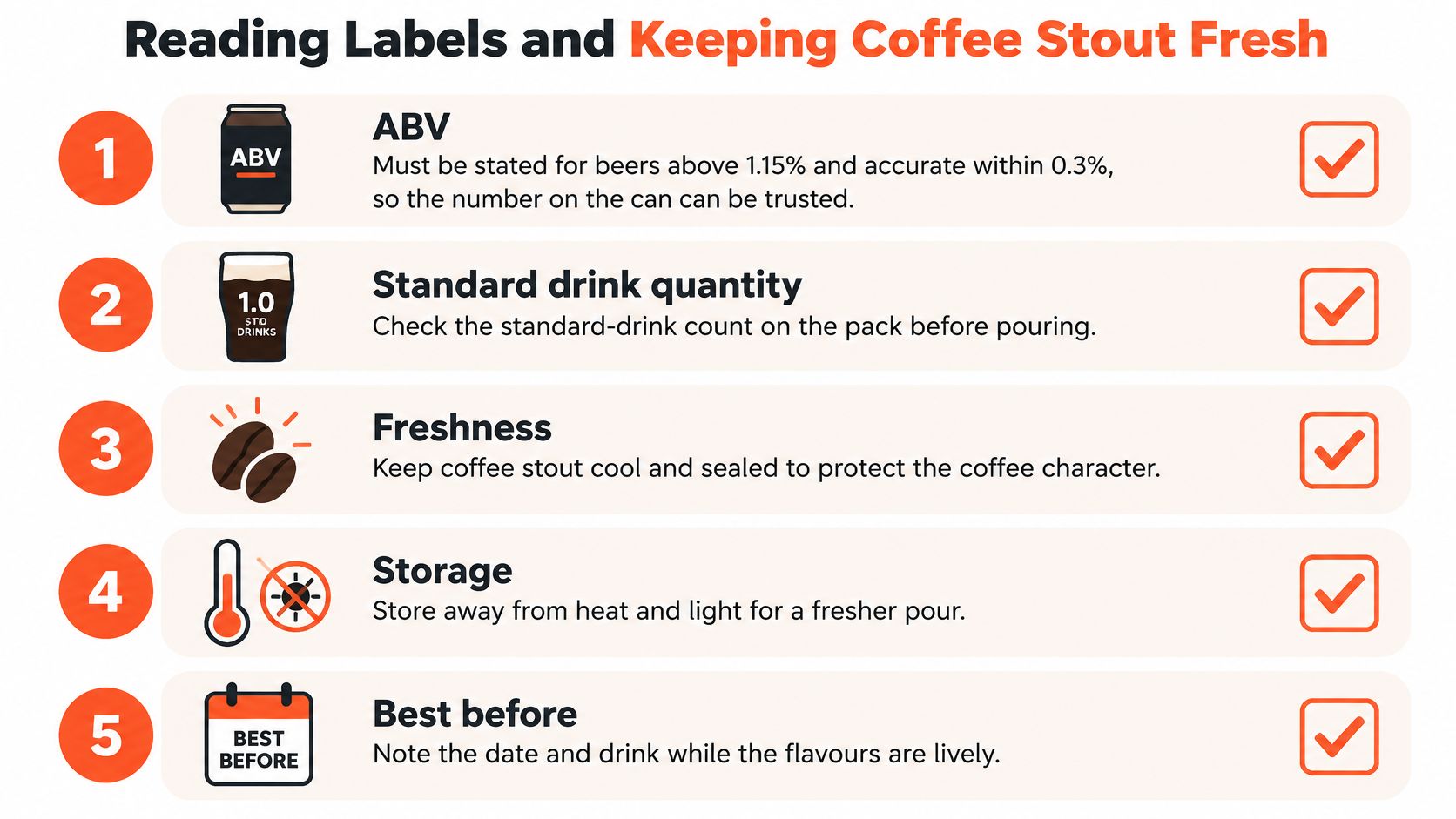
- ABV. The Food Standards Code, Standard 2.7.1 sets requirements for alcohol-content statements on drinks above 1.15% ABV and for the accuracy of beer declarations. The ATO's definition of beer also describes a fermented cereal brew with hops or hop extracts and at least 4 bitterness units. Coffee does not replace those ingredients.
- Standard drinks. Use the pack's count to compare beers of different strengths without calculating the alcohol yourself.
- Supplier and lot. These details help identify the batch if a can tastes unusual.
- Best before. Check the date where one is provided. Coffee aroma and roast character can soften with time, even if the beer remains drinkable.
- Allergens. Read the allergen information, including any milk declaration if lactose is used.
- Pregnancy warning. Read the warning on the label.
What fresh looks like
Check the canning date when it is available and choose recently canned stock. Keep cans cool, dark and upright, away from heat and sunlight. Over time, roast can soften and sherry-like notes may emerge. Some drinkers enjoy that change in a strong aged stout, while a coffee stout is usually easier to assess when fresh.
The same storage principle applies to coffee beans: limit exposure to air, warmth and moisture, as explained in this guide to protecting coffee beans from air and moisture. A sealed can protects the beer from air, but heat can still affect its flavour. For more on how storage affects beer over time, read this guide to craft beer shelf life.
Every Carbon 6 beer is brewed in-house, canned fresh, cold-stored and shipped fast. When buying from any brewer, ask how recently the beer was canned and whether it has been kept cool in storage.
Choose and Order Your Next Coffee Stout
A useful choice starts with the beer in the glass, not the coffee claim on the can. Check the strength, then consider roast and body: those tell you more about the likely pour.
First, choose the family. A standard coffee stout around 5.0–6.5% ABV suits a slower, measured pour. A milk coffee stout around 4.5–6.0% ABV may feel creamier and more dessert-like. An imperial stout at 8% ABV or higher is stronger, so keep the serving modest.
Next, read the label. Check ABV, standard drinks, lot code, best-before date, allergens and pregnancy warning. If the can is past its best-before date or has been stored warm, choose another.
Then compare value per standard drink. A four-pack of 440 mL cans at 5.0% ABV for $20 contains about 6.9 standard drinks, or roughly $2.90 per standard drink. CFO Tech reported average Australian coffee prices of $5.83 in 2025, coffee cup sales down 5.9%, and total coffee volume still 54% above 2021; its reporting also found younger drinkers willing to pay 14% more for beer than Baby Boomers and 23% more for coffee. Add delivery to the beer price, then weigh flavour, freshness and local production. Coffee stout is beer, not a morning coffee or a measured caffeine serve.
Finally, compare styles side by side. A mixed pack lets you taste different strengths, roast levels and bodies at the same temperature and in the same glass shape. Carbon 6 Brewing sells craft beer online, including Dark Orbit, a Choc Hazelnut Stout at 6.6% ABV. Its Beer Swap Guarantee offers a replacement if a customer's first sip tastes like disappointment, with no questions and no forms.
Decide how many standard drinks you intend to have before opening the pack, and stick to that limit.
Carbon 6 Brewing Pty Ltd brews small batches of beer in Stapylton on the northern Gold Coast, with occasional seasonal releases. You can order its beer online for delivery. Start with Carbon 6 Brewing Pty Ltd and choose a stout by its strength, roast and body.