Award Winning Beer: What Medals Really Prove in 2026
Nov 06, 2026
“Buy the beer with the most medals” sounds like sensible advice. It isn't a complete buying strategy. A medal can tell you something useful about brewing quality, but it can't choose your preferred bitterness, inspect the carton arriving at your door or decide whether the price makes sense.
For adults buying award winning beer online, the better approach is to treat recognition as evidence, not a verdict. Read the judging result, assess the style and check the condition of the beer you're buying. That's how you avoid paying for a badge when what you wanted was a good beer.
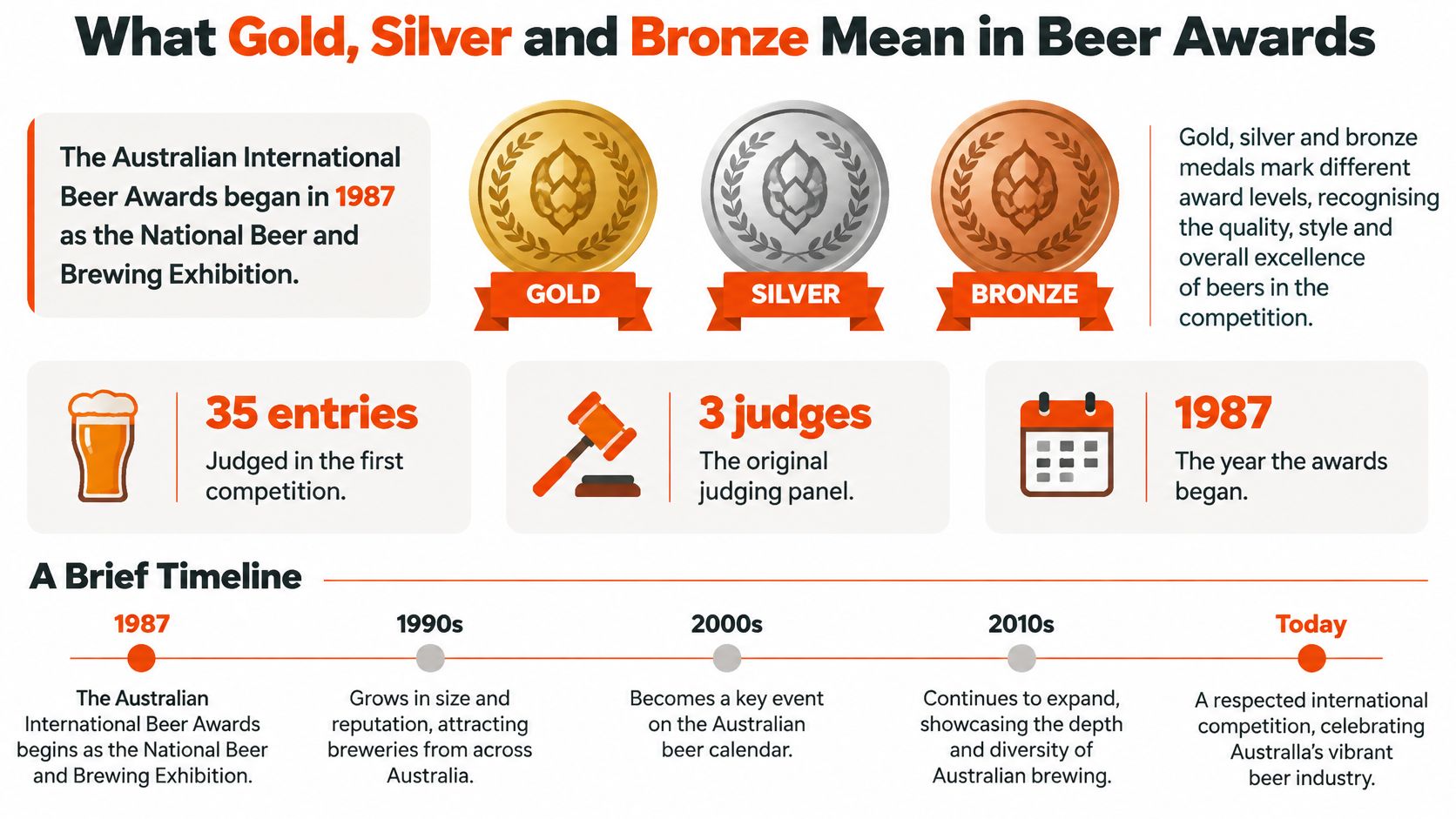
What Gold, Silver and Bronze Mean in Beer Awards
A beer medal records how one set of judges scored one entry against a style standard on one day. That is useful evidence for a buyer, and it is narrower than most medal marketing implies.
The Australian International Beer Awards operates on a substantial scale. Melbourne Royal's AIBA 2024 results catalogue records 2,277 entries from 391 breweries across 22 countries in 2024, comprising 1,611 Australian entries and 666 international entries, with 269 gold, 751 silver and 732 bronze medals awarded.
Those numbers show medals are distributed across a large field. Judges assess technical quality, sensory balance and fidelity to the entered style. Multiple beers can demonstrate an award-worthy standard, and a medal marks a beer that met that standard in a crowded competition.
Medal tiers at the Australian International Beer Awards
| Medal | AIBA 2024 count | What it signals |
|---|---|---|
| Gold | 269 | Top medal tier, with excellent execution and balance for the style |
| Silver | 751 | Well made and true to style, with more visible limitations than gold |
| Bronze | 732 | Sound execution, with clearer gaps against the style standard |
| Champion Australian Independent Beer | Trophy category, separate from medal tiers | Top independent Australian beer across the competition |
A standard-based medal measures a beer against its style. A champion trophy ranks eligible winners against each other. Gold records excellent execution within a style; the champion designation answers a narrower question about the leading eligible beer across the competition.
From a small exhibition to an international benchmark
The same AIBA 2024 results catalogue dates the competition to 1987, when it began as the National Beer and Brewing Exhibition with 35 entries assessed by three judges. It became international in 1993 through Ballarat University College's partnership with Melbourne Royal.
The program also introduced Champion Australian Independent Beer and Champion Australian Independent Brewery trophies in collaboration with the Independent Brewers Association. These distinguish recognition for an individual beer from recognition at brewery level.
For a small Queensland brewer, that distinction can help communicate quality beyond the local taproom. It still requires the buyer to understand what was recognised.
Reading rule: Check the competition, category and year. A medal supports a claim about that beer's performance against its style standard at that judging. Sellers sometimes stretch that result into broader claims.
A gold lager and a gold porter each meet a separate style standard. The lager medal tells a lager drinker about execution in that category. Porter preference remains a separate choice.
How Judges Score a Beer Before It Wins Medals
Professional evaluation starts with observation, not brand reputation. The Australian beer-evaluation competency standard sets out visual, aroma and palate assessment, including colour, clarity, aroma intensity, age, off-odours, acidity, sweetness, body, length and faults.
That gives judges a structured vocabulary. Rather than saying a beer is “a bit much”, they can identify excessive sweetness, harsh bitterness or an inappropriate finish.
What judges check and which faults they record
| Attribute | What judges check | Fault recorded |
|---|---|---|
| Appearance | Colour and clarity under suitable lighting | Cloudiness where the style should be clear |
| Aroma | Intensity, age and off-odours | Oxidised or stale aroma |
| Flavour balance | Acidity, sweetness and bitterness | Harsh bitterness or excessive sweetness |
| Body and carbonation | Weight, mouthfeel and fizz | Flatness or body that's too thin for the style |
| Finish | Length and aftertaste | Lingering off-flavours |
| Diacetyl | Buttery or butterscotch character | Diacetyl where the style doesn't call for it |
A fault isn't the same as a dislike
Style provides the reference point. A pale ale's judging sheet should address colour, hop aroma, bitterness, attenuation, carbonation and finish. Adding more hops does not make the beer a better expression of its category.
Context also prevents lazy fault-finding. Cloudiness isn't automatically a defect in a deliberately hazy beer, and sweetness isn't automatically wrong in a style that calls for it. Judges need to establish whether the attribute belongs, whether its intensity is appropriate and whether it integrates with the rest of the beer.
A drinker can reasonably dislike a technically accomplished beer. That isn't a failure of judging or of the drinker's palate.
Try a structured comparison at home
Use clean glasses and modest tasting pours. Compare beers with their own style descriptions rather than assuming the louder example deserves the higher score.
- Look first. Use neutral lighting and note colour, clarity and foam.
- Cover, then smell. Briefly cover the glass with a clean coaster, uncover it and assess the released aroma.
- Taste deliberately. Notice sweetness, acidity, bitterness, body and carbonation before considering the finish.
- Separate assessment from preference. Write “well balanced, but too bitter for me” if that's the honest conclusion.
This isn't a substitute for a trained judging panel. It's a practical way to understand why a medal-winning beer might still be the wrong purchase for you.
How to Read an Award Before You Buy Online
The most decorated beer can still be a disappointing online purchase. Its award doesn't establish that the parcel will arrive fresh, that you'll enjoy the style or that its delivered price represents good value.
Choice makes a reading method useful. Drinks Digest's report on major retail purchasing data describes 2,312 beer products available in 2026, a 165% increase in range over the previous decade.
Award label checklist before you buy
| Label detail | What to check | What it tells you |
|---|---|---|
| Competition and year | Named organiser and judging year | Whether the claim is identifiable and recent |
| Medal and category | Award level and named style | Which standard the beer was assessed against |
| Judging type | Blind tasting, disclosed-brand judging or popularity vote | Whether brand knowledge or public voting influenced selection |
| Size of category | Entry count, if published | Field size, though not automatically medal difficulty |
| Packaging and best-before date | Dates on the can or carton | The stated freshness window |
| Style, bitterness and ABV | Flavour description and labelled strength | Whether the beer fits your preferences and occasion |
Verify the claim before weighing it
Find the beer in the competition's published results. Match the name, award, category and year, rather than accepting a medal graphic as proof.
Treat a bare award-winning claim without those details as unverified. Also check whether the result concerns packaged or draught beer, because the product format is part of the evidence.
Say you're comparing a recent gold winner in a well-populated category with a bronze winner whose can has no readable packaging date. The gold offers stronger documented recognition, while the undated can creates a separate purchasing uncertainty. That makes the gold a more defensible shortlist candidate, not an automatic winner.
A crowded category doesn't necessarily make a standard-based medal harder to earn. Entry numbers describe the field; the judging rules explain how recognition is awarded.
Test the purchase, not just the medal
Compare delivered price per equivalent serve, then assess packaging dates, best-before information and the seller's delivery and storage explanations. Don't assume a more expensive older medal beer is better value than a freshly packaged alternative.
For every shortlisted beer, write a brief who may not like this note:
- Bitter and dry. Probably unsuitable if you prefer gentle bitterness and a sweeter finish.
- Rich and full-bodied. Potentially the wrong choice if you want something crisp.
- Roasty or experimental. Worth considering only if those flavours appeal independently of the award.
A useful award claim helps you eliminate the wrong beer as well as identify a promising one.
Notable Australian and International Beer Awards
Competition names become more useful when you group them by what they assess. International reach, regional relevance, independent eligibility and a brewery-level trophy aren't interchangeable credentials.
Broad benchmarks and regional relevance
The Australian International Beer Awards, delivered by Melbourne Royal, offers an international comparison across beer styles. Melbourne Royal's announcement of the competition's judging panel identifies 84 beer experts for the 2024 awards, illustrating the professional input behind the results.
For Queensland buyers, the Royal Queensland Beer Awards provides a geographically relevant competition to investigate. Brews News reported more than 600 entries from 87 breweries across 18 categories in 2024.
| Recognition | Most useful question |
|---|---|
| International competition medal | How did this beer perform within its entered style? |
| Royal Queensland medal | What recognition did it receive in a Queensland-based competition? |
| Independent beer trophy | Which eligible independent beer earned champion recognition? |
| Independent brewery trophy | What was recognised at brewery rather than individual-beer level? |
A regional medal isn't necessarily weaker. It describes a different field, and the organiser's judging method matters more than an assumption that bigger always means better.
Our Royal Queensland awards account provides brewery context. For any purchase based specifically on an award, use the organiser's published result as the primary evidence rather than relying solely on a brewery's account.
Match the award to the beer
The World Beer Cup, Oregon Beer Awards and Crafted Festival Gold Coast Brewers Choice Award are names buyers may encounter. Don't assume identical entry rules, judging methods or meanings from their titles, and don't transfer prestige from one system to another without checking.
For a crisp lager, prioritise a relevant lager-category result from a recognised competition. For a hazy IPA, inspect the precise style category; for a porter, assess recognition against the porter brief. Category fit beats name-dropping, whichever competition appears on the label.
How Breweries Prepare a Beer for Competition Entry
Competition preparation should reveal which production controls are working and which are not. Sensory evaluation does that job in four practical ways: difference testing against a reference sample, shelf-life studies backed by microbial analysis, flavour profiling, and fault detection. Each one produces a record a brewer can act on, and each one costs time before an entry is ever shipped.
Queensland's BrewLab model pairs expert-panel tasting with laboratory testing for acidity and alcohol volume. That's the useful principle: sensory assessment and analytical verification should support each other. A panel that flags diacetyl and a lab result showing increased pH are describing the same problem from two directions, which is why the better entries arrive with both kinds of evidence behind them.
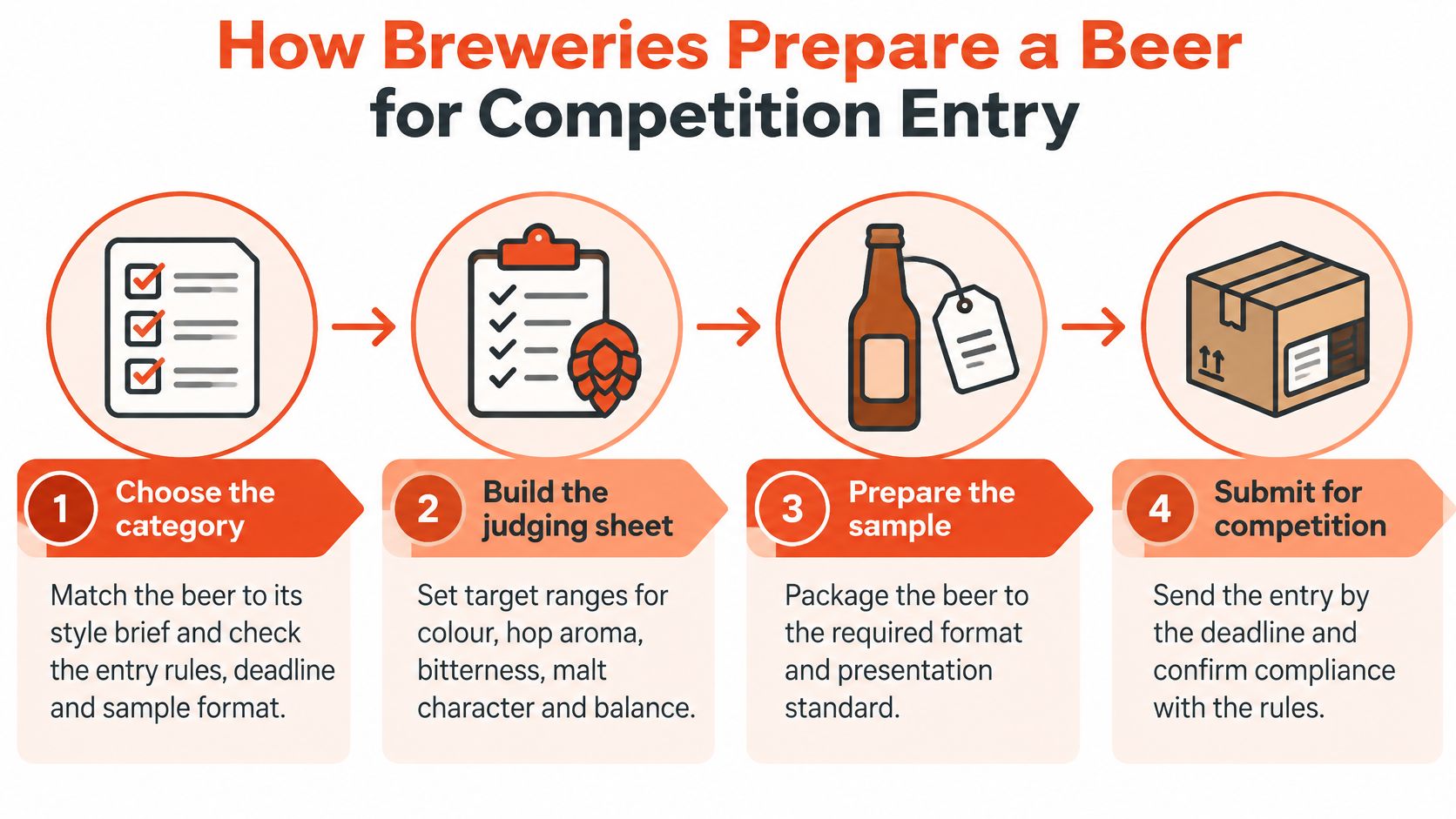
Build an entry that can be traced
- Choose the category before completing the paperwork. Match the beer to the actual style brief, then check entry rules, deadlines and sample format. A beer marketed as hazy that reads as a clear pale ale loses points before judging begins.
- Build a style-specific judging sheet. Set internal targets and acceptance limits for colour, hop aroma, bitterness, attenuation, carbonation and finish. Without written criteria, two tasters can approve two different versions of the same intended beer.
- Run trained-panel checks at release. Record appearance, aroma intensity, flavour balance, body, bitterness, carbonation and faults using consistent descriptors. "Tastes good" tells a brewery almost nothing when an entry later underperforms and someone has to work out whether the fault sat in the recipe, the process or the packaging line.
- Retain a reference sample from each packaged batch. Label it, record its storage conditions, and keep it long enough for a later investigation to mean something. Without a retained sample, oxidation, microbial spoilage and ordinary batch variation look identical on the scoresheet.
- Keep analytical records, packaging data and dispatch plans on one timeline. Log ABV, pH or acidity, dissolved oxygen where available, packaging date and cold-chain conditions against the batch identifier, then record dispatch dates, courier details and known transport conditions against that same identifier. Laboratory results filed separately from dispatch records explain nothing. Nor does a sound tank sample rescue a packaged entry that has spent a week in a hot courier depot.
- Protect the entry stock itself. Store it cold and away from light, then verify package condition and carbonation before it leaves. Judging rewards the beer that arrives, not the beer that was intended.
Make shelf life part of quality assurance
A medal-worthy release sample is not the end of the job. Repeat sensory checks across the declared shelf life and compare the results with the retained sample and batch records. Judges typically taste beer close to packaging; the customer drinks whatever survives the supply chain. A gold medal says the beer was right on the bench that day. It says nothing about the bottle sitting in a fridge four months later.
Production test: Aim for the same acceptable sensory profile at release and near the end of shelf life, not merely an impressive sample on entry day.
Not every aroma has to survive intact. The brewery needs a defined window and evidence that customers receive beer inside it, which is the part of competition preparation a medal will never confirm for a buyer.
How Breweries Promote an Award Within ABAC Rules
Alcohol advertising must not have strong or evident appeal to minors. The ABAC Responsible Alcohol Marketing Code also requires available digital age restrictions and, where a platform can't provide controls capable of excluding minors, an audience reasonably expected to comprise at least 80% adults.
Adult targeting doesn't repair unsuitable creative. ABAC's content checklist addresses youth-oriented imagery and states that people who are or appear to be under 18 may appear only incidentally, without implying they consume or serve alcohol.
Promote recognition without promoting misuse
Avoid cartoon mascots, youth settings, gaming-style challenges and presentation that confuses beer with confectionery or soft drinks. Use adult-oriented photography and accurate flavour or brewing descriptions.
The ABAC guidance notes prohibit encouraging consumption inconsistent with health guidance, including more than 10 standard drinks per week or more than four on any one day, alongside rapid consumption, dares and consumption during pregnancy or breastfeeding. They also prohibit encouraging product selection by emphasising strength or intoxication, except when highlighting relatively low strength.
A hypothetical claim identifying a gold medal, the Royal Queensland Beer Awards, its judging year and the Pale Ale category gives readers something verifiable. A vague claim about being the strongest beer on the Coast substitutes potency for evidence and shouldn't be the promotional angle.
Keep a documented publication check
- Claim evidence. Retain the published result and match its wording to the advertisement.
- Creative review. Check people, imagery, packaging, captions and implied behaviour.
- Placement controls. Record age restrictions, audience settings and the surrounding media environment.
- Applicable requirements. Check platform advertising rules and Queensland liquor-licensing obligations as well as ABAC.
ABAC's compliance FAQs explain the role of internal checking, optional external pre-vetting and the wider regulatory environment. Custom artwork needs the same scrutiny, including when preparing custom-label beer.
For broader e-commerce process review, CartBoss offers a resource to improve your store's compliance practices. Treat that as operational background, not a substitute for Australian alcohol-specific requirements or legal advice.
Choosing Your Next Award Winning Beer
The medal is the least useful part of an award-winning beer until you confirm what it was awarded for and how the bottle has been stored since. Use a buying sequence that keeps your own preferences in charge:
- Confirm the recognition. Match the competition, year, category and medal to the published result.
- Choose your flavour lane. Decide between crisp and familiar, balanced and exploratory, or intense and niche.
- Check the actual stock. Inspect packaging or best-before information and delivery conditions before ordering.
- Explore without overcommitting. Consider a mixed pack rather than a full carton of an unfamiliar style.
Local preference isn't a contest in intensity
Carbon 6's account of Queensland independent brewing reports that pale lager appeals to 30% of Queensland craft drinkers; that Queensland drinkers average 2.8 beer styles, against 3.2 in New South Wales; and that the state has approximately 97 independent breweries, 6,715 jobs and $588 million contributed to the community in 2023-24, with independents representing 51% of brewing-industry employment while holding less than 8% of market share. Restrained flavour is not a less legitimate craft-beer preference.
Supporting independent ownership is a separate purchasing consideration from collecting medals. Check who owns the brewery rather than judging independence from rustic labels or small-batch language. An award alone doesn't establish ownership, sustainability or freshness.
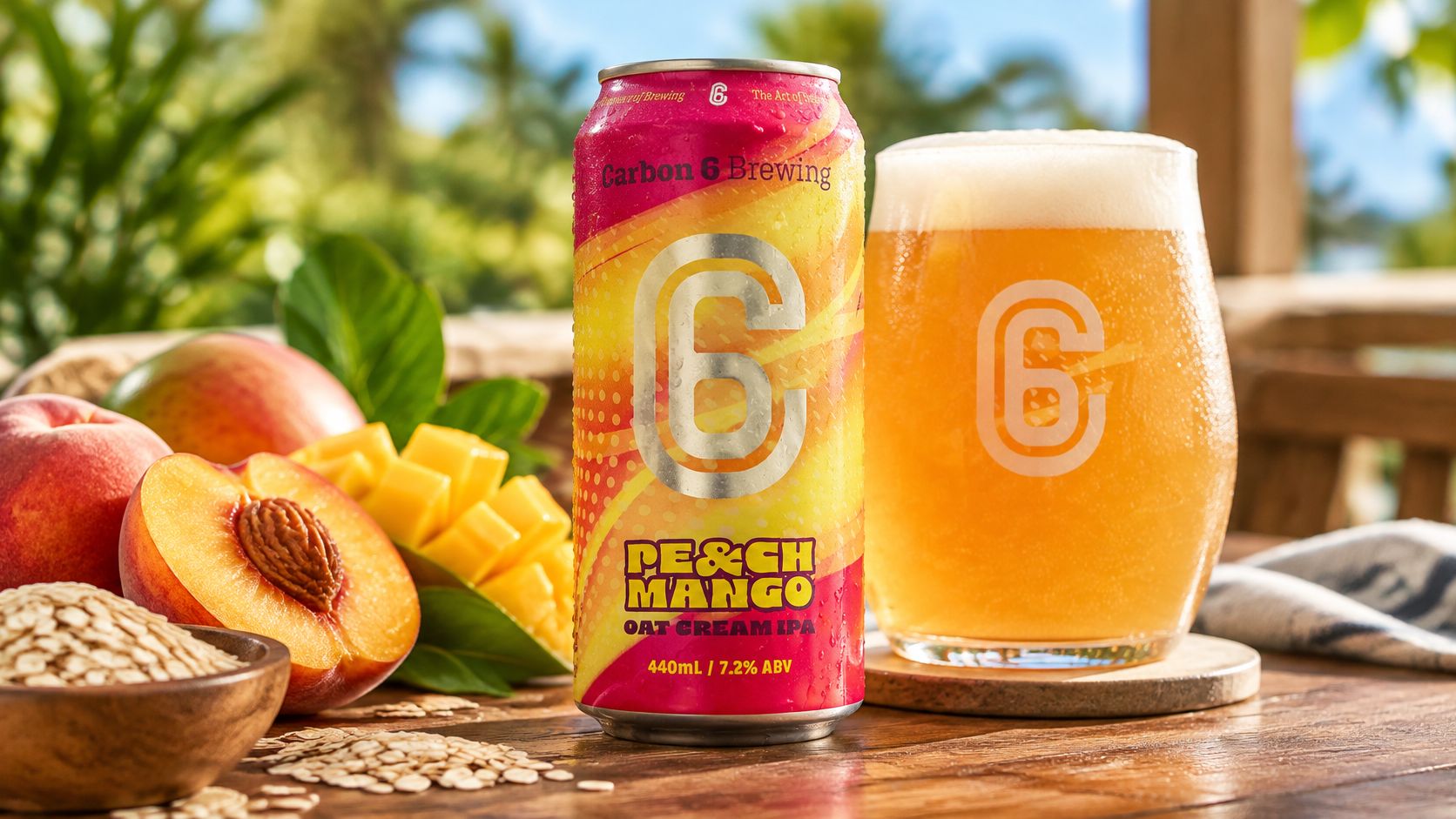
For a concrete flavour comparison, the product listing for Peach & Mango - Oat Cream IPA | Craft Beer describes peach, mango, lactose and rolled oats. Its fruit-forward, creamy profile suits someone seeking a full-bodied hazy beer, not necessarily someone wanting a dry, crisp lager; that distinction doesn't require an award claim.
Carbon 6's Beer Swap Guarantee means that if your first sip tastes like disappointment, the beer is swapped for a better one, with no questions and no forms. That's a customer policy, not proof that every style will suit you.
Use the award-winning beer collection as a starting point, then choose a verified medal beer in a style you already enjoy. Consider a mixed pack for exploration and check the label before you pay.
Carbon 6 Brewing Pty Ltd is an independent craft brewery in Stapylton on the northern Gold Coast, offering beer through online direct sales and local wholesale distribution. Visit Carbon 6 Brewing Pty Ltd to compare styles and award details, then choose on flavour fit and freshness information rather than the medal graphic alone.