
Full Strength Beer Percentage in Australia: What It Means
Oct 11, 2026
4.8% ABV is the Australian benchmark for full-strength beer, but “full strength” isn't a fixed legal category. The reliable answer is on the can, in its declared ABV and standard-drink count.
You're standing at the bottle-o, comparing a familiar lager with a mixed carton of independent beers. One label says 4.8%, another says 6%, and the front of both packs uses language that sounds like “full strength”. The useful question isn't which beer carries the label. It's how much alcohol is in the container you're about to drink.
That answer comes from three figures: alcohol by volume, container volume and standard drinks. Read those together and the small print becomes practical rather than confusing.
Reading the Beer in Your Hand
Start with ABV, or alcohol by volume. This is the percentage of the beer that's pure alcohol by volume. A beer marked 4.8% ABV contains a different concentration of alcohol from one marked 3%, 5.5% or 6%.
Next, check the volume. A 375 mL can, a 425 mL schooner and a tasting pour don't contain the same amount of beer, even if they come from the same keg or can. More liquid at the same strength means more alcohol in the serve.
The third figure is standard drinks. Australian labelling rules require packaged alcohol above 0.5% ABV to show standard drinks, while beverages above 1.15% ABV must state their alcohol content as ABV or millilitres per 100 millilitres. The Food Standards Australia New Zealand alcohol-labelling guidance explains why the label gives you a more useful comparison than a front-of-pack phrase.
Practical rule: Treat “full strength” as a starting description, then trust the ABV, volume and standard-drink declaration.
That trio helps with more than a fridge decision. It lets you compare a mixed carton, work out what you're pouring for guests and understand why two beers that look similar can deliver different amounts of alcohol.
For digitally savvy craft-beer shoppers, this is especially handy online. Product photography may highlight the label or style, but the useful details are the figures attached to the individual can and the whole pack. The label doesn't ask you to guess what “full strength” means. It gives you the information needed to make your own call.
What ABV Means and Why 4.8% Is the Benchmark
ABV means alcohol by volume. If a beer is marked 4.8% ABV, alcohol makes up 4.8% of its volume. That figure describes concentration, not the total amount you'll consume, because container size still matters.
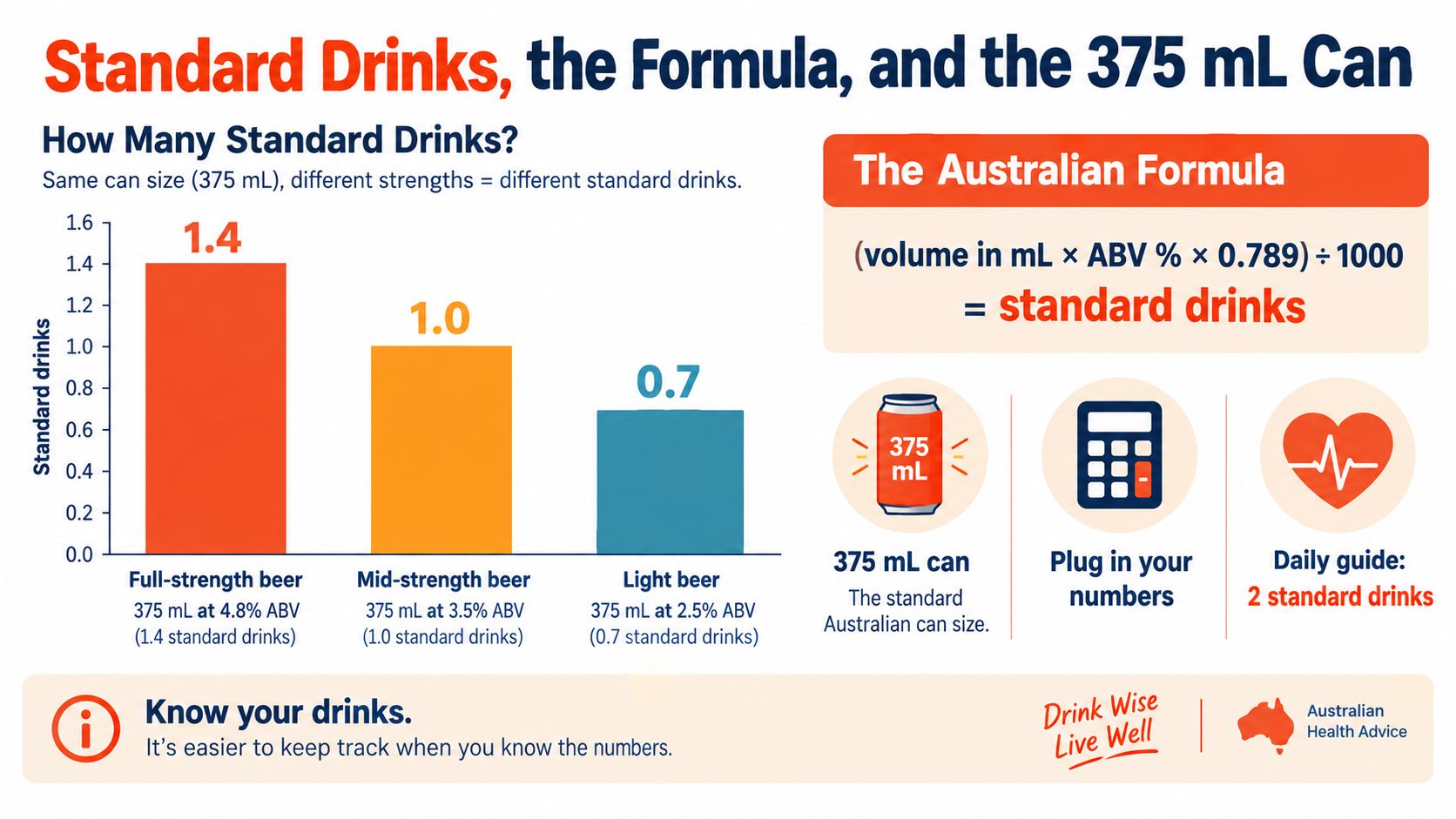
In Australia, 4.8% ABV is conventionally used as the full-strength beer reference. The Australian Government's standard-drinks guidance uses 4.8% in its full-strength example, including a 375 mL can or bottle at approximately 1.4 standard drinks and a 425 mL serve at approximately 1.6 in its standard-drinks guide.
That doesn't make 4.8% a legal border. “Full strength” is everyday market language, not a universal statutory ABV category. A brewer might make a crisp 4.3% West Coast pilsner or a much stronger 6% IPA, and shoppers may still encounter both described in the broad full-strength part of the beer market.
The number on the can settles the ambiguity. A 4.3% beer is less concentrated than a 4.8% beer, while a 6% beer is more concentrated. Style, fermentation and recipe choices determine the result, not the phrase printed on the front.
For shoppers, the practical habit is simple:
- Read the ABV: It tells you the beer's alcohol concentration.
- Read the volume: It tells you how much beer is in the container.
- Read standard drinks: It translates both figures into an Australian measure of pure alcohol.
The phrase “full-strength beer percentage” therefore has a useful but limited meaning. It points you towards the familiar 4.8% benchmark, but it can't replace the declared ABV. If the beer is stronger or the serve is larger, the standard-drink count will show that difference.
Standard Drinks, the Formula, and the 375 mL Can
You pick up a 375 mL can, spot 4.8% ABV, then see 1.4 standard drinks on the label. Those numbers are the practical way to read strength in Australia. “Full strength” is only shorthand. The amount of alcohol in your hand comes from three things working together: ABV, pack size and standard drinks.
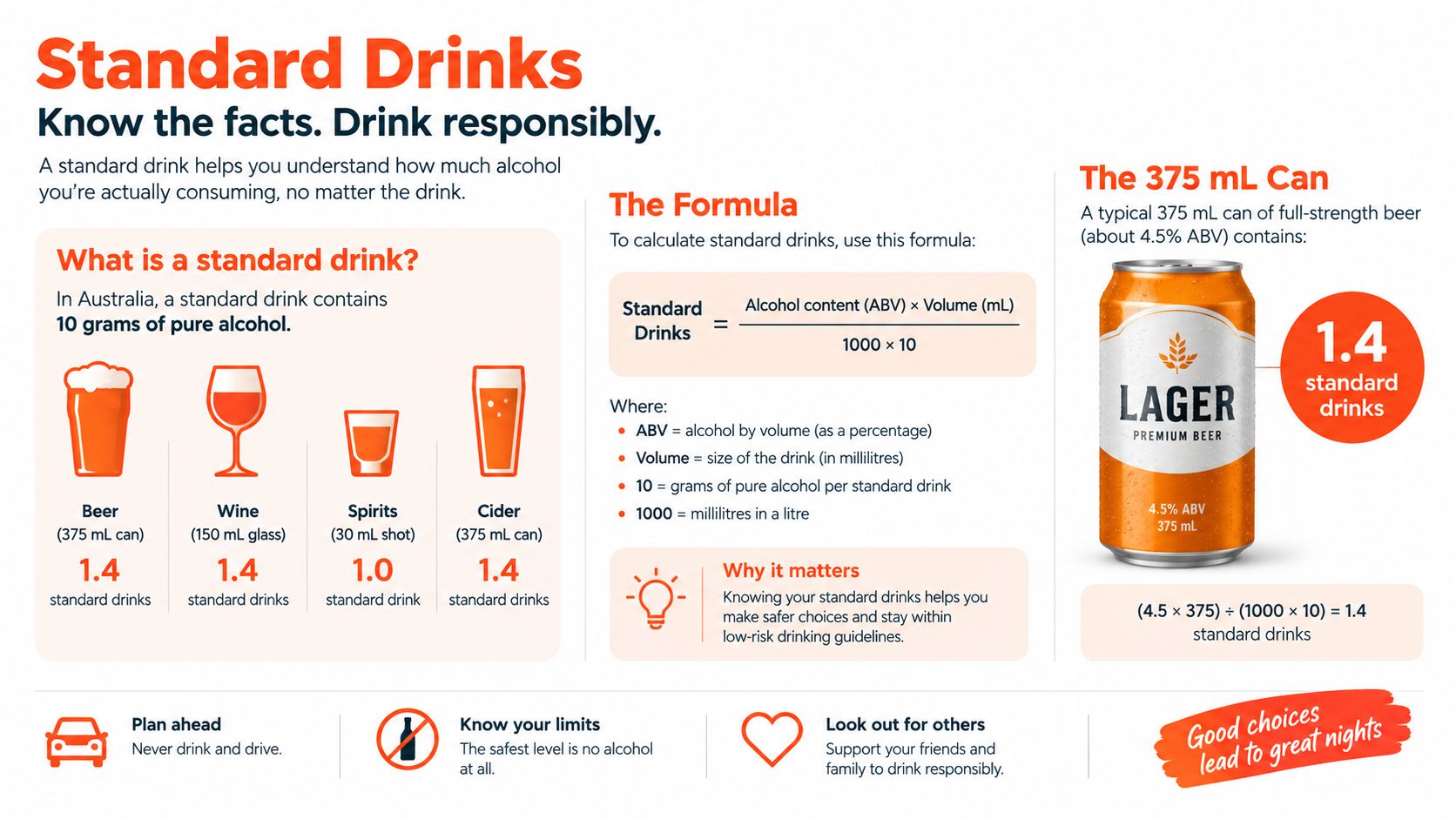
An Australian standard drink contains 10 g of pure alcohol. The formula used in the standard-drinks guidance is:
standard drinks = volume in litres × ABV × 0.789 ÷ 0.01
Run that on a common full-strength can and the label starts to make sense. For a 375 mL can at 4.8% ABV:
0.375 × 0.048 × 0.789 ÷ 0.01 = approximately 1.42 standard drinks
That rounds to about 1.4 standard drinks. The printed figure is rounded for easy reading, while the formula shows the mechanics underneath.
Small changes shift the result quickly. Keep the beer at 4.8% and pour 425 mL, and you get approximately 1.6 standard drinks because the serve is bigger. Keep the can at 375 mL and raise the beer to 6% ABV, and it becomes approximately 1.8 standard drinks because the concentration is higher. Same idea, different outcome.
You do not need to work this out every time you buy a can. Packaged alcohol in Australia usually prints the standard-drinks figure for you. The formula helps when the format changes, such as a growler, a tap pour, a tasting paddle or a mixed carton. If you want a format-by-format example, this growler beer size guide shows how volume changes the count.
| Beer and serve | Approximate standard drinks |
|---|---|
| 375 mL at 4.8% ABV | 1.4 |
| 425 mL at 4.8% ABV | 1.6 |
| 375 mL at 6% ABV | 1.8 |
“One beer” is loose pub language. The label numbers are the measure.
The Australian Strength Tiers From Low to Craft
You are standing in front of the fridge with two cans in hand. One is a mid-strength lager at 3.5% ABV. The other is an IPA at 6% ABV. Both are still beer, both might sit only a shelf apart, but they belong to different parts of the strength range and usually suit different serving choices.
That is the useful way to read Australian beer tiers. “Full strength” is everyday shorthand, not a tidy legal box that explains every beer on the shelf. The clearer guide is the label, then the broad tier the beer falls into.
| Tier | Typical ABV | What it usually signals |
|---|---|---|
| Low strength | Under 3% | Lower-alcohol beer built for lighter drinking |
| Mid-strength | 3% to 3.5% | A lower-ABV option that still aims for flavour |
| Full strength | Roughly above mid-strength mainstream territory | The standard pub and bottle shop range many drinkers mean when they say “regular beer” |
| Higher-ABV craft | 5.5%, 6% and higher | IPA, imperial and speciality releases with more alcohol concentration |
The boundaries are practical, not absolute. Brewers still have room to make a beer feel crisp, full, bitter or malty on either side of those ranges.
Mid-strength is a good example. Lower ABV does not automatically mean thin or dull. Recipe design, yeast choice and hopping still shape the beer, which is why a shopper comparing lighter options can get more context from this Australian low-alcohol beer guide.
At the top end, “craft” can blur style and strength together. A hazy pale ale and a stronger IPA may look similar in the fridge, yet the stronger one carries more alcohol in the same pour size.
Use the tier name as a first clue only. The actual call on what is in your hand comes from the on-label trio, ABV, pack volume and standard drinks.
Real Examples From Mainstream, Mid and Craft
Say you are standing at the bottle shop fridge with three cans in front of you. One says 3%, one says 4.8%, and one says 6%. All three might get called “beer” in the same breath, but they do not carry the same amount of alcohol in the same pack size.
A 3% mid-strength lager sits below the usual full-strength reference point. A beer such as Carbon Mid fits that broad description. In a 375 mL can, it lands lower on the standard-drinks scale than the 4.8% example calculated earlier. That is the practical difference in your hand, not just on a style chart.
A familiar 4.8% lager is the mainstream marker many Australians mean when they say full strength. In a 375 mL can, it works as the middle reference point for this comparison, and it gives you a useful baseline for reading the stronger and lighter options around it.
Step up to a craft beer at 6% ABV and the gap becomes easier to feel. In a 375 mL can, it contains approximately 1.8 standard drinks. Same can size. More alcohol concentration.
The Occasional Beer WC Pils shows why style names can muddy the picture. A West Coast pilsner at 4.3% ABV sits below the 4.8% benchmark, but it still fits the ordinary-strength conversation more than the low or mid-strength end.
These examples are guideposts only. Brewers can make two pale ales, lagers or pilsners that taste similar and still land at different strengths. The can's ABV and standard-drink number beat memory, shelf language and assumptions every time.
What a 16-Pack and a Mixed Carton Really Contain
A carton changes the question from “how strong is this can?” to “how much alcohol is in the group of cans?” For a 16-pack of 375 mL cans, the Australian calculation gives approximately 22 standard drinks at 4.8% ABV and approximately 27 standard drinks at 6% ABV. A mixed carton sits somewhere between or outside those figures depending on the beers selected.
At 3% ABV, sixteen 375 mL cans represent approximately 17 standard drinks. At 4.8%, the same format represents roughly 22 standard drinks, and at 6%, roughly 27 standard drinks. The pack size hasn't changed. Only the concentration has.
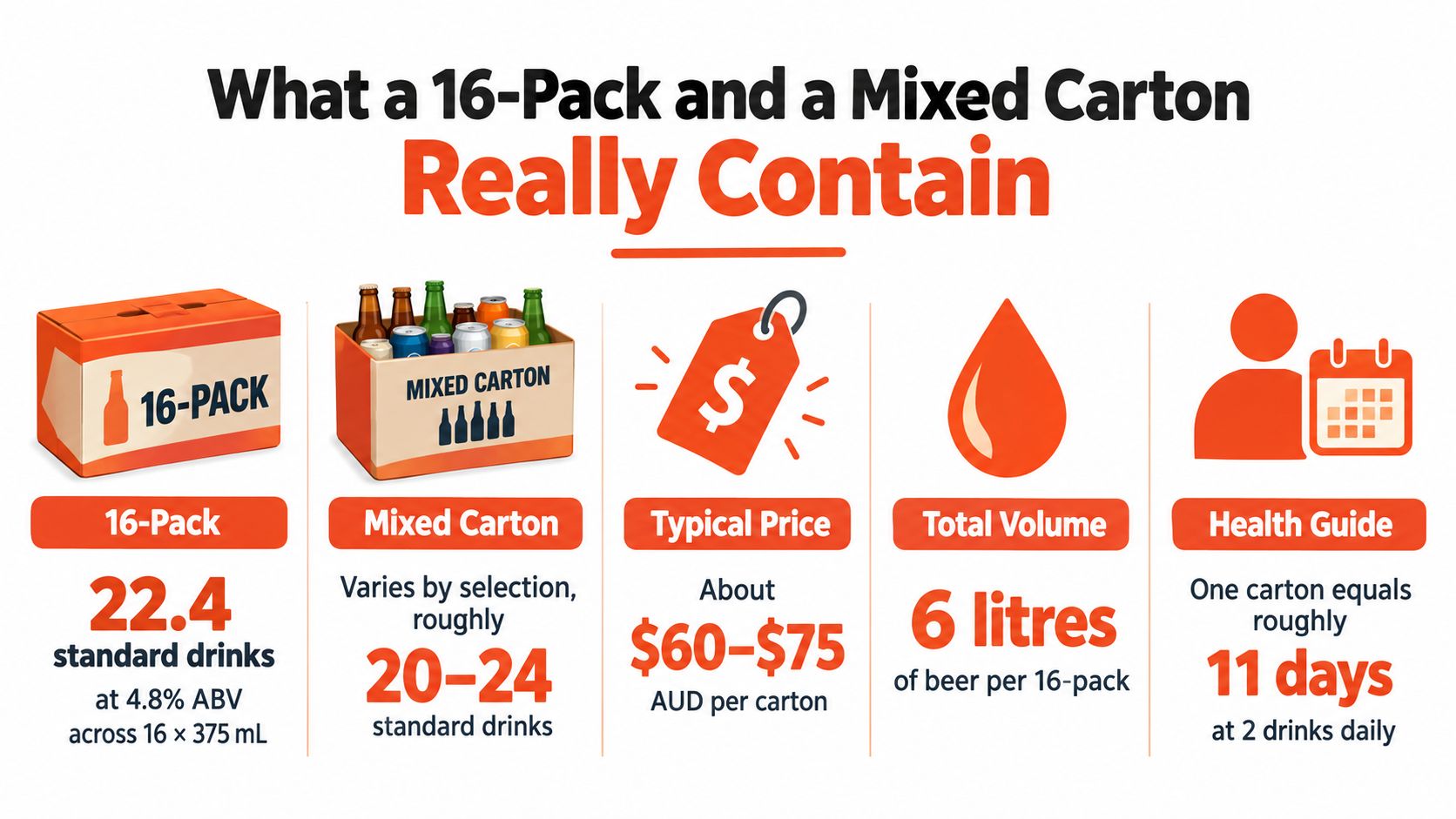
That difference matters when you're buying for a barbecue, filling the esky or ordering online to make delivery worthwhile. A mixed carton can look like a varied collection of individual tasting choices, but the pack-level total tells you how much alcohol the whole selection represents. The Australian beer case guide is useful when you're comparing formats and planning a larger purchase.
The Occasional Beer 16-pack belongs to this pack-level conversation, while limited six-pack designs create a smaller format for trying a particular release. Neither format tells you the total on its own. Add the standard drinks shown for each beer, or calculate from the ABV and volume, then total the cans you're buying.
A “full-strength” carton isn't automatically interchangeable with a craft carton. The total depends on the percentage, the can size and how many cans are included.
For responsible hosting, keep the carton figure visible rather than relying on the phrase “a few beers”. That language hides the difference between lower-ABV and higher-ABV selections. Reading the pack this way supports informed choices without treating stronger beer as a status symbol or a reason to drink more.
Serving Size Changes Everything
Order a pot, then a schooner of the same beer, and the label percentage has not changed. The amount of alcohol in your hand has. Australian health guidance uses a 285 mL serve at 4.8% to 4.9% ABV as an example of about 1.1 standard drinks. The same 4.8% beer is about 1.4 standard drinks in a 375 mL can and 1.6 in a 425 mL serve.
That is why “one beer” is shaky shorthand. ABV tells you concentration. Serve size tells you how much liquid you are drinking. Standard drinks bring those two numbers together, which is much closer to the real-world strength of a pour than the phrase “full strength” on its own.
| Serve | Same beer at 4.8% ABV | Approximate standard drinks |
|---|---|---|
| 285 mL | 4.8% to 4.9% example | 1.1 |
| 375 mL | 4.8% | 1.4 |
| 425 mL | 4.8% | 1.6 |
A big glass of a lower-ABV lager can still add up faster than expected. A small tasting pour of a stronger beer can contain less alcohol than a full can of a weaker one. If you are at a brewery or settling in for a long afternoon, count the actual pour size rather than just the number of glasses.
For healthy adults, the National Health and Medical Research Council guidance is no more than 10 standard drinks per week and no more than 4 on any day. Use those figures as planning guardrails, not as a promise that any set amount is risk-free. The Australian Government standard-drinks guidance gives broader context.
A Practical Checklist for Choosing Your Next Beer
Use the label in this order when you're browsing a bottle shop, brewery website or taproom menu:
- Find the ABV. Around 4.8% is the Australian full-strength reference, but a 3% lager, 4.3% pilsner or 6% IPA will sit somewhere different on the strength spectrum.
- Check the container volume. A 375 mL can and a 425 mL serve aren't equivalent, even when the ABV matches.
- Read the standard-drink declaration. This is the quickest way to understand the alcohol in a packaged serve.
- Calculate the pack total. Add the cans in a mixed carton rather than judging the whole order by its front label.
- Match the format to the occasion. A tasting paddle, a quick knock-off beer, a long afternoon with mates and a carton for the footy involve different serving patterns.
The label gives you a better decision tool than the phrase “full strength”. ABV describes concentration, volume describes quantity and standard drinks bring the two together. Once those three numbers become familiar, you can explore new styles without guessing what the beer percentage means in practical terms.
Keep the Australian health guidance in mind as you plan the week, including no more than 10 standard drinks per week and no more than 4 on any day for healthy adults. If you're driving, pregnant, taking medication or concerned about alcohol, the safest choice may be not to drink.
Carbon 6 Brewing Pty Ltd offers independent craft beers, including The Occasional Beer WC Pils and mixed-pack options where the can details help you compare strength and serving size. Visit Carbon 6 Brewing Pty Ltd to browse the range and choose a format that suits your next occasion.