

Grain Fed Brewery: What It Means for Your Pint
Oct 03, 2026
920,000 tonnes of malt are produced from about 1.1 million tonnes of Australian barley each year, and a grain fed brewery generally relies on cereal grain inputs, especially malted barley, rather than leaning heavily on simple sugars. For Australian craft brewers, that usually means sourcing from local barley where supply and quality allow.
You might be standing at a Gold Coast pub, weighing up a pale ale, XPA or lager while the person behind the bar gives you the quick version: “It's grain fed.” Or you've cracked a cold can on the porch and noticed the phrase on a tap list, brewery website or carton. It sounds wholesome, local and traditional, but it doesn't automatically tell you how the beer was made or whether it'll suit your taste.
The useful question is simpler: what does the grain claim mean inside the brewhouse, and what evidence should a drinker look for before buying? The answer sits across barley quality, malt conversion, water, fermentation, packaging, delivery and responsible alcohol marketing. That supply-chain view cuts through the warm storytelling without taking the good stuff away from a well-made local beer.
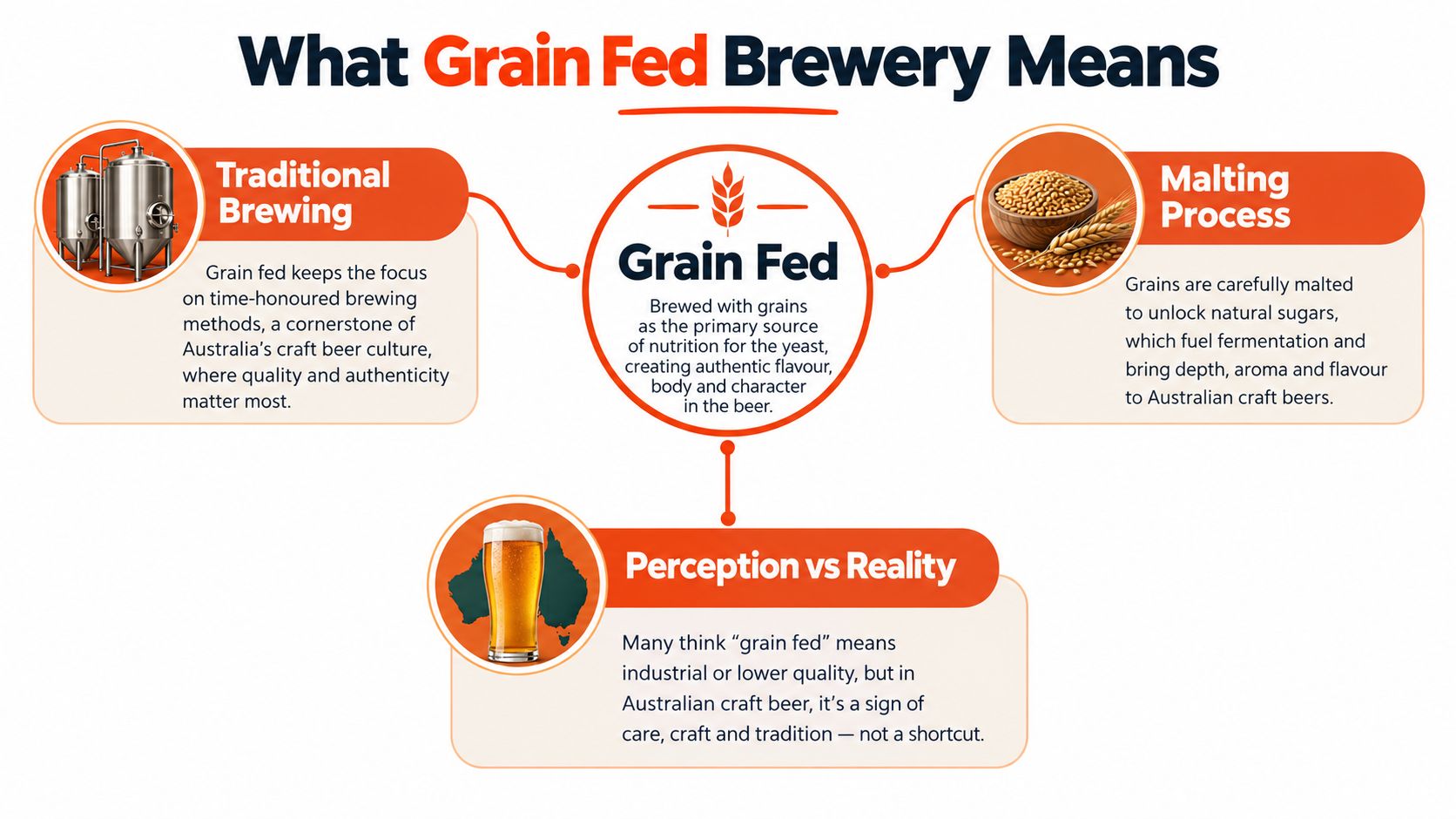
What Grain Fed Brewery Actually Means
At a Gold Coast venue, “grain fed” might suggest a beer with a proper malt backbone, a local connection and a bit of old-school brewing pride. It doesn't, by itself, certify quality. The phrase is best understood as a description of the brewery's main fermentable foundation, not as an award, regulated seal or promise that every ingredient came from nearby.
Most grain-driven beer starts with malted barley. The maltster prepares the barley so the brewer can use its starches, colour, flavour and enzymes in the mash. The brewer then draws sweet wort from that grain and ferments it with yeast. A grain fed brewery may still use other brewing materials, and the finished result depends on recipe design, water, brewhouse control, yeast management, maturation and packaging.
A local idea with a long history
Australia has been adapting grain inputs to brewing conditions for a long time. John Boston, described as Australia's first brewer, used Indian corn rather than barley in 1794, when colonial shortages made barley difficult to obtain. The country's brewery count later peaked at 307 in 1889, before consolidation reduced it to 20 individual players by 1980, according to this history of beer and brewing in Australia.
Modern craft brewing brought variety back into the picture. Hahn Brewery opened in 1988 as the first modern craft brewery, James Squire was reborn in 1999, and the Craft Beer Industry Association counted just over 400 breweries by 2017, as recorded in the same Australian brewing history source.
That history gives “grain fed” a cultural feel, but the practical meaning remains process-based. For a plain-language primer, what malt does in beer is a better starting point than treating the phrase as a guarantee. Ask what grain was used, where it came from, how the beer was brewed and how fresh the packaged product is.
From Barley to Beer Without Shortcuts
A sack of malt isn't beer yet. The brewer has to turn its starch into a liquid that yeast can ferment, and small changes in the grain can affect how smoothly that job happens.
The process begins in the mash tun. Hot water surrounds crushed malt, allowing enzymes to break starch into sugars. The brewer separates the sweet liquid, called wort, from the grain husks, then boils the wort, adds hops, cools it and transfers it to fermentation. Yeast consumes suitable sugars and produces alcohol, carbon dioxide and flavour compounds. This overview of how craft beer is made shows why the grain bill is only one part of the result.
Quality starts before the brewhouse
Australian barley guidance draws a useful line between malting barley and feed barley. Top malting grades commonly require maximum protein of 9%, while feed grades generally have no protein minimum or maximum. Delivered grain is also commonly capped at 12.5% moisture, and feed barley is selected for plump kernels, high starch energy and low screenings, as outlined in Australian barley marketing guidance.
Those figures aren't trivia for a brewer. Protein contributes to the beer's body and head, but too much can reduce extract efficiency or create a less predictable mash. Excess moisture increases storage risk and can affect how the grain performs. A brewer receiving a variable lot may need to adjust the recipe, milling, mash temperature or water treatment rather than assuming every truckload behaves the same way.
Practical rule: “Grain fed” tells you about the foundation. It doesn't tell you whether the brewer extracted that foundation well.
What the drinker notices
When conversion is consistent, the brewer can reproduce a beer's body, fermentability and balance from batch to batch. If the wort contains a different mix of usable sugars, the yeast may leave a beer fuller, drier or sweeter than intended. That difference can show up as a crisp finish, a rounded malt note or a beer that feels heavier than the label suggests.
Water chemistry matters here too. Minerals influence mash performance, hop expression and perceived bitterness. A grain-focused recipe still needs a brewer who understands the local water profile and makes deliberate adjustments. The phrase earns credibility through that discipline, not through a sack of barley photographed beside a stainless-steel tank.
Grain Fed Brewing vs Other Brewing Approaches
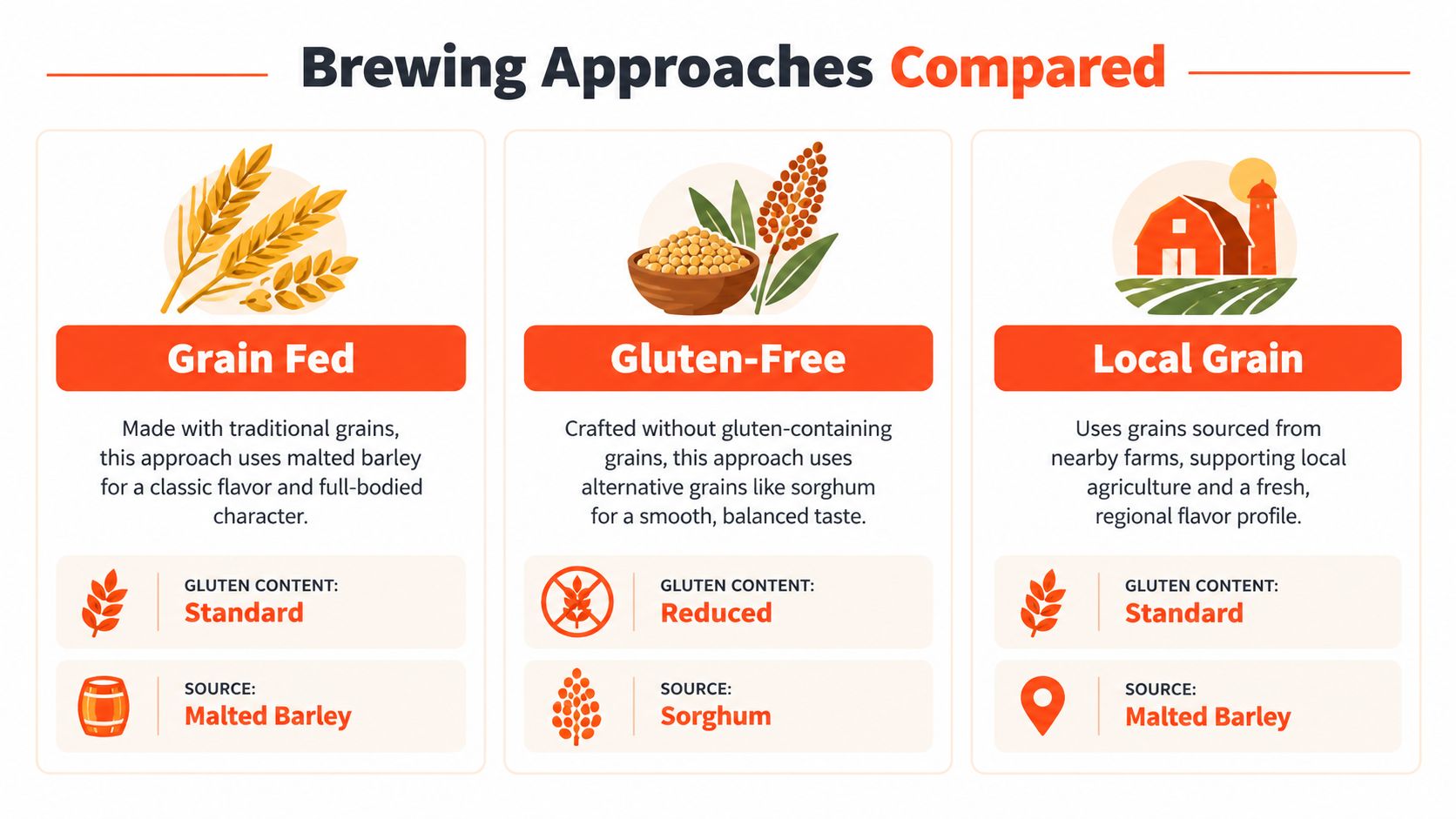
Three ideas often get bundled together even though they describe different things.
Traditional grain-fed brewing uses malted cereal grain as the principal source of fermentable material. Malted barley commonly brings the base of the beer, while specialty malts can contribute colour, toast, caramel, roast or other flavour dimensions. The beer's character comes from the interaction between the grain bill, mash, hops, water and yeast.
Adjunct-heavy brewing uses additional fermentable materials or flavouring inputs alongside malt. That isn't automatically a flaw. Brewers may use an adjunct to lighten body, shape texture, support a particular style or create a specific flavour. The important question is whether the ingredient choice is intentional and clearly communicated.
Gluten-free brewing is a separate category again. Australian beer coverage includes examples made entirely gluten-free with alternative grains such as millet, buckwheat and rice, as discussed in this Australian beer and grain overview. A standard malted-barley beer shouldn't be treated as gluten-free only because the brewer describes it as grain fed.
Local isn't the same as grain fed
“Local grain” describes origin, while “grain fed” describes the role grain plays in brewing. A beer can be grain-driven without every grain being Australian-grown. A beer can also use local grain without the brewer making it the dominant fermentable base.
| Approach | What it usually describes | What to ask |
|---|---|---|
| Grain fed | A beer built primarily around cereal grain inputs | Which grain and malt were used? |
| Gluten-free | A beer made with ingredients selected to avoid standard gluten-containing brewing grains | Is the product specifically tested or labelled for your needs? |
| Local grain | Grain or malt sourced from a nearby or Australian supplier | Is the origin stated clearly, and does it vary by batch? |
For buyers, the distinction is useful. Ingredient transparency is more valuable than a familiar-sounding badge, especially if you have gluten sensitivity, a dietary requirement or a strong preference for Australian provenance.
How Queensland Breweries Turn Grain Into Packaged Beer
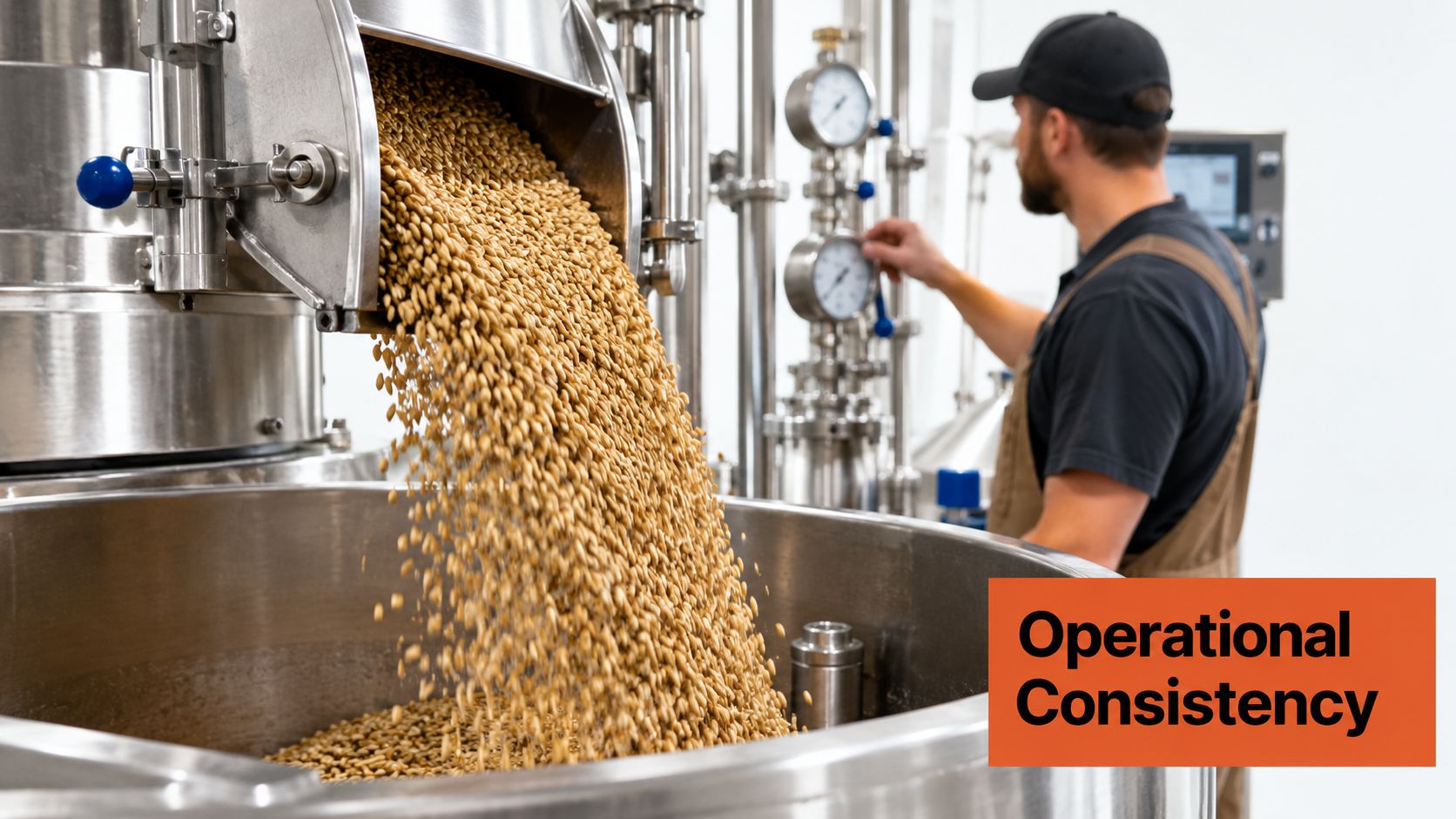
A brewery turns grain into a saleable beer through a chain of decisions. The first is recipe control. If the malt changes, the brewer needs enough information to protect the wort profile and fermentation target. That means checking deliveries, storing grain properly and monitoring brewhouse results rather than relying on the label alone.
The second is production consistency. The brewer measures the mash, wort and fermentation because packaged beer must taste like the beer customers ordered, whether they bought it at the venue or online. A stable process helps the brewery manage body, bitterness, alcohol strength and carbonation without making promises the beer can't support.
Spent grain is part of the operating model
Brewing leaves behind a substantial wet, fibrous residue. Australian brewers' spent grain is estimated at around 500,000 tonnes per year, according to this industry report on spent grain handling. One industry specification describes the material as roughly 22% dry matter, with about 22% protein and 49% sugar on a dry-matter basis.
That composition explains why removal, dewatering, drying or reuse can't be treated as an afterthought. Wet residue spoils quickly, takes space and costs money to move. A brewery that manages it well can reduce disposal pressure and make more credible sustainability decisions. The grain story continues after the mash tun.
Packaging changes the customer offer
Packaged beer adds another layer. A Queensland brewery may need to balance fresh stock, mixed packs, cartons, cold storage and wholesale orders while freight costs influence what customers are willing to buy. A single pack can be convenient, but a mixed carton may make delivery more practical for someone ordering from outside the immediate neighbourhood.
The public FAQ for Grainfed Brewing shows this dual model clearly, with venue beer alongside packaged beer, 24-pack cases and cold-stored delivery, as described in its delivery and product FAQ. The commercial lesson is straightforward: a grain claim attracts attention, but reliable stock, sensible pack architecture and good temperature handling turn that attention into a repeat order.
What Grain Fed Branding Signals to Buyers
“Grain fed” can speak to several real motivations at once. One buyer wants to support Australian agriculture. Another wants a beer with a firm malt structure. Someone else is looking for a fresh local product and wants confidence that a carton won't sit warm in a warehouse.
Those motivations are valid, but they need different evidence. Local pride calls for a stated malt or barley origin. Freshness anxiety calls for clear packaging and storage information. Curiosity calls for a description of the grain, hops, yeast and intended flavour. A single phrase can't answer all three.
Branding meets pack architecture
A brewery selling through a venue and a DTC shop has to explain more than the beer's name. Pack sizes, mixed-pack options, cold storage and delivery coverage shape the buying decision, particularly in Queensland where distance can make freight a meaningful part of the order.
A useful brewery unique selling proposition guide should connect the emotional story to something a customer can verify. Does the brewery state the malt source? Does it identify the beer's format? Does it communicate how the beer is handled after packaging? Those details are more useful than saying “premium” without support.
Code Cracker XPA '26 provides a concrete example of ingredient-led communication. The beer is the final result of Crack The Code '26, a South East Queensland beer hunt that united 7 breweries across six locations. Its listed recipe details include fresh barley from Cryer Malt, Nelson Sauvin, Rakau and Motueka hops from Clayton Hops, Neumaker Yeast AY04, an ABV of 4.8%, and 4-pack and single 440mL can formats.
Responsible storytelling matters
Alcohol marketing isn't just a caption on a social post. The ABAC Responsible Alcohol Marketing Code applies to marketing communications within a marketer's reasonable control, including digital content, social media, packaging, product names, competitions and point-of-sale material. Its standards cover both message and placement across Australia, as explained by ABAC's code overview.
That means a brewery can talk about grain, place, process and flavour, but shouldn't suggest beer creates success, changes someone's mood, or encourages rapid or excessive drinking. Queensland guidance also prohibits depictions involving people under 25, drinking before safety-critical activities and challenges to drink, as set out by Business Queensland's alcohol advertising guidance.
How to Read Grain Fed Claims Like a Smart Drinker
Start by treating the phrase as a prompt, not a conclusion. A good claim gives you enough detail to understand what the brewery means and decide whether that matches your preferences.
| Indicator | What It Suggests | Why It Matters |
|---|---|---|
| Named malt or barley origin | The brewery can explain part of its supply chain | Provenance becomes checkable rather than implied |
| Grain description | The brewer has identified the role of the malt in the recipe | You can anticipate body, colour or malt flavour |
| Consistent beer information | The brewery tracks recipe and production outcomes | Batch variation is less likely to surprise you |
| Storage and freshness details | The brewery understands packaged-beer handling | Temperature and time can affect the drinking experience |
| Clear pack formats | The offer is designed for venue, takeaway or DTC buying | You can choose a quantity that suits your occasion and delivery |
| Gluten statement | The brewery distinguishes standard grain beer from gluten-free products | People with dietary concerns can make a safer decision |
Look for evidence, not romance
If a venue menu only says “grain fed”, ask what that means in that brewery. A useful answer might identify malted barley, Australian sourcing where applicable, or a specific flavour intention. A vague answer doesn't prove the beer is poor, but it gives you less information to work with.
For online buyers, check the product page for the packaged format, storage guidance, delivery conditions and ingredients. Freshness, consistency and transparency matter more than a rustic photograph of grain. They also help you compare an independent Queensland beer with a larger-market option on practical grounds.
Your own motivation matters too. You might be exploring new flavours, supporting a local business or choosing a fresh carton for a gathering. Buy the beer that fits your taste, budget and storage plans, and don't let “local” or “grain fed” pressure you into more alcohol than you intended.
Common Misconceptions About Grain Fed Brewing
Myth one, grain fed means guaranteed quality. It doesn't. Grain is a foundation, but brewhouse control, water treatment, yeast health, packaging and storage determine whether that foundation becomes a clean and enjoyable beer.
Myth two, grain fed means gluten-free. Standard malted barley contains gluten, so the phrases describe different brewing approaches. A drinker with gluten sensitivity should look for a specific gluten-free statement and ask the brewery for the information they need, rather than interpreting “grain” as a safety claim.
Myth three, local grain automatically makes a beer better. Australian supply is substantial, with more than 2 million tonnes of malting barley produced by Australian farmers each year for brewing in Australia and overseas, according to the Brewers Association economic contribution report. That establishes a strong pipeline, not a guarantee that every lot or recipe will suit every drinker.
Myth four, adjuncts always mean inferior beer. A brewer can use an adjunct deliberately to adjust body, fermentability or style. The sensible test is whether the ingredient serves the recipe and whether the brewery communicates the beer openly.
A good beer doesn't need a fog machine around its ingredient list. It needs a clear recipe, careful production and a format that reaches you in good condition.
Making Smarter Choices at the Tap and Online
At the tap, ask yourself what you are really chasing. If you want malt flavour and a fuller grain profile, ask whether the beer is built around pale malt, specialty malt or another cereal input. If freshness is the priority, choose a venue with good turnover or ask when the packaged beer was stored and released.
Online, the decision becomes more practical. Look at the stated ingredients, pack size, storage information and delivery terms before you add anything to the cart. A mixed pack may suit an explorer who wants variety, while a single style may make more sense when you already know what you like. Neither choice is more virtuous. It just needs to match the occasion and the logistics.
Use four words as your filter:
- Provenance: Can the brewery explain where its grain or malt comes from?
- Process: Does it describe the beer in terms of recipe and brewing rather than vague quality language?
- Freshness: Is packaged stock handled in a way that protects the intended flavour?
- Responsibility: Does the marketing invite informed choice without encouraging excess, pressure or unsafe behaviour?
A grain fed brewery can be a cracking example of how farming, malting, brewing and local distribution connect. But the phrase should help you ask better questions, not make the decision for you. Choose the beer that matches your palate, buy an appropriate amount, and enjoy it slowly and responsibly.
Carbon 6 Brewing Pty Ltd brews and packages independent craft beer from Stapylton on Queensland's northern Gold Coast, with venue, local wholesale and direct-to-consumer options. Visit Carbon 6 Brewing Pty Ltd to explore the current range and choose a beer based on its ingredients, format and freshness details.