

500ml Can Cooler Guide for Aussie Craft Beer
Oct 04, 2026
You've cracked a fresh craft beer beside the pool, at the footy, or halfway through a barbecue. The first sip is bright and properly cold. Then Queensland does what Queensland does. The can sits in the sun, condensation runs over your hand, and the beer loses the crisp edge that made it worth ordering from an independent brewery in the first place.
A 500ml can cooler is more than branded merch. The right vessel slows the warming process, protects your grip, and gives a bigger can a stable home while you take your time with it. That matters when you've paid for distinctive malt, hop character and careful packaging, rather than treating the beer as something to skull before it gets warm.
What a Warm Tinnie Really Costs
A warm tinnie fails gradually while you're talking, cooking and reaching for another snag. Aromas soften, bitterness feels heavier, and the refreshing finish suited to the afternoon starts to fade. With a flavour-driven beer, that shift can make the drink feel unbalanced even though the beer itself is sound.
Independent brewers put careful work into how a beer should present when it reaches your lips. Temperature affects how quickly aromas lift, how bitterness registers and how comfortably carbonation carries the beer across the palate. A can left against a hot esky lid or held in a wet hand cannot preserve that intended profile.
That matters even more when the beer has travelled through direct-to-consumer shipping. The brewer has paid for packaging and freight to get a fresh product to your door, while Queensland heat can begin undoing that work once the can leaves the fridge. A cooler is part of the serving setup, not an afterthought added for a logo.
Why the final half matters
The first mouthful benefits from refrigeration. The final half has to deal with the weather. That gap is noticeable with a 500ml can, because there is more liquid to finish and more time for the aluminium to absorb heat from surrounding air, your hand and nearby surfaces.
A cheap foam holder still suits a quick drink at a crowded event. It cushions the can and provides a dry grip. Its performance drops when the fit is loose, the foam has compressed or the can sits exposed above the holder for most of the session. If the sleeve only surrounds the lower section, the uncovered aluminium remains in direct contact with hot air and sunlight.
Practical rule: choose the cooler around the can you actually drink, not the can size you wish every brewery used.
Protecting the drinking experience
A good holder protects the practical side of the ritual. It limits condensation, reduces wet rings on outdoor furniture and gives you a firmer grip when your hands are greasy from the barbecue. Those details matter when you're carrying food, opening a gate or setting the beer down on a damp table.
The Australian-made can cooler from Didgeridoonas uses 100% Australian wool insulation and premium oilskin, and its listing says it keeps a cold stubby or can chilled “for hours”. It is designed for standard cans, stubby bottles and long-necks, reflecting the mixed formats Australian drinkers encounter (the Australian can cooler). The practical takeaway is straightforward: assess insulation, material, fit and intended format together. A cooler that keeps the vessel stable and the beer cold for longer helps the brewer's intended flavour survive the whole drink.
Thermal Science In The Queensland Sun
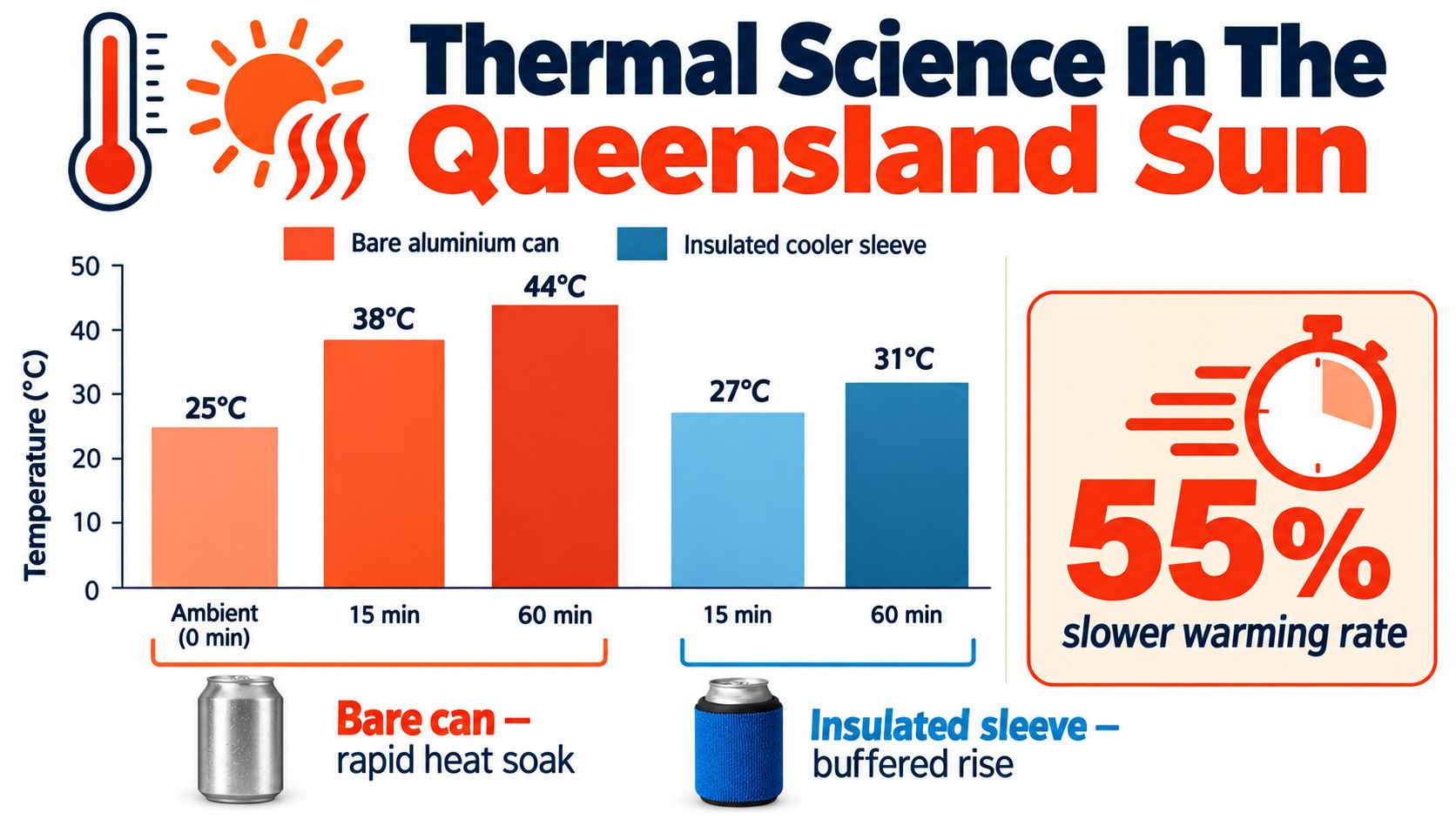
A cold 500ml can can turn warm quickly on a Queensland afternoon. Leave it on a picnic table, in direct sun or beside a hot barbecue, and the aluminium transfers heat into the beer. For a brewery shipping direct to Australian drinkers, that matters beyond comfort. The cooler helps protect the flavour profile the brewer intended from the brewery to the final sip.
Marketing claims such as “keeps it cold for hours” give little usable information. The practical question is how quickly the drink warms under a defined load, especially when the can faces high ambient heat and direct sunlight.
An Australian outdoor test measured a 500ml can inside an insulated vessel rising from 3.2°C to 4.1°C in 60 minutes, while an uninsulated can rose from 3.3°C to 17.9°C over the same period (Australian 500ml can cooler performance test). The test gives buyers a useful comparison: the insulated system changed little, while the bare can moved rapidly towards a warm-drink temperature.
What the walls are doing
A sealed outer shell and low-conductivity walls reduce heat exchange at the can surface. Warm air has fewer opportunities to transfer heat into the aluminium and the liquid inside. A well-designed rigid cooler also limits heat transfer from your hand, which can warm the can where you hold it.
Copper and stainless composite construction may reduce that transfer further, depending on the engineering. The label matters less than the result. The cooler needs to create a consistent barrier around the can and hold it securely, without exposed gaps that let hot air reach the vessel.
Brewery products sent directly to Queensland customers should account for high UV, high ambient conditions, condensation and oversized cans. Materials need to tolerate repeated use at beaches, campsites and barbecues. A cooler that fails after a few outings does little to preserve the value of a carefully brewed beer.
How to read a performance claim
Ask for the starting temperature, test duration, can volume, ambient conditions and whether the can sat in direct sun. Without those details, “cold for hours” remains a broad promise rather than a comparison you can apply to your own conditions.
Rigid holders usually provide stronger structure and thermal resistance through stainless construction and multiple insulation layers, but that protection adds bulk and empty weight. A heavier vessel also takes more room in a crowded esky, so the trade-off is practical, not purely technical.
For a soft neoprene option designed around a larger format, the Carbon 6 Stubby Cooler is specified for standard 440ml cans and is also intended for larger limited releases. Judge it by fit, hand comfort and portability rather than comparing it directly with a vacuum-insulated rigid vessel. For serving and storage guidance, see beer temperature and storage advice.
Insulation Materials And Build Quality
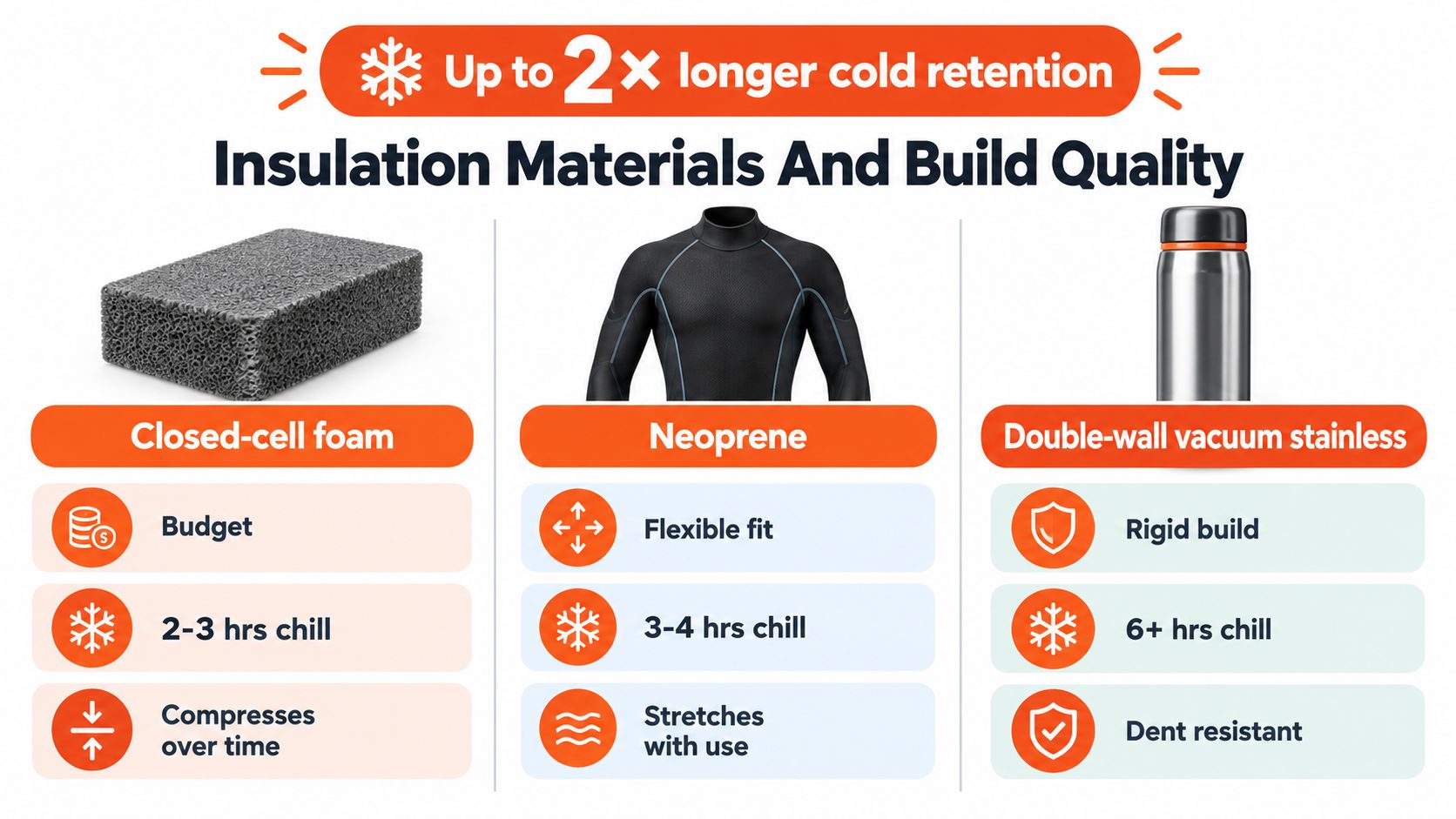
The cheapest holder and the most engineered cooler solve different problems. A closed-cell foam sleeve is light, inexpensive and easy to squash into a bag. Neoprene adds flexibility and a closer, more forgiving fit. A double-wall vacuum stainless vessel brings a rigid structure, stronger protection and greater thermal mass, but it takes up more space and costs more to manufacture.
The mistake is treating those options as direct substitutes. A soft holder works well when you're moving between the esky and your chair, sharing branded merchandise at an event or drinking the can promptly. A hard-shell model makes more sense when the same drink needs protection through a long afternoon outdoors.
Soft materials suit movement
Foam is forgiving, but it can compress and lose its original grip. Neoprene stretches around different cans and feels comfortable in the hand, though repeated use can change the fit. Both materials help control condensation, but neither should be expected to perform like a sealed rigid vessel if the top of the can remains exposed to hot air.
Soft construction wins on packability. It can be pushed into a tote, slipped beside ice and folded around other gear. That matters for a Gold Coast beach day when every item competes for room. It also makes soft holders practical for brewery merchandise, where the object needs to be useful without becoming a bulky piece of kit.
Rigid construction suits long sessions
Double-wall vacuum stainless steel is more resistant to crushing and can provide a stronger thermal barrier. It also gives you a stable base and can be easier to wipe clean, although finishes and seals vary by product. A rigid vessel may be the better choice for a patio, campsite or home bar where the cooler stays upright and gets used as a reusable drinking vessel.
Look at the lid, base, wall junction and internal diameter, not just the headline material. A premium wall paired with a sloppy fit still lets the can move and leaves an air gap where you don't want one.
Build-quality test: if the can rattles, the cooler is doing less work than its material list suggests.
Condensation control is another practical separator. A properly insulated outer wall keeps your hand dry and prevents the cooler from transferring moisture to a timber table. If you're comparing drinkware for a broader outdoor setup, this guide to finding a seat cushion cooler is useful because it shows how insulation design changes when the product also has to function as seating equipment.
For brewery owners and drinkers comparing formats, beer bag cooler options are worth considering when portability and group storage matter more than a single-can rigid fit.
Navigating Australian Can Sizes And Fit
Australian coolers need to handle more than one format. Retail listings commonly use 355ml as a reference can size, with one major Australian retailer explicitly stating “1 can = 355ml” for a 24-can insulated cooler. Another Australian listing describes a stubby holder for standard cans in the 355ml to 375ml range, with a claimed outdoor cooling period of up to 3 hours (Australian insulated cooler sizing).
That makes the familiar 375ml tinnie an important reference point, but it doesn't settle the question for craft beer drinkers. Independent breweries also use 440ml and 500ml formats, and a cooler that fits one of those poorly can leave the most valuable part of the drink exposed.
Check the can before buying
Use this simple process:
- Measure the actual can. Check height and diameter from the product listing or the can in your fridge. Don't rely on the nominal volume alone, because two cans with the same volume can have different proportions.
- Read the cooler's internal dimensions. External measurements include insulation and won't tell you whether the can reaches the base or sits securely below the rim.
- Check for movement. A little tolerance helps insertion, but a large gap allows the can to rock and reduces the value of the insulation around its sides.
- Confirm the opening. A narrow neck can reject a wider craft can even if the body appears tall enough. A flexible rim can accommodate variation, while a rigid opening demands more precision.
- Test the full range you buy. If your fridge holds 375ml lagers, 440ml releases and 500ml specials, don't purchase for only the smallest format.
Fit affects use as much as warmth
A snug base stops the can sliding when you lift the cooler. A stable rim reduces knocks and makes it easier to drink while standing. Adjustable bases and gasket-style seals can help, but they add moving parts that need cleaning and may be unnecessary for a simple neoprene sleeve.
Don't assume a product called a “stubby cooler” is designed for every Australian can. Ask the seller for the intended format, then match that information to your regular brewery purchases. The right choice protects both the drink and the money you spent on a mixed pack.
The Economics Of Direct To Consumer Beer
Direct-to-consumer craft beer changes the value calculation. Buyers often combine cartons or mixed packs to make delivery feel worthwhile, then receive a larger order intended for several sessions rather than one evening. A reusable cooler becomes part of that wider purchase decision because it can improve the experience long after the original shipment is empty.
That doesn't mean every buyer needs stainless steel. A premium rigid cooler may be excessive for someone who drinks beside the fridge and wants a lightweight sleeve for the walk to the barbecue. It can make more sense for someone who regularly takes a 500ml can outdoors, wants a stable vessel and will use it for water or other cold drinks as well.
Pay for repeated use, not a logo
The useful comparison is between reusable function and short-lived convenience. A foam holder may be the sensible choice for bulk event gifting, promotional distribution or a one-off gathering. A durable cooler earns its place when it gets washed, packed, carried and used across many occasions.
The sustainability question is practical rather than performative. A product that survives repeated use avoids the need to replace it whenever the foam collapses or the stitching fails. A stainless cooler may also serve as a 500ml tumbler, which broadens its purpose beyond holding a can. That dual use helps justify shipping space and ownership more convincingly than branding alone.
Consider the delivery experience
A brewery can add a cooler to a DTC offer without pretending it replaces refrigeration. The cooler protects the beer once the customer opens it. The beer still needs to arrive through an appropriate delivery process and be stored responsibly at home.
For Australian online alcohol sales, Retail Drinks states that same-day unattended alcohol deliveries aren't permitted under any circumstances. It also requires specific unattended-delivery instructions for non-same-day unattended deliveries, collected at checkout and passed to delivery agents (Retail Drinks Code of Conduct). That operational detail matters when a brewery designs its delivery promise and communicates what happens after the parcel leaves the brewery.
Carbon 6's discussion of direct-to-consumer e-commerce fits the same practical principle. The product, packaging and delivery process should work together, with the cooler presented as a reusable part of the drinking routine rather than a disposable extra.
Care Cleaning And Practical Accessories
A cooler that smells of old beer has usually been stored before it was properly dry. Rinse the inside after use, remove any sugary residue and let the product breathe before it goes back into a cupboard or esky. This matters even more in Queensland, where warm, damp conditions can make trapped moisture unpleasant quickly.
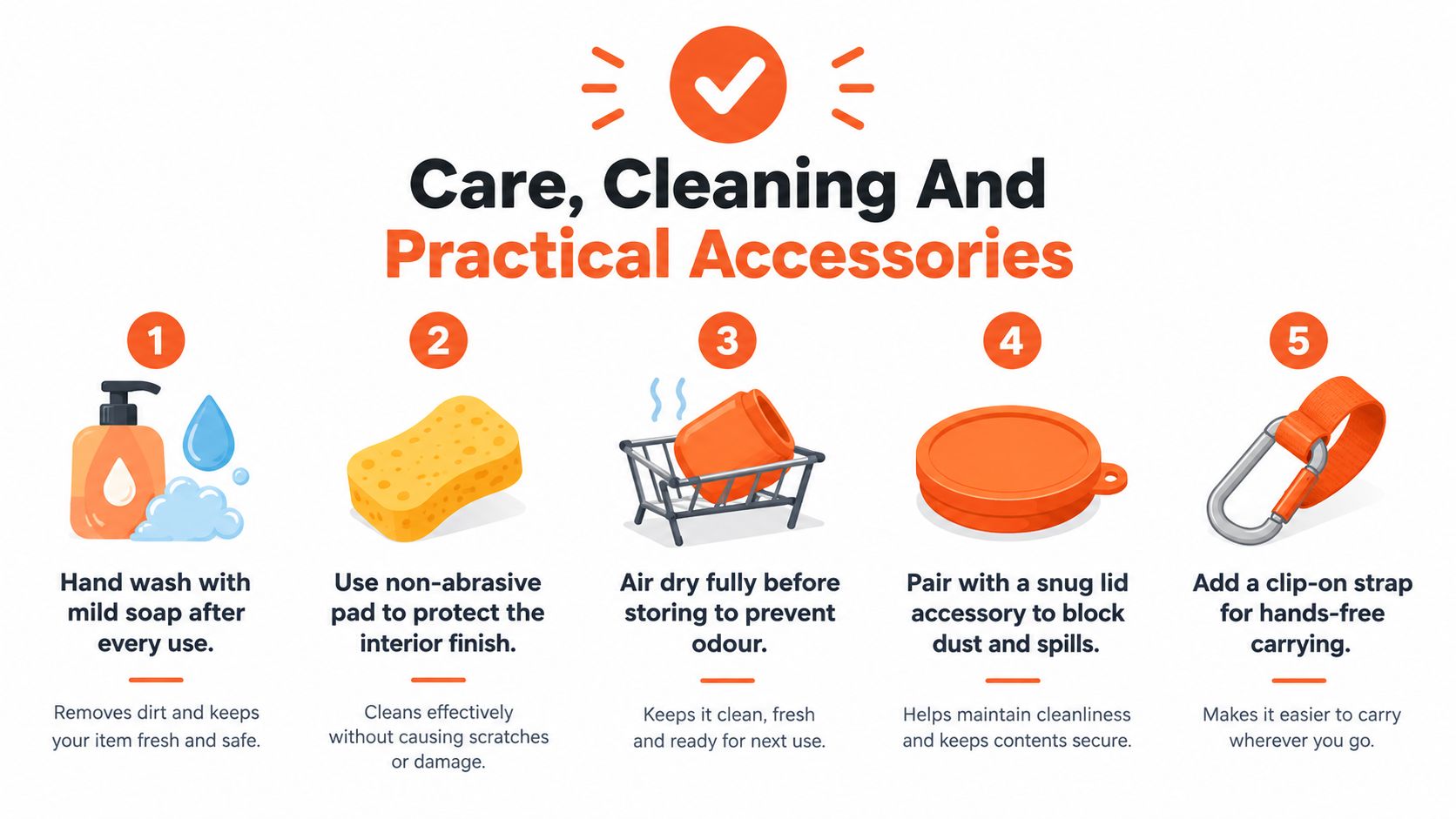
Follow the maker's cleaning instructions first. Some rigid coolers are dishwasher safe, while others need a gentle hand wash to protect seals, coatings or vacuum construction. Soft foam and neoprene generally benefit from mild soap, a non-abrasive cloth and thorough air drying rather than aggressive scrubbing.
A short care routine
- Rinse promptly: Clear beer, foam and condensation from the interior before residue dries.
- Wash gently: Use mild soap and a soft pad, especially on printed or coated surfaces.
- Dry completely: Leave the cooler open and allow air to reach every seam before storing it.
- Inspect the fit: Check that the base, rim and stitching still hold the can securely.
- Pack it sensibly: Don't crush a rigid cooler or bury a damp soft sleeve under wet towels.
A reusable flip lid is a useful companion at the beach or campsite. It keeps flies, dust and sand away from the opening while letting you sip without balancing a loose cover on the esky. A clip-on strap can also free one hand when you're carrying food, a towel or a tackle box.
Outdoor drinkware has a surprisingly broad support ecosystem, and this overview of what sits behind every bar is a useful reminder that cleaning, storage and serving accessories all affect how reliably gear performs.
The best accessory is the one you'll actually use. A lid that is awkward to clean becomes a nuisance. A strap that pulls the cooler sideways can make a full can unstable. Keep the setup simple, washable and compatible with the can format.
Choosing The Right Cooler For Your Lifestyle
Start with the session, not the marketing claim. If you're carrying a 500ml can from the fridge to the backyard and drinking it promptly, a flexible neoprene holder may provide the right mix of grip, condensation control and low bulk. If the can will sit beside you through a long, exposed afternoon, a rigid double-wall vessel deserves closer attention.
Match the build to the job
| Your drinking setup | Sensible priority | What to check |
|---|---|---|
| Beach or barbecue | Light weight and secure grip | Flexible fit, dry-hand comfort and easy cleaning |
| Camping or fishing | Protection and thermal buffering | Rigid construction, stable base and resistance to knocks |
| Home patio | Condensation control and appearance | Upright balance, wipe-clean exterior and comfortable rim |
| Mixed craft formats | Versatility | Internal dimensions that suit 375ml, 440ml and 500ml cans |
| Events or bulk gifting | Packability and cost control | Compressible construction, durable stitching and simple care |
A rigid cooler isn't automatically better. It may last longer in rough conditions, but its weight and storage footprint can become irritating if it spends most of its life in a drawer. A soft sleeve isn't automatically cheap in performance terms either. A well-fitted neoprene holder can be the most practical answer for regular movement and quick access.
Keep responsible marketing in the picture
If a brewery sells a cooler with alcohol branding, its copy still needs to follow the Australian alcohol marketing framework. ABAC applies to digital and social communications, packaging, product placement and other marketing formats, with compliance assessed through pre-vetting, complaints and enforcement pathways (ABAC Responsible Alcohol Marketing Code).
The code aims to keep alcohol marketing consistent with the National Alcohol Strategy and avoid encouraging minors to consume alcohol. Its Parts 3 and 4 apply to all alcohol marketing communications (ABAC Responsible Alcohol Marketing Code PDF). Queensland guidance also says advertising and packaging must not encourage excessive or rapid drinking, irresponsible behaviour, alcohol use by people under 25, or the idea that alcohol creates success, status or a mood change. It must not show drinking before safety-critical activities such as driving, boating, machinery use or swimming (Queensland alcohol advertising guidance).
For adjacent drinkware ideas, a guide to a cold cup for smoothie bars shows how reusable vessels can be designed around portability and repeat use without tying the product to alcohol consumption. That is a useful standard for any cooler: make the object functional, durable and appropriate for the occasion.
The right 500ml can cooler respects the beer inside it. Choose the lightest construction that fits your cans, handles your climate and suits the way you drink. A Gold Coast afternoon is hard on a warm tinnie, but a properly matched vessel gives the beer a fair chance to finish the way the brewer intended.
Carbon 6 Brewing Pty Ltd makes independent craft beer and practical can gear for drinkers who care about how their beer arrives and how it drinks outdoors. Visit Carbon 6 Brewing Pty Ltd to explore its beer range and can-focused accessories for your next Queensland session.