
Local Brewing Company Guide for Queensland Beer Lovers
Sep 13, 2026
You're standing in a Gold Coast bottle shop with a carton in one hand and a decision to make. Do you grab the familiar national brand, or drive to a Stapylton taproom where the beer may have been canned only days ago? Both choices can suit the occasion, but they offer very different connections between the brewer, the beer and the person drinking it.
A local brewing company isn't a business with a nearby address. It has a production base, a traceable supply chain, people who make decisions close to the drinker and a relationship with the community around it. That relationship can affect freshness, variety, buying convenience and the way an independent brewery earns a place beside much larger beer companies.
Queensland has built a particularly strong independent brewing culture. A Queensland government craft beer strategy reported nearly 90 independent craft breweries, around 1,700 employees and about $62 million in annual economic contribution during the period it examined, with revenue growing at 9.7% a year between 2013 and 2018. The strategy also recorded Queensland's share of Australia's craft beer market rising by more than 9% over that period. (Queensland's craft beer strategy)
This guide uses Carbon 6 Brewing in Stapylton as a practical example, while keeping the focus on a bigger question: how can Queensland drinkers make smarter, fresher and more responsible choices when buying local beer? You'll learn how to identify a local operation, understand what freshness and traceability mean in practice, compare taprooms with bottle shops and delivery, and support independent brewers without turning a good afternoon into a poor decision.
Introduction Why Local Beer Tastes Different
On a warm Gold Coast afternoon, a supermarket carton can be the easy answer. It's cold, familiar and ready to go. A visit to a local taproom feels different before you've even taken a sip. At Carbon 6 Brewing's Stapylton site, you're closer to the tanks, the people and the point where the beer enters the local supply chain.
That doesn't mean every beer bought from a bottle shop is old, or that every local beer will suit every palate. It means the distance between production and drinking can be shorter, and the story behind the can is easier to check. You can ask what's pouring, see where the beer was made and choose something that fits the day rather than settling for whatever happens to be on the shelf.
Local means more than nearby
For a drinker, local brewing is partly about geography, but it's also about visibility and accountability. An independent brewery can usually tell you where the beer was brewed, what style it is intended to be and which formats are available. That direct connection helps you make a choice based on flavour, freshness and occasion, not just packaging.
It also creates room for variety. A small Queensland brewery may produce a crisp lager for a barbecue, a hop-forward beer for someone who likes aroma, or a richer seasonal release for slow sipping. The point isn't to buy the most adventurous can every time. It's to have more say in what ends up in the esky.
Why the local decision matters
Independent breweries compete in a market where large producers have far greater reach. A purchase from a taproom, a local venue or a direct online order can therefore do more than fill the fridge. It can help keep money moving through local hospitality, distribution and service networks.
The useful question isn't “Is local always better?” A better question is “What matters for this occasion?” If you're after convenience, a nearby bottle shop may win. If you want maximum freshness and a conversation with the brewer, the taproom may be the better call. If you're planning a gathering, a mixed order may give you more choice without several separate trips.
By the end, you'll be able to judge a local brewing company on practical evidence, choose the right buying channel for your needs and support Queensland independents while keeping responsible drinking at the centre of the experience.
What Makes a Local Brewing Company Truly Local
A brewery earns the local label through more than a suburb name on a can. Start with where the beer is made, then look at who owns and operates the business, how the beer reaches you and whether the company has a real connection with its surrounding community.
Queensland's artisan producer licence provides a useful operational reference point. The licensed premises must have craft beer production as its main activity, with annual output between 2,500 litres and 5 million litres. (Australia craft beer market overview) That range allows a producer to operate at a small-batch level while retaining room to grow without abandoning the core brewing model.
A paddock-to-plate restaurant doesn't need to grow every ingredient itself, but you'd expect it to know where the food is prepared and how it gets to the plate. A local brewery doesn't need to source every raw material from the same postcode. It should, however, be able to identify its production site and explain its path from tank to can, keg or tap.
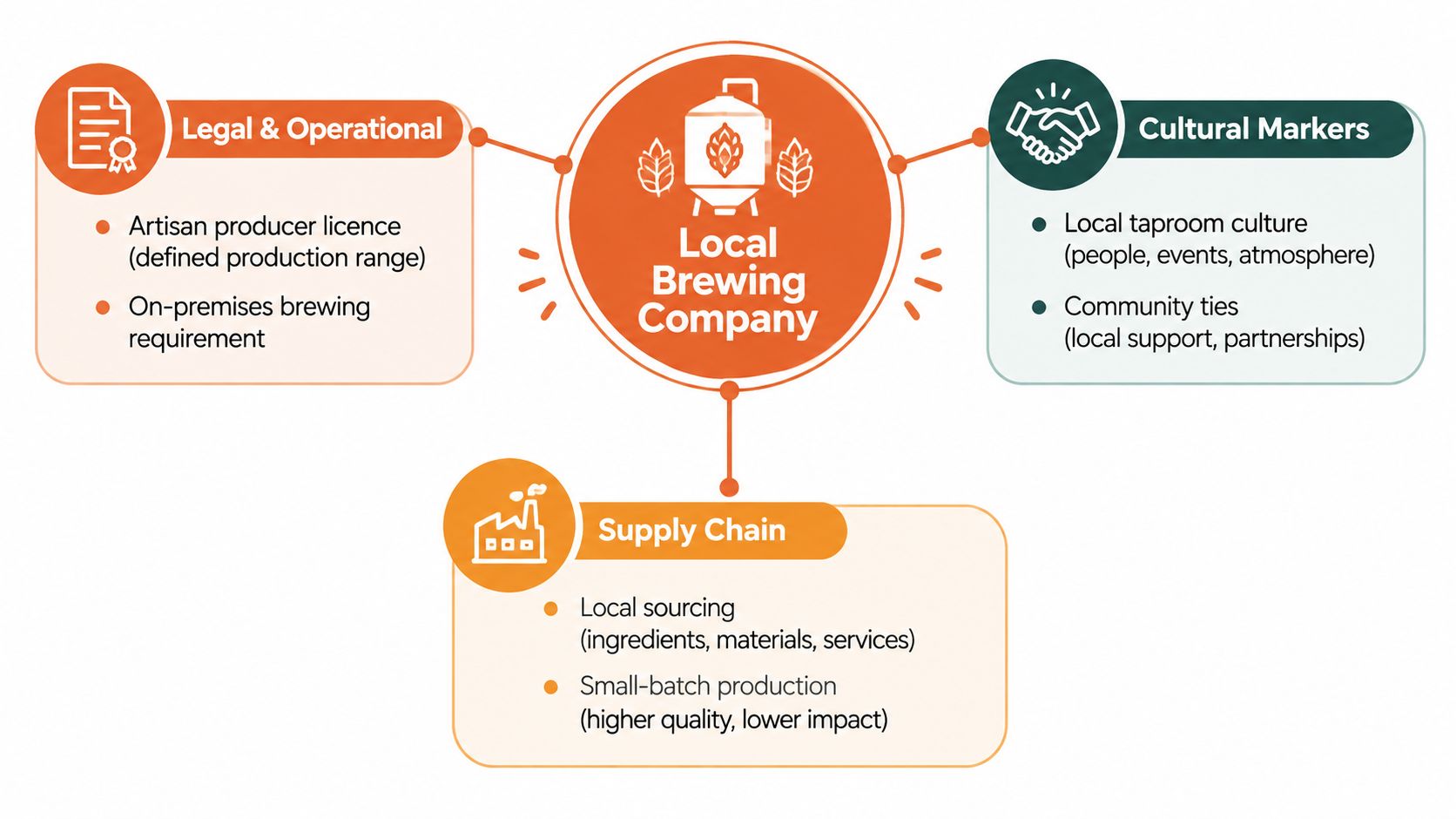
Three checks for a genuine local operator
Production check. Look for a clear brewing address and evidence that beer is produced there. A taproom attached to tanks, packaging equipment or a working brewhouse gives you a stronger connection than a label that only uses local imagery.
Ownership check. Independent does not mean tiny, and local does not automatically mean independent. An independent brewery makes its own commercial decisions rather than operating as a brand within a large multinational portfolio. If ownership is unclear, ask the brewery or check its published business information.
Supply-chain check. Freshness depends on handling after brewing as well as the brewing itself. Shorter routes can support regular tank turns, smaller production runs and direct sales, particularly when the brewery sells through its own taproom or online shop.
The product format can also reveal how a brewery serves its community. The Occasional Beer: WC Pils is described as a West Coast Pilsner with a lightly fruity, dry profile and 4.3% ABV, offered in selected pack formats including 4-packs and 16-packs, with a limited collector's six-pack featuring six label designs.
Culture is part of the test
A genuine local brewing company has contact with the place around it. That may mean a taproom, local wholesale relationships, events, staff who know the beer or customers who return because they recognise the people behind the product.
No single sign proves that a brewery is local. Taken together, on-premises production, transparent ownership, a traceable route to market and an active local presence give you a much more reliable picture than a slogan on a carton.
Freshness Traceability and Community Benefits Explained
Suppose you're choosing a mixed carton for a weekend barbecue. The useful question is not just whether the beer is local. It is how recently it was packaged, how it travelled and what information comes with it.
For beer, freshness means the time and conditions between packaging and drinking. Hop aroma, balance and brightness can change with handling and storage, so a short route from brewery to drinker can matter.
Freshness is flavour at the point where the drinker meets the beer.
Buying from a taproom, brewery shop or direct delivery service can reduce unnecessary movement through the supply chain. It cannot rescue a poor recipe, weak brewing practice, unsuitable packaging or warm storage. It does, however, give you a clearer way to choose beer that has spent less time passing between distributors.
Traceability builds confidence
Traceability answers practical questions: who brewed the beer, where it was packaged, which batch it came from and how it should be stored. That information helps whether you're picking up a few cans for cricket or ordering a mixed carton for friends.
Batch details also make comparisons easier. You can remember which beers suited you, ask useful questions and recognise the styles you want to buy again. Carbon 6 Brewing has published a practical guide to batch number tracking for breweries, explaining why production records matter beyond the brewery floor.
Direct-to-consumer buying has a practical Queensland advantage. A mixed carton can provide more variety than one bottle shop shelf and save a separate stop, particularly when the brewery offers delivery. For independent bottle shops, pubs and restaurants, clear product information and responsible, ABAC-compliant support can make local stock easier to present without encouraging irresponsible drinking. That helps smaller venues offer choice while keeping their service within the rules.
Community value is tangible
Queensland's early craft beer strategy connected independent brewing with employment and economic activity, including nearly 90 breweries, approximately 1,700 jobs and around $62 million in annual economic contribution during its reporting period. (Queensland craft brewing strategy) The local effect shows up in ordinary work: hospitality shifts, delivery routes, packaging, maintenance, events and suppliers.
The social value matters too. A taproom gives locals a nearby meeting place. A wholesale venue can introduce a new beer alongside a meal. A direct order supports the brewery while giving the customer a broader selection than the nearest shelf.
Match the benefit to the occasion
For dinner, convenience may matter most. For a long afternoon, food and a lower-strength option may suit better. A varied pack can help a group with different tastes avoid choosing one style for everyone.
Local beer creates value through those decisions. You buy a clearer route to the maker, better information about the product and a practical way to keep independent brewing connected to Queensland life.
Queensland and Gold Coast Brewing Scene Today
A mixed carton can make more sense than several bottle shop runs when you want variety, live nearby and can store the beer properly. That practical choice reflects Queensland's wider brewing scene, which has grown from a niche interest into a busy field of independent producers.
Queensland government reporting recorded nearly 90 independent craft breweries during its reporting period. The share of Australian beer-manufacturing enterprises located in Queensland rose from 15.7% in 2019 to 18.4% in 2024, while brewery numbers more than doubled since 2017. The same reporting also identified 69 Queensland members, an estimated $256 million economic impact and 4,413 jobs in 2021, with most independent breweries producing under 100,000 litres a year. (Queensland government industry statement)
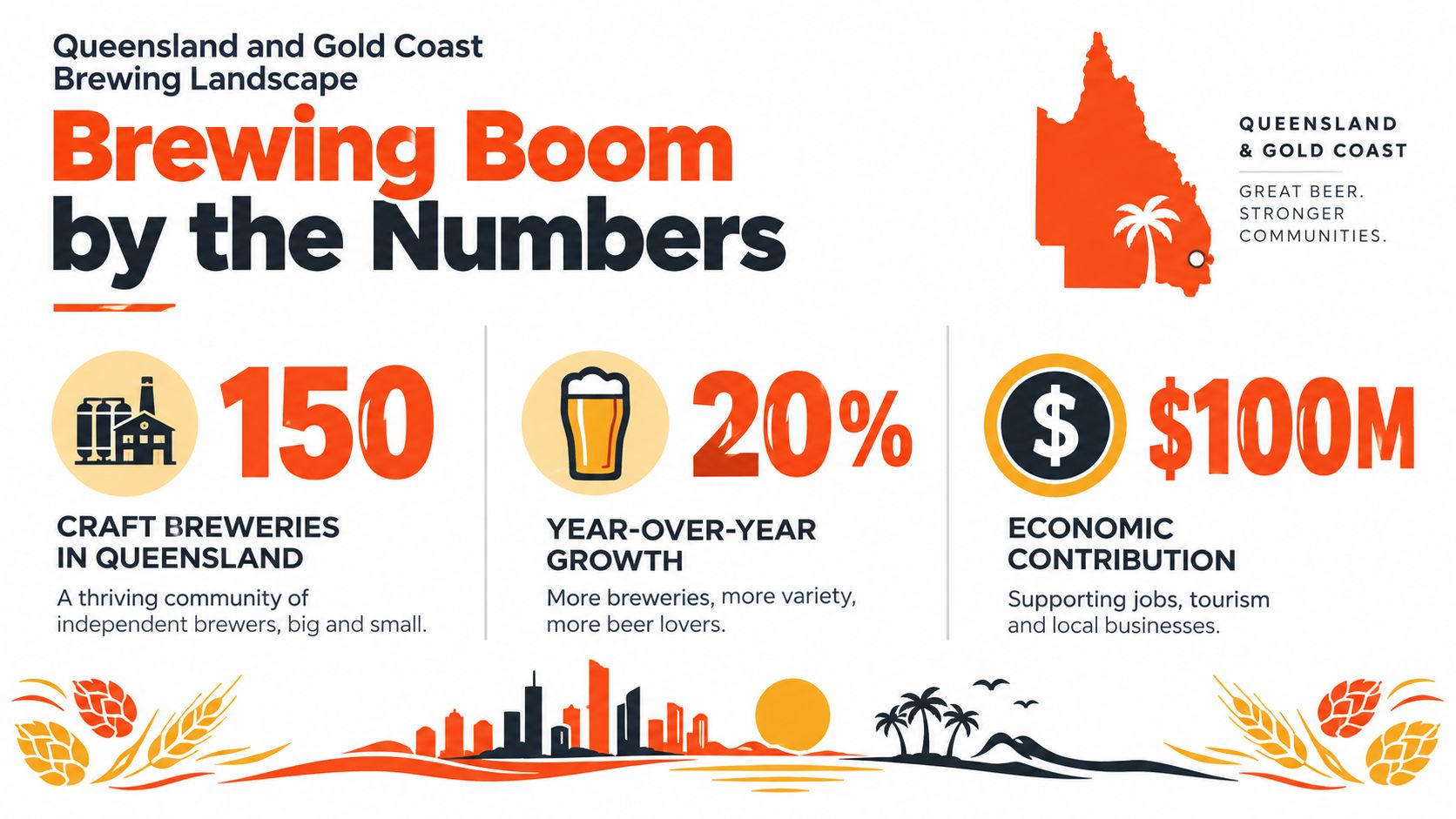
Small scale remains a defining feature. More brewing activity does not mean a few giant plants control the whole market. Many Queensland breweries still work in batches, serving nearby drinkers while building relationships with venues, retailers and direct customers.
Choice brings a buying decision
Australian craft beer production remains spread across many businesses. IBISWorld places the sector at about $1.9 billion with 578 businesses in 2026, with revenue growing at an annualised 6.8% over the past five years. (IBISWorld craft beer production data) For locals, that variety can mean more styles, clearer regional identities and a better chance of finding a beer suited to a particular palate.
For brewers, attention and shelf space are limited. Independent producers commonly compete through freshness, variety, local identity and premium positioning rather than a commodity price fight. Traceable stock and clear product information also help customers understand what they are buying and why a mixed carton may offer better value than separate trips.
Stapylton's northern Gold Coast location makes distribution a practical issue. Carbon 6 Brewing can serve visitors at the brewery while supplying nearby venues and shipping selected packs to customers who prefer home delivery. That gives people different ways to buy without cutting the brewery off from its local base.
Discovery happens online
Accurate online information helps breweries show what is available, where customers can visit and how to purchase responsibly. Businesses improving their discovery content may find a local guide to Instagram growth useful, provided promotions and ordering information remain clear and ABAC-compliant.
For locals planning a brewery outing, Carbon 6 Brewing's Gold Coast breweries guide can organise scattered searches into a practical route. The variety rewards comparison. You can consider styles, venue food, storage, delivery and responsible service before choosing where your next carton comes from.
How to Find and Support Local Breweries Near You
The right buying channel depends on the occasion. A taproom gives you the closest connection to the brewery, while a local venue adds food and conversation. A bottle shop suits a quick top-up. Direct-to-consumer delivery can work well when you want variety, enough beer for a gathering, or a mixed carton delivered home.
Use this table as a practical filter, not a hard rule.
| Buying Option | Best For | Freshness and Value Tip |
|---|---|---|
| Taproom visit | Tasting, meeting the team and seeing the local site | Ask what was packaged recently and buy only what you can store properly |
| Local wholesale venue | Beer with a meal or a social afternoon | Choose venues that rotate independent taps and keep stock cold |
| Bottle shop pickup | Convenience and a quick top-up | Check dates, storage conditions and whether the range includes Queensland independents |
| DTC online order | Mixed cartons, broader choice and home delivery | Compare delivery with your likely driving cost, and order enough variety to justify the trip or freight |
When a mixed carton makes sense
There is no single break-even pack size. Delivery fees, distance, vehicle costs and the order itself all change the result. The calculation is simple:
- Add the delivered order total, including any freight shown at checkout.
- Compare it with the local alternative, including fuel, parking and the value of your time.
- Check freshness and storage, because a cheaper carton loses its value if the beer arrives warm, sits warm or exceeds what you will enjoy.
- Choose a mixed format when possible, so the whole carton is not tied to one style.
For a gathering, planned tasting or household with established favourites, a larger order may make good sense. It is less useful for a casual purchase. If you only want a few cans tonight, a nearby bottle shop or taproom may cost less overall and create less waste.
Freshness also depends on the final handover. Ask how the beer was stored, check packaging information where available and make sure you have room to keep it properly at home.
Support the brewery without overbuying
Responsible support is not measured by how much alcohol you take home. You can visit during a quiet service, choose a local venue for dinner, recommend a brewery to an adult friend or ask a bottle shop to consider independent Queensland stock.
Digital support helps independents reach customers, provided the message stays responsible. The ABAC Responsible Alcohol Marketing Code covers brand advertising, competitions, social media, product names, packaging, advertorials, point-of-sale material, retailer advertising and marketing collateral.
Posts should not strongly appeal to minors, depict people under 25 years old, or encourage rapid or excessive drinking. They must not promote alcohol use before driving, boating, operating machinery or swimming. The Queensland liquor advertising guidance provides the local advertising and promotion requirements.
Clear, ABAC-compliant communication lets independent breweries explain freshness, mixed-carton options and local delivery without turning convenience into pressure. That balance helps customers make informed Queensland buying decisions and gives small producers room to build lasting local support.
Carbon 6 Brewing and What Award Winning Local Looks Like
A local brewing company becomes easier to understand when you look at a real brewery rather than a definition. Carbon 6 Brewing operates in Stapylton on the northern Gold Coast, with a model that combines direct customer sales and local wholesale distribution.
That matters because the two channels serve different occasions. A taproom visit can turn a purchase into a local outing. A direct order can suit someone planning a gathering or looking for a broader mix without making several bottle shop trips. Wholesale places the beer in venues where customers may discover it alongside food, conversation and other Queensland-made products.
Awards provide a useful quality signal
Carbon 6 Brewing says it was crowned Best New Brewery at the 2025 Royal Queensland Awards and received a substantial haul of gold, silver and bronze medals for its craft beers. (Carbon 6 Brewing's Royal Queensland Awards results) Awards don't replace your own taste, but they do offer an external signal that the brewery's beers have received repeated formal recognition.
That recognition is most useful when paired with a real drinking situation. A barbecue may call for something easy to enjoy over a longer afternoon. Carbon Mid Mid Strength Lager, listed at 3.0% ABV, is an example of how a local brewer can make a sessionable beer for that kind of occasion without reducing the choice to a standard mass-market lager.
A different gathering may suit a more expressive style, while a quiet evening may call for one carefully chosen can rather than a mixed carton. The award-winning point isn't that every beer suits everyone. It's that Carbon 6 has built a range broad enough for locals to explore while keeping production connected to its Stapylton base.
For shoppers, that creates a sensible decision path. Start with the occasion, check the style and strength, look at freshness information, then decide whether taproom pickup, wholesale purchase or direct delivery gives you the best overall value.
Your Next Steps to Enjoy Local Beer Responsibly
You're choosing a local carton for a barbecue, planning a venue's drinks list or deciding whether delivery beats another bottle shop run. Start with three checks: where the beer was made, who operates the business and how it travelled from brewery to your glass. A local label should make those details reasonably clear.
Match the buying method to the occasion. Visit a taproom for conversation and discovery. Choose a nearby venue when food and atmosphere matter. Bottle shop pickup suits a quick top-up, while direct-to-customer ordering can offer better value when a mixed carton gives you useful variety and delivery terms make sense. That option also lets you trace the purchase more easily back to the brewery.
Freshness and traceability support informed buying, not extra drinking. Store beer as directed, check age-verification requirements for online delivery and follow Queensland liquor rules. Marketing and promotions should not strongly appeal to minors, show people under 25 years old, or encourage excessive drinking, unsafe behaviour or alcohol use before safety-critical activities. Keep the relevant Queensland guidance in mind when supporting an independent brewery online or in your venue.
For hospitality operators, local beer can give a drinks list a clearer connection to the region. A venue comparing serving formats may find this practical guide to choosing a beer tower for restaurants useful for considering presentation, capacity and service before buying equipment.
Start with a small order. Ask a Gold Coast independent what is fresh, choose an amount you'll enjoy responsibly and note which styles suit your household or customers. Over time, those choices can make local beer part of Queensland life while helping independent brewers and venues build steady demand.
Carbon 6 Brewing Pty Ltd offers locally brewed craft beer from its Stapylton brewery through direct customer sales and local wholesale channels. Visit Carbon 6 Brewing Pty Ltd to explore the range, check current visiting and ordering options, and make your next local beer choice with confidence.