

Best Craft Beer Boxes for Aussie DTC Shipping
Sep 14, 2026
You've ordered a mixed carton from a brewery you discovered at a Gold Coast pub. The beers sounded excellent, the order confirmation looked polished, and you're ready to turn delivery night into a tasting session. Then the box arrives with crushed corners, dented cans and beer that's been sitting hot in the Queensland sun. The liquid may still be safe, but the experience has already failed.
That's the practical test for the best craft beer boxes in Australia. A DTC carton must protect heavy liquid, control avoidable freight waste, communicate freshness and make the customer feel that the brewery cared about the journey, not only the sale. For independent brewers, packaging is part of the product.
Why Your DTC Beer Carton Is Your Most Important Brand Asset
A customer buying craft beer online isn't only buying liquid. They're buying provenance, variety, discovery and a connection with an independent brewery. Australian consumer research describes craft beer buyers as people seeking flavour exploration, local identity, authenticity and novelty, with perceived quality often more important than choosing the cheapest option. Independent Australian consumer research on craft beer motivations supports the idea that a mixed carton is an experience, not a larger shopping basket.
That experience often starts somewhere else. On-trade venues, including pubs, bars and restaurants, still account for about 60% of Australia's craft beer market in 2025, according to Australia craft beer market analysis. A drinker may first taste a beer at a venue, remember the brewery, then order a carton at home. The shipping box becomes the final touchpoint in a journey that began over a taproom bar or a pub counter.
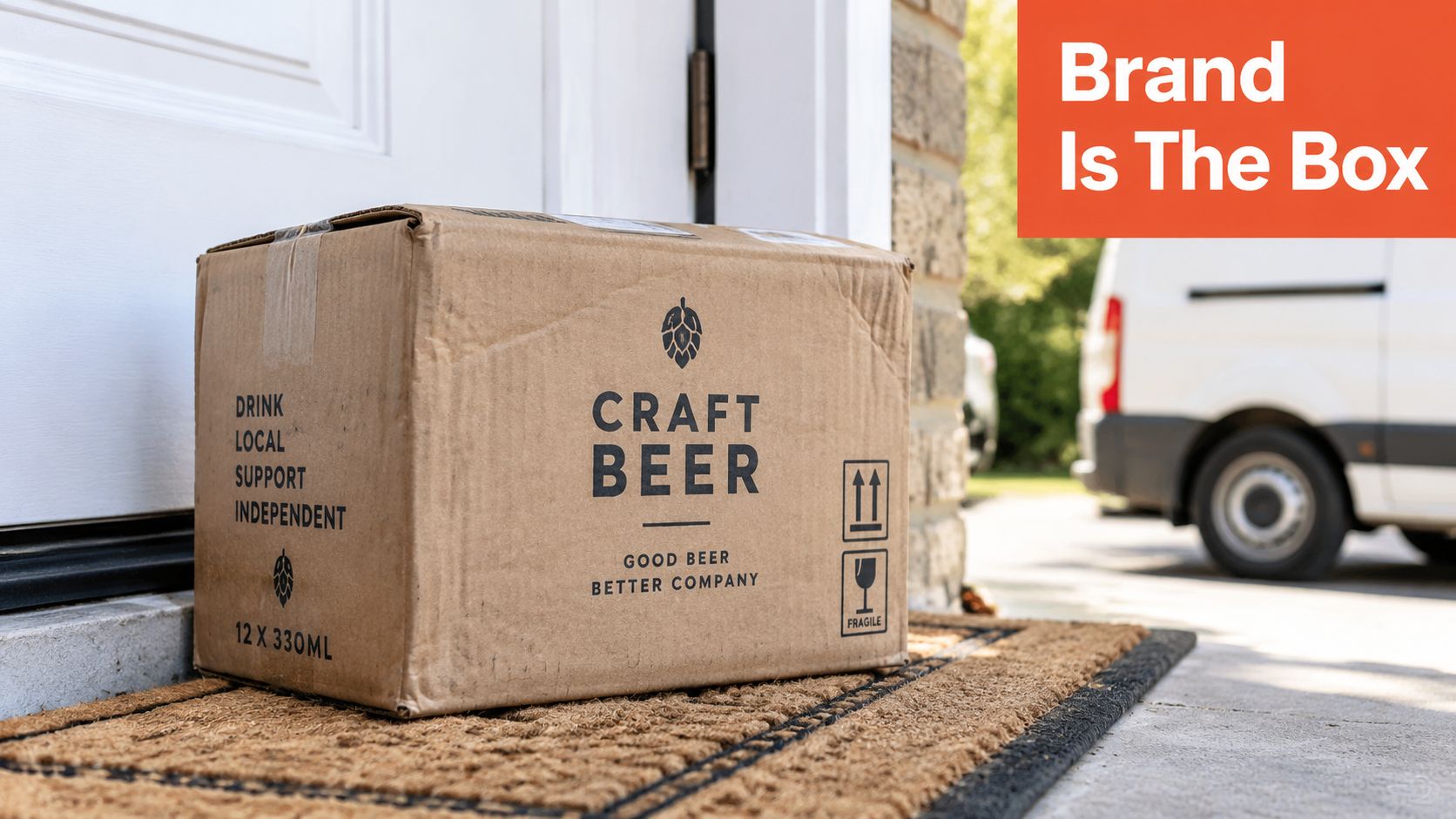
A damaged carton changes the customer's memory
A weak retail carton can look fine in a brewery warehouse and fail once it meets a courier network. Pallet movement, vehicle vibration, sorting equipment, wet weather and doorstep handling all test the box. Dented cans signal poor control, while a warm hop-forward beer can undermine the freshness promise the customer thought they were paying for.
Practical rule: Treat the carton as the customer's last tasting-room interaction. If it looks careless, the buyer may remember the packaging more vividly than the beer.
The strongest cartons do three jobs at once. They keep cans restrained, prevent the case from collapsing and present the brewery with enough clarity that the customer knows what they've received. A clean kraft finish, readable beer identification and a simple tasting prompt can turn opening the carton into a guided exploration.
Good product photography supports that same promise before purchase. When a brewery is developing pack concepts, the Bulk Image Generation product image tips can help teams plan consistent product visuals that show the carton, can arrangement and unboxing context accurately. That matters because the customer should see a realistic representation of what will arrive.
A beer box isn't a decorative afterthought. It protects repeat purchase, reduces complaints and gives the drinker a reason to share the experience with others.
Structural Realities of Australian Beer Freight
A beer carton designed for retail shelving is rarely ready for direct-to-consumer freight. Beer is heavy, rigid and vulnerable to impact, while courier networks add vibration, compression, sorting and wet-weather exposure. The shipping carton needs stronger compression performance, reliable internal restraint and enough tolerance for handling beyond the brewery or shop.
Australian suppliers commonly offer 4-, 6-, 12-, 16- and 24-bottle or can cartons. Twenty-four-pack cases are widely used as a freight benchmark for beer e-commerce, and Beer shipping cartons available in Australia shows how local packaging formats are built around these standard configurations.
Weight affects both freight cost and handling risk. A 24-pack is approximately 15 kg, while a 12-pack is about 7.5 kg, based on published beer-pack weight guidance. The carton should support the carrier's practical per-case limit without adding void space or excess board. Every unnecessary centimetre increases material use, storage demand or freight exposure.
Comparing carton formats
| Pack Size | Approx. Weight | DTC Suitability | Best Use Case |
|---|---|---|---|
| 4-pack | Not specified | Limited for standalone freight | Trial purchase, add-on or local delivery |
| 6-pack | Not specified | Suitable when the order has a clear premium or local-delivery rationale | Focused style discovery |
| 12-pack | Approximately 7.5 kg | Practical for mixed cases and moderate freight consolidation | Curated variety with manageable handling |
| 16-pack | Not specified | Strong balance between selection and carton efficiency | Brewery mixed packs and exploration-led orders |
| 24-pack | Approximately 15 kg | Freight benchmark for larger DTC cases | High-volume mixed cartons and repeat buyers |
Pallet dimensions also influence the carton specification. Australian beer packaging is commonly designed around the 1165 × 1165 mm Australian pallet standard, which helps suppliers improve layer efficiency and limit repalletisation and damage during warehouse movement. A carton that wastes pallet space can add cost before the carrier receives it.
What to ask a packaging supplier
Request board specifications, compression testing and a sample packed with the brewery's actual can format. Empty cans do not reveal how the carton behaves once loaded, taped and stacked. Check that dividers keep cans separated, the top panel remains flat under pressure and the board retains strength during wet handling.
Ask the supplier to measure the sealed case, not only its internal dimensions. External dimensions affect freight classification, pallet utilisation and storage density. A compact carton with low void space can outperform a larger-looking box that relies on filler, while still giving the mixed pack enough protection for the route.
Navigating the Cold Chain in an Australian Summer
Summer shipping requires honest planning rather than unrealistic promises. Insulation slows heat gain, but it doesn't create refrigeration. If beer leaves the brewery warm, an insulated carton can only delay the temperature rise. The most effective process starts before the box is sealed.
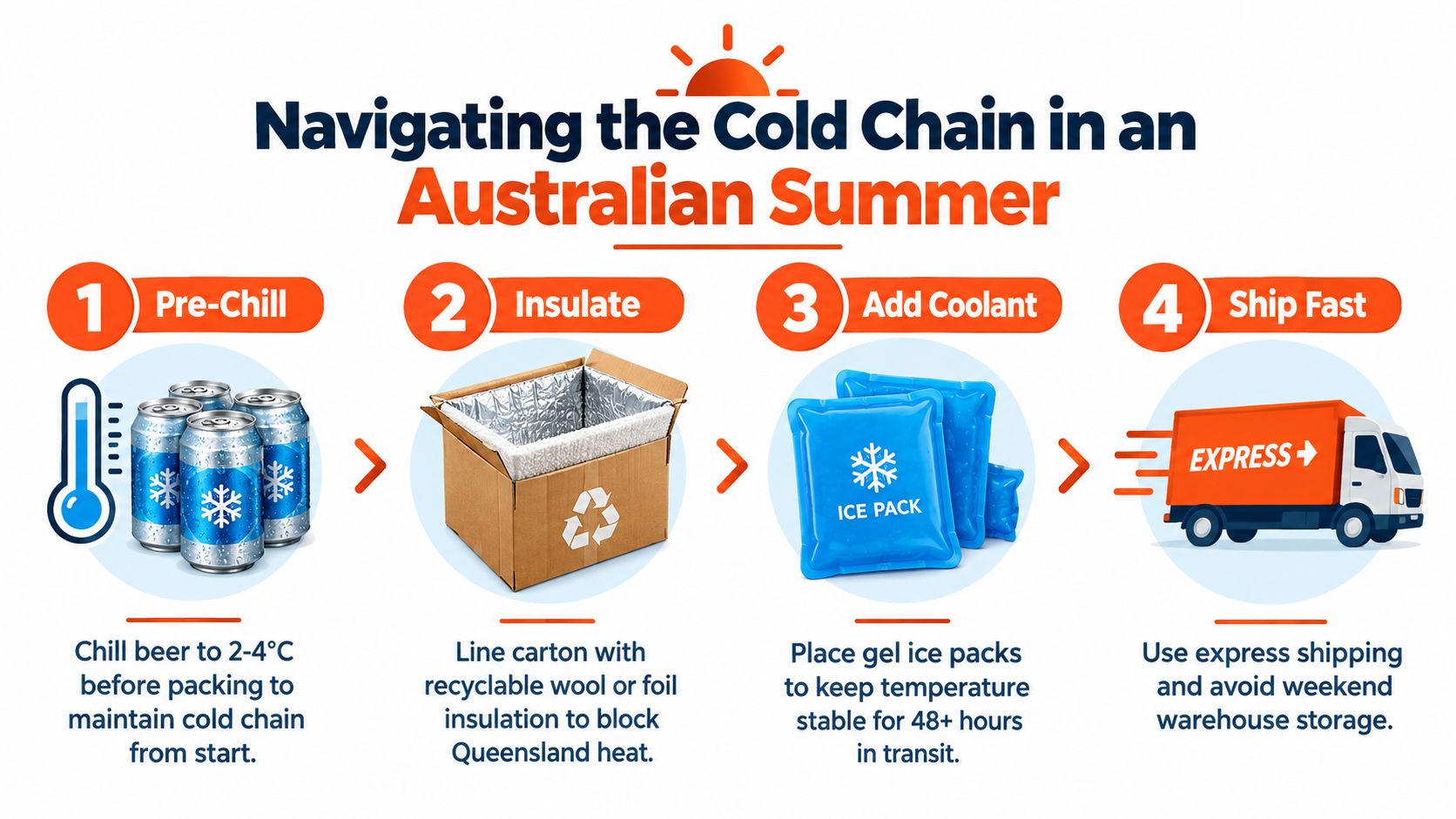
Build temperature control into the packing sequence
- Pre-chill the beer. Pack cans cold whenever the brewery's equipment and dispatch schedule allow. Starting cold gives the carton more thermal capacity before outside heat becomes a problem.
- Choose insulation for the route. EPS provides strong insulation but creates disposal and sustainability concerns. Wool or denim liners can offer a more recyclable presentation, while foil-faced materials reflect radiant heat. The right choice depends on the season, lane, pack size and delivery promise.
- Use coolant with restraint. Gel packs can stabilise temperature, but they add mass and occupy valuable internal space. They also don't replace a fast carrier service. The pack must keep cans secure while allowing the coolant to sit where it can influence the beer rather than merely touch the carton wall.
- Dispatch at the right time. Avoid sending temperature-sensitive orders into a weekend warehouse hold. Express freight can reduce exposure, but breweries should still communicate that transit conditions vary by destination and carrier.
Beer styles don't all respond to heat in the same way. Hop-forward IPAs and fruit sours can be especially sensitive to the freshness expectations attached to their flavour profiles, so a brewery may choose more protection for those releases than for a lager or porter.
For customer education, Carbon 6's guide to beer temperature and storage gives buyers a practical reference once the carton reaches home. The landing page should explain dispatch timing, delivery limitations and what customers should do if a parcel is delayed, without claiming a temperature outcome the brewery can't verify.
Set a promise the network can meet
Don't market every shipment as perfectly cold unless the brewery controls the entire route. A better promise is clear handling guidance, appropriate seasonal packaging and transparent dispatch communication. That approach protects trust because customers understand what the pack can and can't do.
The Economics and Appeal of the Mixed Pack
A customer ordering an unfamiliar craft beer faces a simple risk: committing to an entire carton of one style. A mixed pack lowers that barrier and turns the order into a guided tasting experience. The carton therefore supports both conversion and repeat purchase, provided the selection feels deliberate rather than assembled from leftover stock.
Australian buying behaviour supports carton-led offers. A national craft beer survey found that 68% of drinkers mostly buy six-packs, 54% also buy cases of 24, 42% buy 16-packs and 38% buy four-packs. It also found that 55% of core-range beers are purchased in four- or six-packs. These figures appear in the Queensland Government's Craft Beer Strategy.
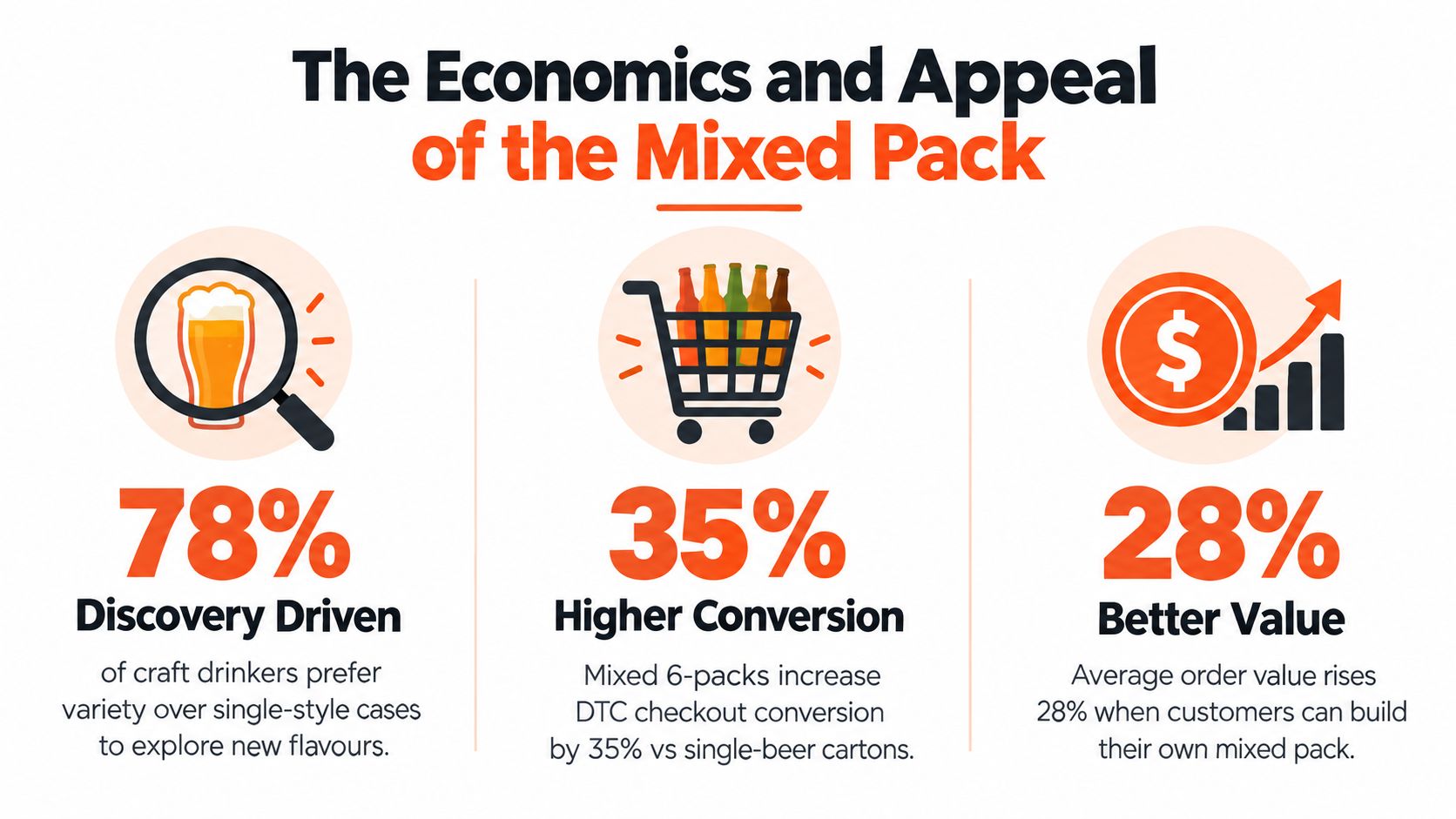
Pack size changes the value equation
A four-pack is easy to trial, but freight is spread across fewer cans. A six-pack suits a focused style selection and keeps the initial commitment approachable. A 12-pack gives the brewery room to introduce several styles without creating a difficult parcel to handle. A 16-pack can support a substantial tasting journey while remaining distinct from a traditional full case.
For repeat customers, the 24-pack has the clearest freight logic. At approximately 15 kg, it is a serious shipment, yet consolidation may cost less than sending several smaller parcels. Published freight structures commonly price by case, with some rate bands grouping Queensland with Victoria and South Australia. That makes the carton design and pack configuration part of the margin calculation, not merely a presentation choice.
For premium buyers, the cheapest carton isn't always the best value. A larger mixed pack can justify delivery when it provides meaningful variety, reliable protection and less risk of being left with a full case of one unfamiliar style.
The offer should make exploration straightforward. Name each style, explain the tasting sequence and identify substitutions before checkout. Customers can accept variation when the brewery shows that the selection has a clear purpose.
Carbon 6's guide to mixed beer packs in Australia can help explain why a curated selection works. The product page should then reduce the choice to a few clear options: a discovery pack, a focused style carton or a larger replenishment order.
Awards and quality cues may support the decision, but practical information closes it. Buyers still need to know what is inside, how fresh it is, how the carton is configured and whether the selection matches their palate.
Designing a Sustainable and Premium Unboxing Experience
Premium packaging doesn't require excessive plastic. It requires control. The carton should open cleanly, hold each can securely and use its available surfaces to explain the brewery's point of view.
A kraft board finish with restrained colour can feel more authentic than a glossy package covered in competing messages. Soy-based inks may support a more considered material story, but the practical test remains recyclability, print durability and how the finished carton performs after refrigeration, condensation and handling.
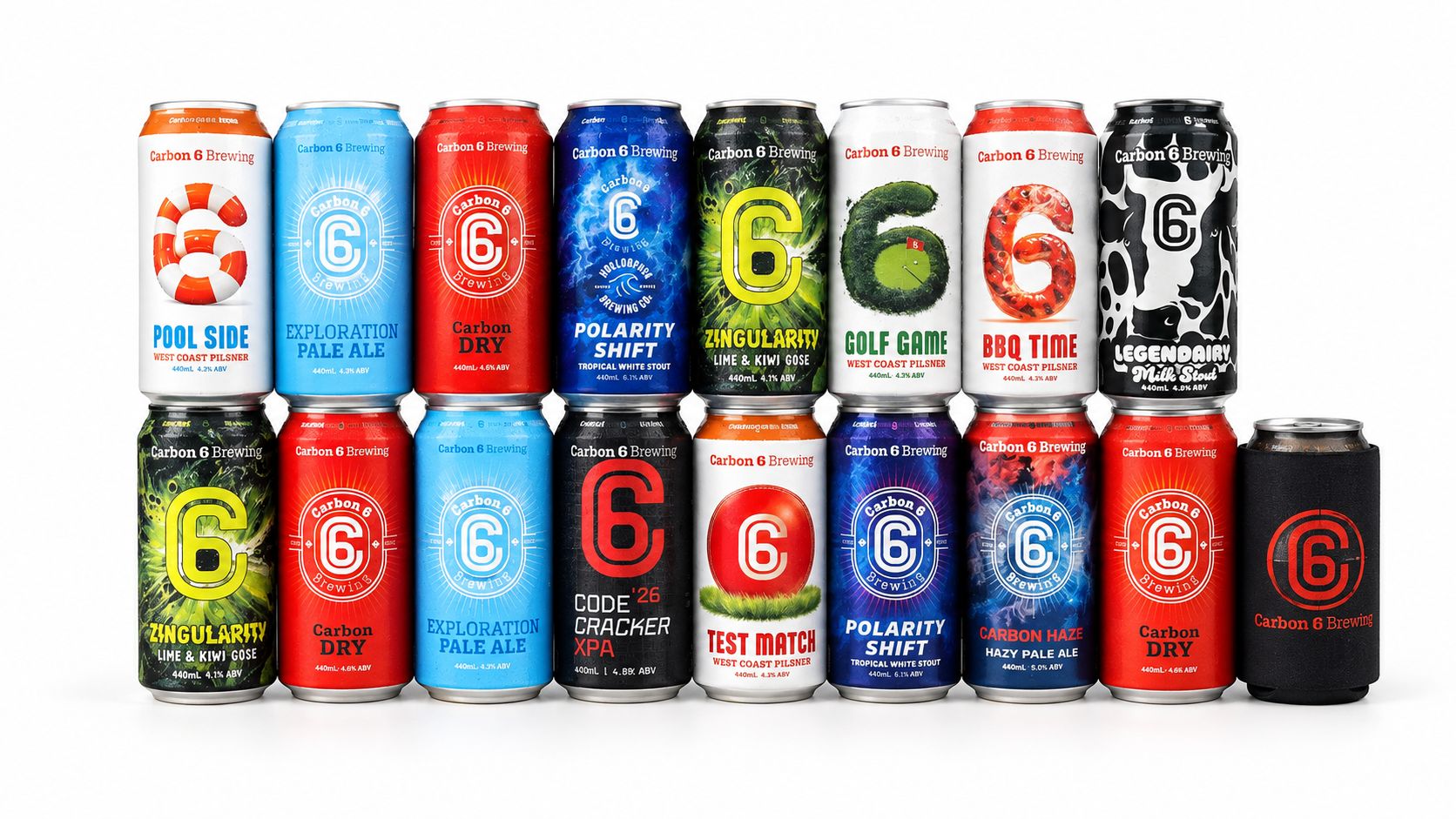
Engineer out the unnecessary extras
Bubble wrap and shrink wrap can create a sense of security, but they often add material without solving the central problem of can movement. Proper dividers, a snug internal fit and a correctly sized outer carton usually do more for protection.
The unboxing should also help the customer understand the beers. A printed panel can identify styles, suggest a tasting order or tell the story of an independent brewery based in Stapylton on the northern Gold Coast. That's useful content, not decoration, because it gives the buyer a reason to pause before opening the first can.
For teams testing concepts before committing to print, an AI packaging mockup generator can help compare carton artwork, label hierarchy and shelf or doorstep presentation. The mockup still needs to be checked against the physical dieline, board performance and print requirements.
Carbon 6's sustainable beer packaging guide for 2026 is a relevant companion for breweries weighing material choices. Sustainability claims should stay specific. Say what the carton contains, how customers should dispose of it and which components can be separated.
The Mixed 16-Pack is described as sixteen 440mL cans from Carbon 6's lineup, with a hand-picked variety of flavours and styles. The product information also explains that an unavailable beer may be substituted with another brew, and that the image is illustrative. That kind of disclosure helps a mixed pack feel curated without creating an expectation that every pictured can is guaranteed.
Marketing Your Beer Boxes Within Australian Compliance Rules
A common mistake is treating compliance as a website footer problem. In Australia, the ABAC Responsible Alcohol Marketing Code applies to communications generated by, or within a marketer's reasonable control, including brand advertising, competitions, social media, product names and packaging, advertorials, point-of-sale material and retailer advertising. The ABAC Responsible Alcohol Marketing Code should be part of campaign planning from the beginning.
The creative can still be persuasive. Focus on flavour, provenance, brewing method, pack contents and adult enjoyment in moderation. Avoid language that encourages rapid or excessive drinking, suggests alcohol drives achievement or mood change, or uses cues that strongly appeal to minors.
Digital placement needs evidence
Alcohol advertisements can only be placed alongside content where reliable data shows at least 80% of the audience are adults, as outlined in Australian reporting on the updated alcohol advertising placement standard. That threshold affects paid social, display placements, sponsorships and audience targeting. A generic “18+” line in the artwork doesn't fix an unsuitable placement.
Before launching a campaign, document:
- Audience controls: Use adult-focused targeting and review the platform's available audience data.
- Creative review: Check people, styling, language, music and visual cues for underage appeal.
- Retargeting lists: Confirm that customer data and promotional audiences are handled in a way consistent with the applicable rules.
- Email and direct marketing: Don't send alcohol communications to children. The ABAC framework also addresses delivery to a child by hand or direct mail.
- Packaging checks: Review the carton, can names and inserts as marketing communications, not only as logistics material.
A high-converting advert doesn't need challenge language, party pressure or exaggerated promises. It can show a clearly adult tasting occasion, explain the mixed selection and invite customers to choose a pack that suits their preferences. Responsible marketing is commercially useful because it attracts buyers who care about quality and clarity, rather than encouraging behaviour the brewery can't responsibly support.
Finalising Your Packaging Strategy and Supplier Selection
The right carton is a joint decision between brewing, fulfilment, finance, customer service and marketing. A package that looks excellent but fails under load is a cost centre. A strong box that photographs poorly or hides the beer selection leaves conversion value on the table.
Start with a short supplier scorecard:
- Structural performance: Request samples, compression information and drop-test options using filled cartons.
- Freight dimensions: Measure the sealed outer carton and assess how it sits on the Australian pallet footprint.
- Pack range: Check whether the supplier can support the configurations customers buy, from smaller trial packs through larger mixed cases.
- Internal restraint: Confirm that dividers prevent can-to-can contact and limit movement without creating excessive void space.
- Material choices: Compare board strength, recycled content, print finish and disposal instructions.
- Operational fit: Test how quickly staff can pack, tape, label and stage each configuration.
- Customer communication: Make sure product pages explain substitutions, seasonal handling and delivery limitations accurately.
Run a live trial before ordering a large quantity. Send filled cartons through the same carrier lanes used by customers, including a Queensland route and a longer interstate route. Inspect the cans, corners, seams, dividers and labels when the cartons return. Record the packing time and every customer-service question generated by the delivery.
For broader fulfilment planning, resources on Shopify cargo logistics with SelfServe can help teams compare logistics considerations around e-commerce operations. The packaging decision should still come from your own packed-case measurements and carrier requirements, not from a generic carton catalogue.
A practical launch sequence is simple. Define the mixed-pack promise, select the smallest carton that protects the load, validate cold-season and summer handling, test the freight route, approve the artwork under ABAC rules and monitor damage complaints after launch. The best craft beer boxes are the ones that make the whole system work, from brewery bench to customer fridge.
Carbon 6 Brewing Pty Ltd offers independent craft beer from Stapylton on Queensland's northern Gold Coast, including mixed-pack formats designed for flavour exploration and DTC delivery. Visit Carbon 6 Brewing Pty Ltd to explore the current range and choose a carton that suits your next tasting session.