41 Pints of Beer: How Much It Is in Litres and Cans
Oct 26, 2026
A 41-pint order at 425 mL per pour delivers 17.425 litres. At 4.8% ABV, that works out to about 66 Australian standard drinks, calculated as 425 mL × 4.8% × 0.789 g/mL ÷ 10 g per standard drink. Use the volume to choose pack sizes, then divide the order by the drinkers and expected pints per person.
Before ordering, check the stated pour size, pack format and beer strength. Together, those figures show how much beer the order contains and its alcohol content.
Converting 41 Pints into Litres, Cans, Cartons and Kegs
At the common Australian 425 mL pour, 41 pints is 17.425 litres, which we'll use as the planning figure. A pint isn't a nationally standard serving size in Australia, so the vessel determines the total. A 568 mL imperial pint brings 41 servings to 23.288 litres. Queensland guidance also notes that Australian glassware has no common standard size, which is why the label or venue's stated pour size matters more than the word “pint” (Queensland standard drink guidance).
The table shows the pack quantities needed to match or exceed 41 full pours, with no foam or waste. For pack sizes that don't divide evenly into the target, round up to whole packs.
| Vessel or pack | Size | Units for 41 pints |
|---|---|---|
| Australian pint | 425 mL | 41 pours |
| Stubby or can | 375 mL | 47 units |
| Carton of 24 stubbies | 9 L per carton | 2 cartons (48 units) |
| 16-pack of 440 mL cans | 7.04 L per pack | 3 packs (48 cans) |
| 20 L keg | 20 L | 1 keg |
| 50 L keg | 50 L | 1 keg |
The calculation is straightforward: convert the order to litres first, divide by the pack volume, then round up. A 375 mL stubby needs 47 units, not 46.5, because you can't buy half a can. Two cartons give you 48 stubbies. Three 16-packs of 440 mL cans give you 48 cans, or 21.12 litres.
A 20 L keg covers the 17.425 L order with about 2.6 litres to spare. A 50 L keg leaves about 32.6 litres unused, so it's a poor fit if the plan is only to pour 41 pints. Kegs also require suitable cooling and dispensing equipment, whereas cans and stubbies are easier to split across an esky and fridge.
Practical rule: Buy to the measured volume, not the name of the pour. A short order leaves guests without beer; an oversized keg can leave you managing a large surplus.
For more context on local glassware, see Queensland beer glass sizes. Before doing the sums, check the stated volume on the product label or product page.
How Many Drinkers 41 Pints Will Serve
At two pints per drinker, 41 pints serves 20 people with one pint left. Base the headcount on guests expected to choose beer, accounting for drivers, children and people who prefer other drinks.
| Drinkers | Pints each | Pints needed | Result against 41 |
|---|---|---|---|
| 6 | 2 | 12 | 29 spare |
| 10 | 2 | 20 | 21 spare |
| 15 | 2 | 30 | 11 spare |
| 20 | 2 | 40 | 1 spare |
| 12 | 3 | 36 | 5 spare |
| 20 | 3 | 60 | 19 short |
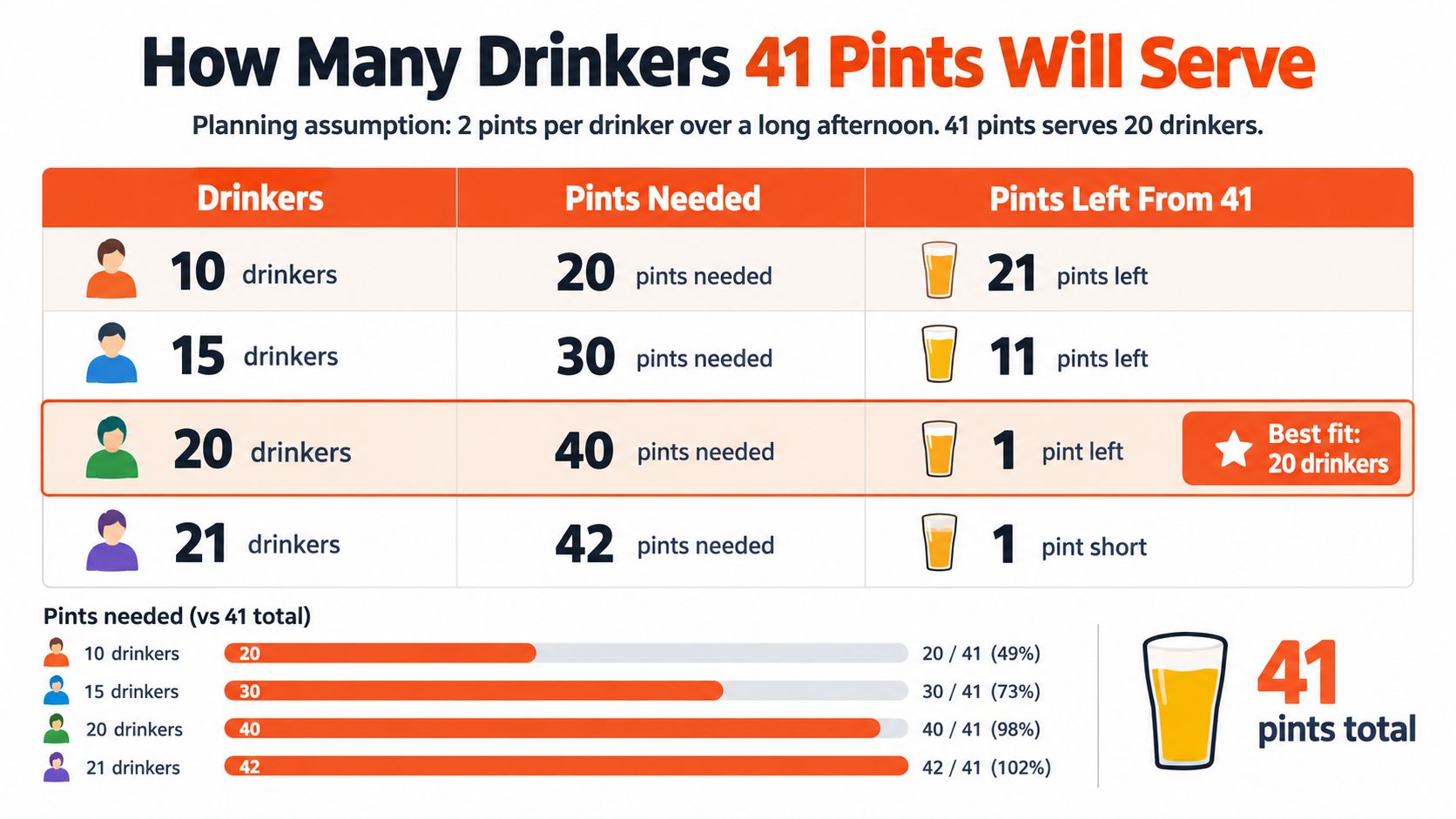
The useful limit depends on the expected serve. Twenty people having three pints each need 60 pints, leaving this order 19 short. At two pints each, 20 people use 40, leaving only one pint. That is little cover for a late-arriving beer drinker or a spill.
For a practical estimate, multiply the number of beer drinkers by the pints each person is likely to have. Then compare that total with the order and decide how much surplus is worth paying for. A larger reserve reduces the chance of running short, while unused beer adds cost and may be difficult to manage after the event.
Write down the expected beer-drinker headcount and servings before ordering. For example, 15 drinkers at two pints each need 30 pints, leaving 11 from an order of 41. If the estimate approaches the full order, arrange a suitable alternative for guests who want beer once it runs out. The pint count helps size the order; alcohol content is a separate part of event planning.
Chilling, Storing and Serving 41 Pints Safely
Keep the beer cold from the fridge to the glass. A well-planned cold chain protects flavour and makes service easier, especially when the order includes more than one format.
- Chill packaged beer ahead. Put cans and stubbies in the fridge about a day before the event and hold them at 2 to 4°C. Don't try to rush the job by putting them in the freezer.
- Pack the esky for steady cooling. Put ice underneath and over the beer, keep the esky out of direct sun, and don't leave it on a hot car floor. Check the ice during the event and top it up before the contents warm.
- Settle and chill the keg. Keep it upright at 2 to 4°C, and after moving it, give it about a day to settle before tapping. Check the CO₂ pressure setting before the first pour; an unsuitable setting can make service foamy or slow.
- Make room for the full order. Plan fridge and esky space before delivery, because 41 cans take up more room than the number sounds like. A 50 L keg needs a tall fridge or a dedicated cooler, so confirm the fit rather than discovering the problem at setup.
- Prepare the pour. Use a clean glass, pour a 425 mL serve with a head, and clean the tap lines before the first pour. Keep the serving area organised so guests aren't waiting while you troubleshoot the tap.
- Track the tapped keg. Note when it's opened and keep an eye on what remains so it can be finished within a few days. Don't leave it warm between uses.
Freezing can make cans and stubbies burst and leak, while cycling beer from warm to cold can spoil its flavour. When guests arrive, check the fridge temperature and ice level; move any beer that's been sitting in the sun to a cold place straight away.
What 41 Pints Means in Standard Drinks and Alcohol
At 425 mL per pour, 41 pints contain about 17.4 litres of beer. Their alcohol content depends on the beer's strength, so use both the pour size and ABV when planning an order.
| ABV | Standard drinks in 41 pints of 425 mL |
|---|---|
| 3.5% | 48 |
| 4.8% (common full-strength pint) | 66 |
| 5.5% | 76 |
An Australian standard drink contains 10 grams of pure alcohol. At 4.8% ABV, a 425 mL pint is about 1.6 standard drinks, making 41 pints approximately 65.6 standard drinks, or about 656 grams of pure alcohol, according to the Australian Government standard drinks guide. The table rounds that result to 66; the figures for 3.5% and 5.5% ABV are approximate.
Pack size also changes the total. A 375 mL can or bottle at 4.8% ABV contains about 1.4 standard drinks, calculated as 375 mL × 4.8% × 0.789 ÷ 10. Across 41 containers, that is about 57.4 standard drinks, 8.2 fewer than 41 serves of 425 mL. Check the ABV on each label and use the full-strength beer percentage guide to understand how strength affects the calculation.
Australian guidance recommends healthy adults have no more than 10 standard drinks a week and no more than 4 on any one day, as set out in the Australian Government standard drinks guide. The 41-pint quantities in the table exceed that one-day guidance. Use the totals to plan how the beer is allocated across people and occasions.
Standard drinks describe alcohol content and make different pack sizes and strengths easier to compare. For a large order, check each product's ABV and count standard drinks alongside litres and serving volume. This gives a clearer planning figure than the pint count alone.
Cost per Pint and Shipping for Direct Orders
A pack's price matters less than its cost per litre once you compare formats. Carbon Dry Lager is listed at $18 for a 16-pack and $8 for a 4-pack. At 440 mL per can, those packs hold 7.04 L and 1.76 L respectively. Both work out to about $2.56 per litre, or $1.09 per 425 mL pint, before delivery.
Use the same calculation for any pack: divide its price by the total litres, then multiply the cost per litre by 0.425. To find the delivered cost per pint for an order covering 41 pints, add the delivery charge to the beer total and divide by 41. If delivery costs $D, the calculation is (beer total + $D) ÷ 41. This keeps pack comparisons separate from the final cost of getting the order to the event.
A fixed delivery fee has less impact per litre when spread across a larger order. That can improve the unit cost, but only if you have cold storage and a plan for the additional beer. Compare the delivered total with the available pickup option using the same pack mix and volume; include only charges confirmed at checkout.
Delivery conditions can vary by location and courier. Check the current product price and delivery charge at checkout, and arrange for an adult to receive and sign for the parcel. In Queensland's summer heat, schedule delivery so cans are not left in a hot doorway before the event.
Choose the Pack Mix and Check the Order Before You Buy
The target for 41 pints at 425 mL each is 17.425 litres. Carbon Dry Lager is described as a 440 mL can, so the basic order calculation is target volume ÷ can volume, rounded up to a whole can. At that size, 40 cans provide 17.6 litres, just above the target. That leaves very little allowance for spills or larger pours, so treat the result as a volume estimate rather than a drinking target.
Use the same formula for any pack format: multiply the number of cans in each pack by 440 mL, then add the volumes together. The product page currently presents a product variant, so check its listed pack configuration and stock before choosing how many to buy. Do not assume that particular multi-pack sizes are available.
| Pack mix | Cans (440 mL) | Total volume | Position against 41 pints |
|---|---|---|---|
| Any listed pack combination totalling 40 cans | 40 | 17.6 L | About 0.4 pint spare |
| Any listed pack combination totalling more than 40 cans | Pack total | Pack total × 440 mL | More than 0.4 pint spare |
| Any listed pack combination totalling fewer than 40 cans | Pack total | Pack total × 440 mL | Short of the target |
The table gives the volume maths without assuming a pack configuration. A pack combination totalling 40 cans covers the calculated pour with only a small buffer. If the available formats add up to more cans, the difference becomes spare volume; if they add up to fewer, the order falls short.
Carbon Dry Lager - Crisp & Refreshing Easy-Drinking Beer is listed at 4.6% ABV and in 440 mL cans. Check the live page for the current pack configuration and stock before building the order. If you want more than one style, compare the available formats in this guide to mixed beer packs.
Before you place the order
- Confirm the product details. Check the live page for can size, ABV, pack configuration and stock.
- Choose how you'll receive it. Select delivery or pickup, then confirm the collection or delivery window is before the event.
- Check cold storage. Make sure the fridge and esky can hold the full order, including any extra volume.
- Set the budget. Use the delivered cost per pint and compare it with what you're comfortable spending.
Full packs simplify serving and keep the beer selection consistent. Allow time for the order to arrive before the event, and plan where the cans will stay cold. If you share the quantity online, state the volume in millilitres and ABV as a percentage. Keep the wording factual and avoid presenting consumption as a challenge, reward or invitation to drink quickly.
Australia's ABAC Responsible Alcohol Marketing Code says alcohol marketing must not depict, encourage or make amusing consumption that conflicts with the Australian drinking guidelines. It also prohibits marketing that promotes rapid consumption, alcohol misuse or irresponsible behaviour, including through social media and paid advertising. A clear order description gives readers the quantity and alcohol content without turning the volume into a drinking goal.
Carbon 6 Brewing Pty Ltd offers beer for direct orders, including Carbon Dry Lager. Check the current product details and delivery or pickup options, then visit Carbon 6 Brewing Pty Ltd to plan an order that fits the required volume, storage and event.