Black Hops Pale Ale: Taste, ABV and Buying in Australia
Oct 28, 2026
The usual advice, “dark beer means heavy beer”, is a poor way to choose a pale ale. Colour won't tell you how full the beer feels, how strongly it tastes of roast, or how bitter the finish will be.
There's another trap with Black Hops Pale Ale: Black Hops is a brewery name, not a promise that the beer is black. Before ordering a carton, establish whether you're buying that brewery's pale ale or a brewer's dark, hop-forward interpretation. Those aren't interchangeable.
What Black Hops Pale Ale Means Today
Black Hops Pale Ale is a branded Australian pale ale, not a recognised shorthand for a dark beer. A dark, hop-forward pale ale can combine pale-ale aroma with a slightly toasted finish, but you shouldn't assume those characteristics from the Black Hops name.
In its 2025 listing, Black Hops Brewing described its Australian Pale Ale at 4.4% ABV, with packs priced from $20.00 to $62.00. Its core-range listing offered 4-pack and 16-pack formats in 2025. Those are dated listings, not current price promises, so check the live product page and actual label before paying.
Read the beer, not just the name
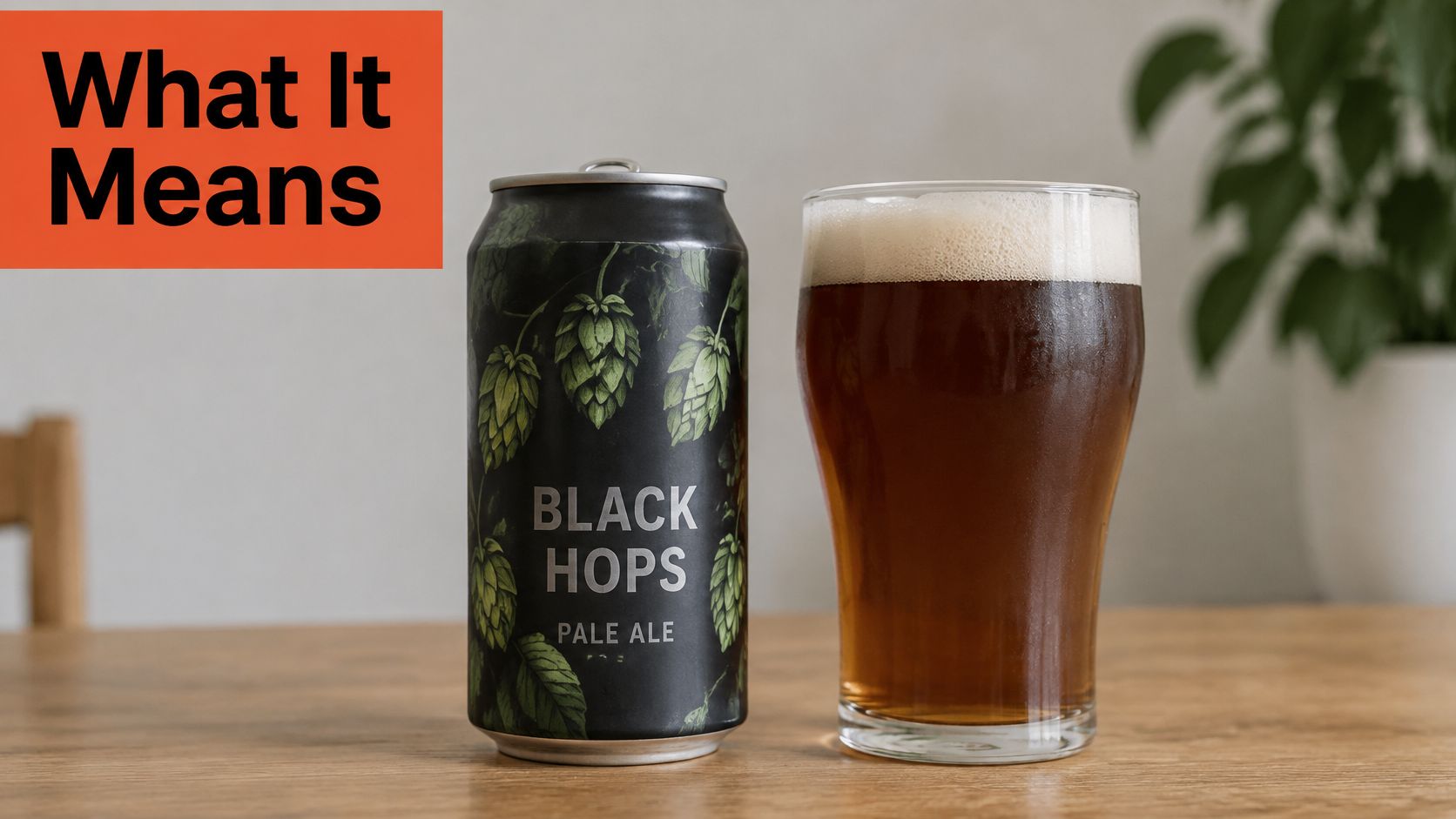
When another brewer uses a description such as black-hopped pale ale, treat it as descriptive language rather than a tightly defined style. Look for an actual colour description, named malt flavours and a clear explanation of the hop character.
Black Hops Pale Ale at a glance
The numerical bands below are illustrative shopping benchmarks for a dark, hop-forward pale ale, not verified specifications for Black Hops Brewing's product.
| Attribute | Typical range | What it means for you |
|---|---|---|
| Strength (ABV) | Illustrative band of 4.5–6.0% | Mid-range for craft pale ale; the dated Black Hops listing sits just below this band |
| Bitterness (IBU) | Illustrative band of 30–50 | Roast and malt can make it feel sharper than the number suggests |
| Colour | Amber to dark brown for a dark interpretation | A darker colour doesn't automatically mean a heavier body |
The distinction matters when you're buying unseen. A photograph can show colour, but it can't reliably show sweetness, mouthfeel or roast intensity.
Use ABV and IBU as starting clues, not tasting guarantees. Treat colour as a hint about the ingredients, and give the brewer's flavour description more weight than the name.
How Black Hops Pale Ale Differs From Stout, Porter and Black IPA
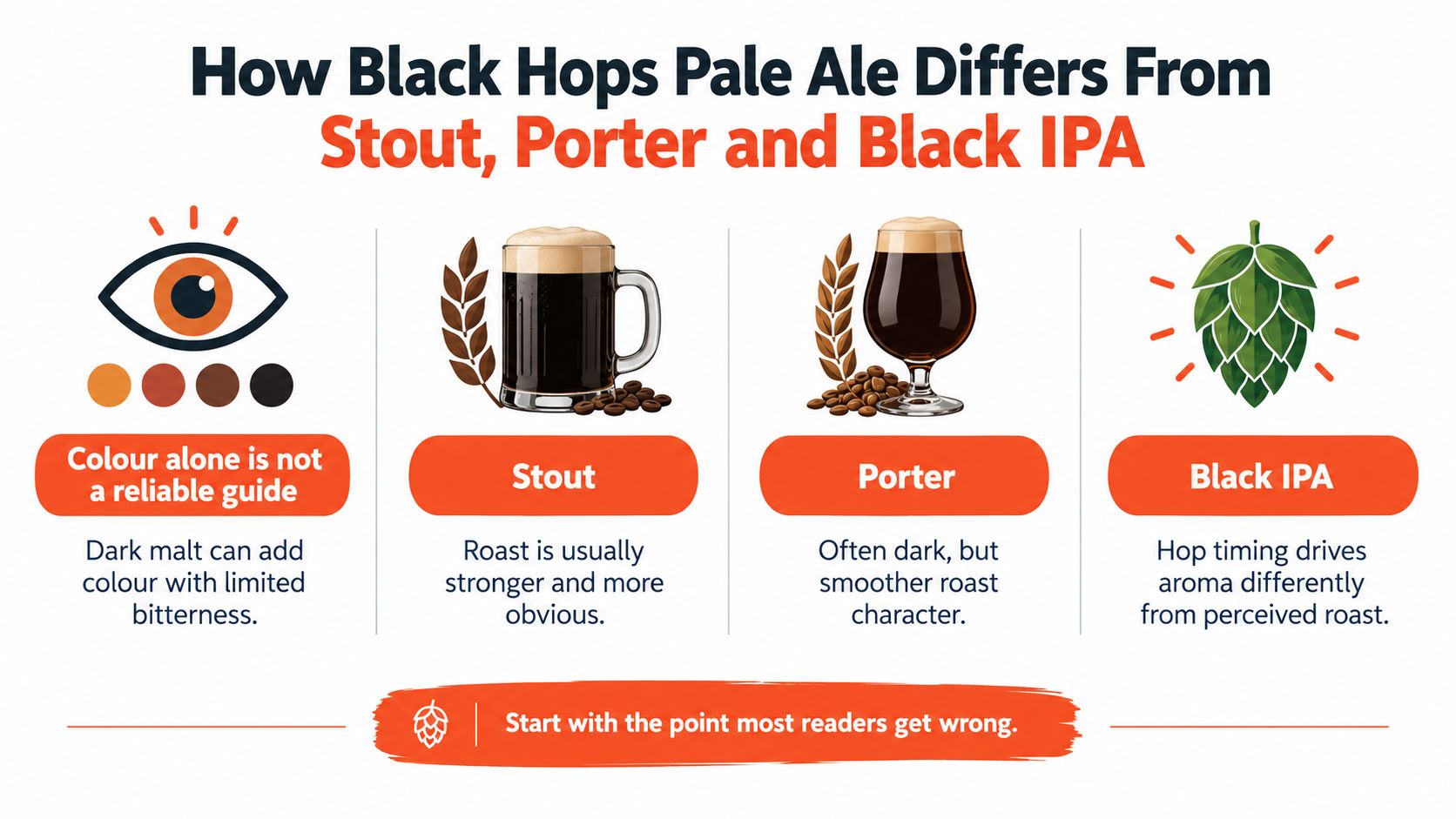
Porter usually brings roast, chocolate or coffee closer to the centre of the flavour. In a dark pale ale, roast tends to play a supporting role, leaving the pale-ale character prominent. Brewers can use dark malt mainly for colour, including husk-reduced roasted malt that brings less of the rough, drying character associated with heavily roasted grain.
A dark pale ale can therefore finish briskly, while a porter's malt character may feel rounder. Judge the dominant flavour in the mouthful before the colour.
Sensory markers across dark and pale beer styles
Here, black hops pale ale means a descriptive dark pale-ale interpretation, not a specification for the Black Hops brand.
| Style | Colour | Roast character | Bitterness | Hop aroma |
|---|---|---|---|---|
| Black hops pale ale | Amber to dark brown | Light toasted or roasted edge | Moderate to firm | Pale ale citrus, resin and tropical lift |
| Standard pale ale | Golden to copper | Little to none | Moderate | Clean, bright, hop-led |
| Black IPA | Very dark | Light to moderate | High | Intense, piney or citrus hop character |
| Porter | Dark brown to black | Moderate, chocolate or coffee | Low to moderate | Subdued, malt-led |
| Stout | Black | Moderate to strong, coffee or burnt notes | Low to moderate | Subdued, malt-led |
These are broad buying cues, not rigid boundaries. Dry stout can be relatively light-bodied, porter needn't be sweet, and some modern stouts have substantial hop character.
The styles differ mainly in emphasis. A dark pale ale keeps its pale-ale character prominent, with toast or roast in support. Porter and stout usually put malt-derived chocolate, coffee or roast nearer the centre. Black IPA generally pushes hop intensity and bitterness further. The guide to black India pale ale can help if you're considering that sharper, more assertive style.
What the tasting notes should tell you
Clear flavour descriptions help distinguish these styles when the name alone is vague. Australian market analysis from IMARC Group describes consumer interest in distinctive flavours and premium experiences.
Look for hop notes alongside toast, cocoa or coffee, then notice which flavours lead. Their relative prominence says more about the beer's direction than a dramatic name.
A dark appearance is a visual feature. A heavy mouthfeel is a separate brewing decision.
At the bottle shop, a description that mentions roast and hops together suggests a deliberate balance. Roast-focused notes point more towards porter or stout, while hop-focused notes suggest a hop-led beer, even when it looks dark. Use those descriptions to screen your options, not as proof of a formal style.
What the Taste, Bitterness and Strength Really Mean
A good dark pale ale shouldn't taste like a stout with hops tipped into it. The brewer needs to balance aroma, malt flavour and texture so they remain distinct without clashing.
Separate the three tasting layers
Start with the hop layer. Citrus, resin and tropical fruit can arrive through aroma before the beer reaches your tongue. Those flavours don't automatically mean aggressive bitterness.
Think of lemon zest and lemon pith. Both suggest citrus, but the fragrant outer skin and bitter white layer give quite different sensations. Hop aroma and hop bitterness are similarly related without being the same thing.
Then assess the malt. A light toast note can add depth without making the beer taste burnt. A rough, tea-like drying sensation is different from a clean bitter finish, even though drinkers often describe both as bitter.
Research available through the University of Melbourne repository explains that hop-derived iso-alpha acids contribute to bitterness and foam stability, while darker malt compounds can affect astringency and perceived bitterness.
Why aroma and bitterness don't rise together
Brewers who add hops late in the kettle or during the whirlpool can retain more aroma while limiting additional bitterness formation. Longer boiling extracts bitterness but drives off more volatile hop character.
That trade-off explains why an aromatic beer can taste relatively gentle, while a less fragrant beer can finish firmly bitter. The explanation of IBU in beer helps separate the laboratory measure from your own sensory response.
Finally, assess body, meaning how substantial the beer feels in your mouth:
- Lean and dry: The mouthful clears quickly, leaving little sweetness.
- Rounded: Malt sweetness softens the bitter edge.
- Full or sticky: Residual sweetness and texture linger after swallowing.
Higher strength doesn't guarantee a thick beer, and lighter texture doesn't mean lower alcohol. Read strength separately from flavour.
For a restrained dark pale-ale interpretation, expect expressive hops, supportive toast and a dry finish. If burnt grain or harsh drying dominates, the balance may not suit your palate.
Standard Drinks and Label Strength for Every Serve
A can is a package, not a standard drink. Its alcohol content depends on both the volume inside and the strength printed on the label.
Under the Australia New Zealand Food Standards Code, an Australian standard drink contains 10 g of pure alcohol; beverages above 0.5% ABV must declare approximate standard drinks, beverages above 1.15% ABV must state alcohol content, beer's declared strength has a 0.3% ABV tolerance, and packaged beverages above 1.15% ABV require the prescribed pregnancy warning.
Calculate the alcohol, not the number of containers
For a worked estimate, use:
Standard drinks = volume in mL × (ABV ÷ 100) × 0.789 ÷ 10
The factor represents the approximate mass of ethanol per millilitre. Use the ABV percentage as a fraction in the calculation, rather than multiplying by the whole percentage.
Standard drinks for common pale ale serves
These are calculated examples, rounded for comparison, not replacement label declarations.
| Serve | ABV | Standard drinks |
|---|---|---|
| 375 mL can | 4.4% | About 1.3 |
| 375 mL can | 5.2% | About 1.5 |
| 440 mL can | 4.4% | About 1.5 |
| 440 mL can | 5.2% | About 1.8 |
For example, the hypothetical smaller can at the stronger example strength contains about the same alcohol as the larger can at the lower example strength. Package size alone won't tell you which has more alcohol.
Use the actual batch label
The can's declaration is the practical reference because the brewer calculates it from the packaged product. A retailer's old product description may not reflect a changed recipe or pack format.
Before a planned evening:
- Read the can: Check both ABV and standard drinks.
- Count the total: Multiply standard drinks per can by the number you intend to consume.
- Check current health guidance: Compare the plan with Australian alcohol guidance, recognising that less alcohol means lower risk.
- Plan transport separately: Don't use these estimates to decide whether you're fit to drive.
A crisp finish can make alcohol less obvious to taste. It doesn't reduce the amount in the glass.
Serving and Pairing Black Hops Pale Ale
Pour into a clean tulip or nonic glass rather than drinking straight from the can when you want to assess the beer. Leave a finger of foam and give the aroma somewhere to collect.
Serve it chilled, then let it warm slightly in the glass. Very cold beer suppresses both malt detail and hop aroma; warming an entire carton on the bench isn't necessary.
Let the dominant flavour choose the food
Hop-led beers suit bright, charred dishes. Barbecued chicken, grilled prawns with lime and fish tacos give citrusy hops something familiar to sit beside. A little char works well, but a heavily burnt crust can make the combined bitterness seem rough.
Thai larb can also work with a fragrant pale ale. Keep the chilli at a level you enjoy comfortably, because alcohol and bitterness can make an already fiery dish feel more intense.
Toasted malt suits browned and savoury food. Try grilled red meat, a burger with caramelised onion, roasted pumpkin or mushrooms cooked until their edges colour. You're matching browned flavours, not looking for the darkest food available.
Match richness without overpowering the beer
A dry finish works well with pork belly, fried snacks and other fatty dishes because the contrast makes each mouthful feel less cloying. Carbonation also helps refresh the palate between bites.
The trade-off is intensity. A delicate pale ale can disappear beside sticky barbecue sauce, heavily smoked meat or a sweet dessert. Choose restrained seasoning when the beer's appeal is its subtle toast and hop detail.
Pairing rule: Match the strongest flavour on the plate, which is often the sauce rather than the protein.
For a mixed barbecue menu, a useful approach is to keep lime wedges, chilli dressing and rich sauces separate. That lets each adult adjust the food without needing a different beer for every dish.
A dark pale ale can suit a backyard meal without feeling as full as its colour suggests. Choose the amount for the meal rather than treating a long afternoon as a reason to keep pouring, and have water and alcohol-free options available.
Where to Buy Pale Ale Locally Across Australia
Availability changes with the brewery, distributor and region. Check the brewer's current range or ring the retailer before making a special trip, particularly for limited releases.
A listing isn't always confirmation that stock is sitting in the fridge. Ask whether the beer is available for immediate collection, dispatched from the brewery or ordered through a wholesaler.
Local purchase channels for craft pale ale in Australia
| Channel | Best for | Check before buying |
|---|---|---|
| Brewery direct online | Cartons and mixed packs with home delivery | Shipping cost, delivery window and whether the brewery ships to your postcode |
| Brewery taproom or cellar door | Single cans and fresh stock | Opening hours and onsite-only formats |
| Independent bottle shop | Single bottles, cans and tasting before buying where offered | Best-before date and storage on the shelf |
| Pub or bottle shop with craft range | Trying a beer on tap or by the glass where licensed | Whether the beer is listed on tap or in the fridge |
| Festival stall | Sampling a range in one place | Whether stock is sold on the day or only for pick-up |
Direct ordering makes sense when you already know the beer and will use the pack within its flavour window. It doesn't automatically offer better value once freight is included.
An independent bottle shop is often the more useful first stop for an unfamiliar style. You can inspect the package and buy a smaller quantity, although tasting isn't universally available.
Choose the channel that reduces uncertainty
Carbon 6 Brewing, based in Stapylton on Queensland's northern Gold Coast, is one local option with online and onsite sales; its pale-ale formats include multipacks online and selected single cans onsite.
For broader comparisons, the Australian online bottle shop guide can help you assess delivery and buying options.
- Buying something unfamiliar: Prioritise singles or a modest mixed selection over a carton.
- Buying a known favourite: Compare delivered cost and dispatch arrangements.
- Trying it on tap: Ask whether packaged stock is the same beer and current recipe.
- Visiting a festival: Check collection arrangements before committing to a pack.
Don't increase an order purely to dilute the freight charge. A cheaper delivered can isn't better value if it sits around longer than you intended.
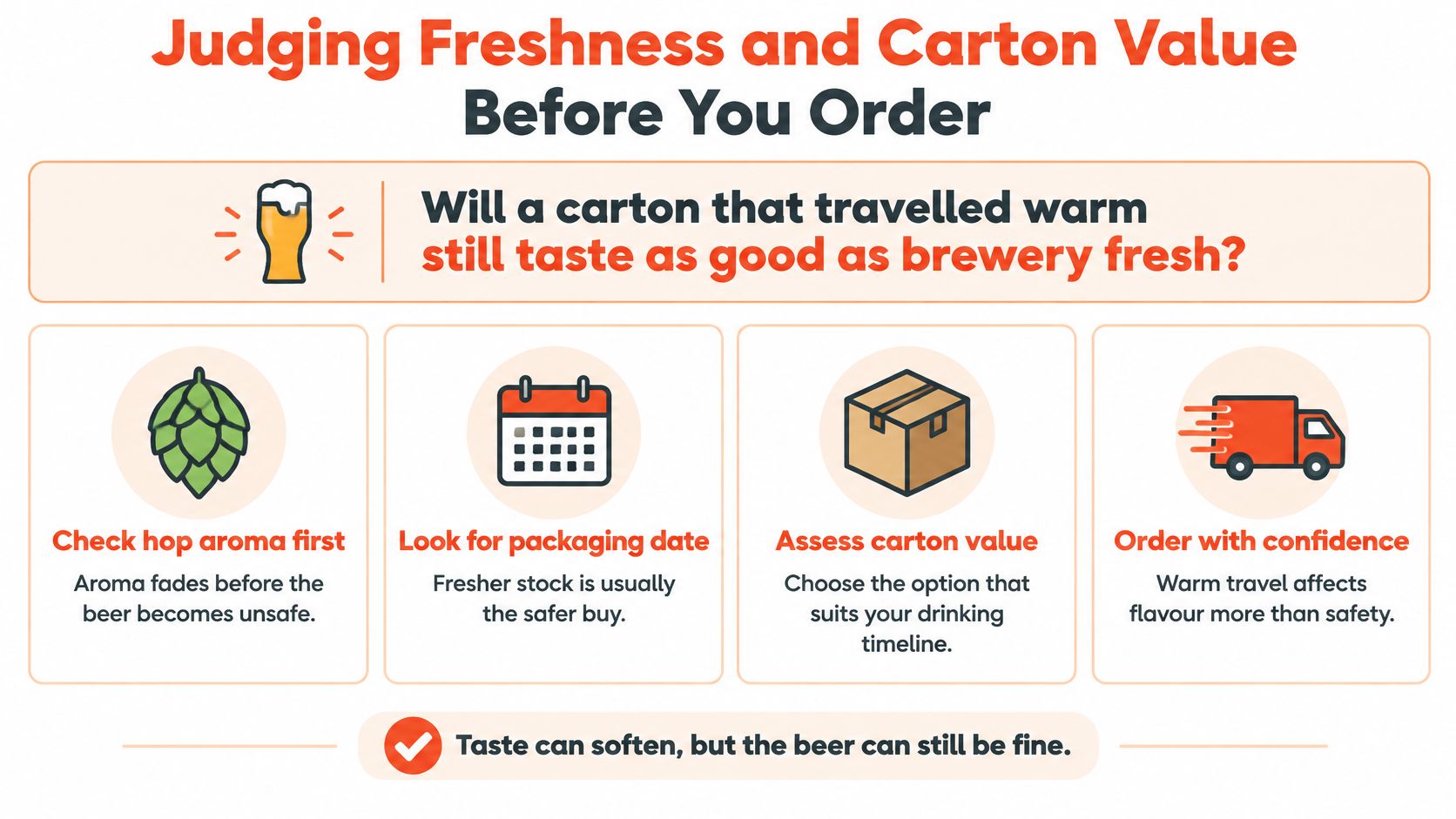
Judging Freshness and Carton Value Before You Order
Will a carton that travelled warm taste as good as it did at the brewery? Possibly, but warm storage and transport can accelerate flavour deterioration, especially in hop-forward beer.
Hop aroma can fade before beer becomes unsafe. That's a flavour distinction, not a blanket safety guarantee: leaking, swollen or damaged packaging needs separate attention.
Check the journey as well as the date
- Find the packaging code: Check the carton and can, and ask the seller to interpret an unclear batch code.
- Compare storage history: Prefer recent stock with sensible handling over a newer carton left somewhere hot.
- Ask about summer delivery: Find out whether dispatch, transport and unattended delivery involve refrigeration. Don't assume they do.
- Store promptly: Keep beer away from heat and direct light, preferably refrigerated when space allows.
IBISWorld's Australian craft-beer industry overview describes a shift towards premium beer despite declining consumption. Paying more can make sense when you're choosing fewer, better-suited serves, but premium pricing alone doesn't establish freshness.
Put freight and flavour beside the price
Compare delivered price per can, then account for different can sizes. Ask the brewery for its recommended flavour window rather than applying a universal shelf life to every pale ale.
For a historical example, an Australian bottle retailer listed a 375 mL Black Hops Pale Ale can at $4.99 in 2025. In a hypothetical calculation using 4.4% ABV and about 1.3 standard drinks, that price works out to roughly $3.84 per standard drink.
For any carton, calculate:
Delivered price ÷ number of cans ÷ labelled standard drinks per can
That figure helps compare alcohol content across formats, but it shouldn't become a target for buying the most alcohol cheaply. Flavour suitability, storage and the quantity you want matter more.
A cheaper, older carton can save money at checkout and still disappoint in the glass.
Choose a Local Pale Ale You Can Order This Week
Choose a pale ale for the flavour and strength you want, rather than the novelty of its packaging. Check the current product listing before ordering, since stock and product details can change. A smaller pack is a sensible way to try a beer before committing to more.
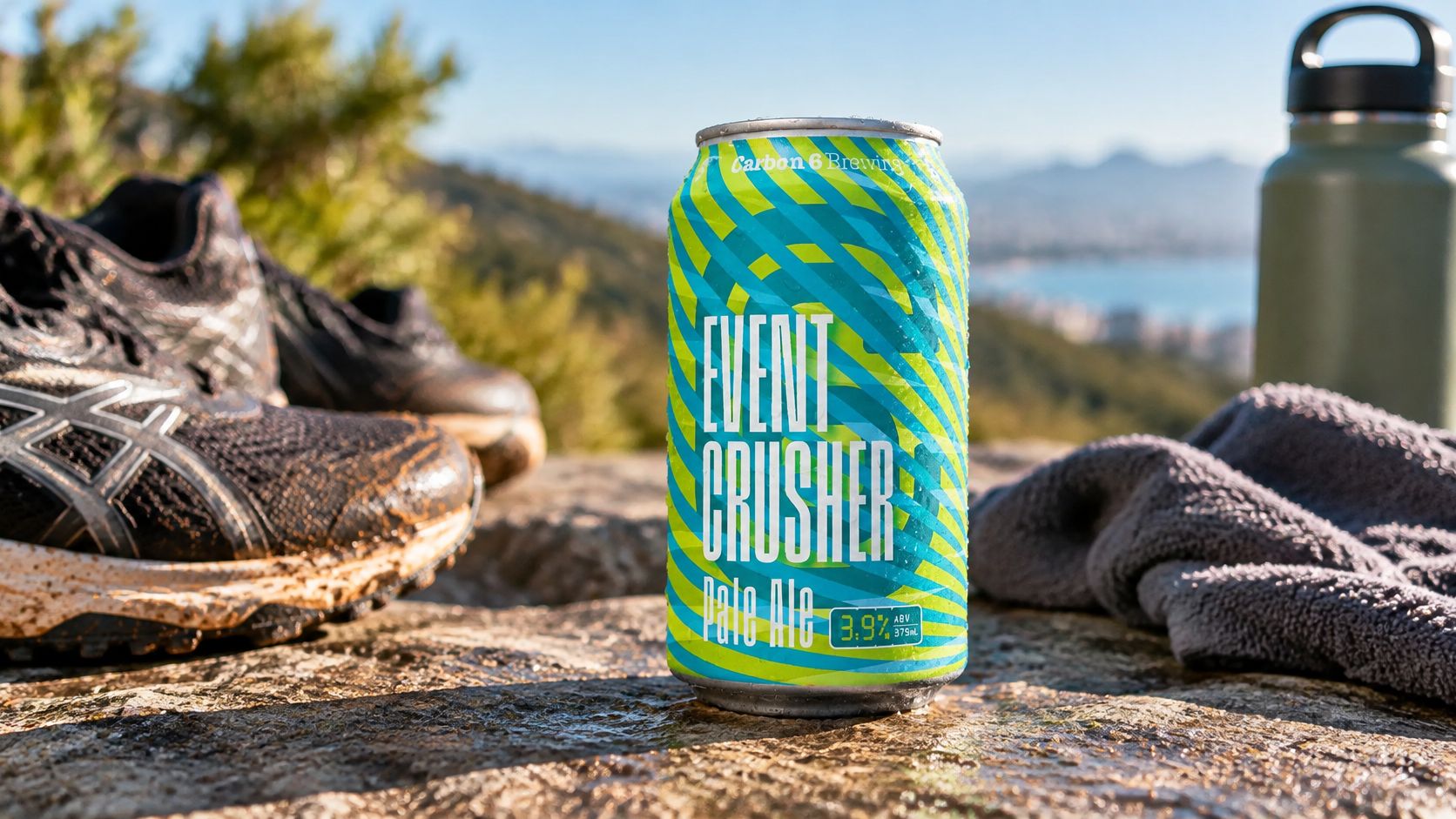
For a lighter-strength citrus-led pale
Event Crusher Pale Limited Edition 375ml is listed as in stock at 18. The available listing does not provide an ABV or enough detail to confirm its flavour profile, so check the current product information before choosing it for a particular taste.
A lighter-strength pale can suit someone looking for less alcohol per can, but strength alone does not tell you whether the beer tastes light, bitter or aromatic. Lower strength reduces the alcohol per can but does not make drinking low-risk.
For a bolder pale ale
Exploration Pale Ale is listed as 5.2% ABV, priced at 29, and in stock. That gives you a clear strength figure to compare with other pale ales. The listing does not establish that it is dark or roasted, so do not choose it specifically for toasted-malt character.
For a darker direction, ask a local retailer for a hop-led beer described as having darker malt and restrained roast. If the seller cannot explain that balance, try a single before buying more.
Match the beer to the meal and the amount you plan to drink. Check the current product details, then choose a quantity that suits your plan. After tasting, note whether you would prefer less bitterness, more aroma or a drier finish. Those preferences are more useful than judging a beer by the novelty of its name.
Carbon 6 Brewing Pty Ltd offers pale ales through online sales and local distribution in Australia. Visit Carbon 6 Brewing Pty Ltd to compare current product details and choose a strength and flavour profile that suit your meal and planned quantity.