Independent Brewers Association: What It Does for Brewers
Nov 07, 2026
The Independent Brewers Association is the peak national body for Australia's independent craft-brewing sector, representing more than 600 independent craft breweries. It gives those businesses a shared voice, provides industry resources and helps explain their economic contribution.
For beer buyers, though, an industry badge and a local-looking label answer different questions. Understanding what the association does is useful, but knowing who owns a brewery and where its beer is made is what turns a brand story into something you can check.
What the Independent Brewers Association Is and Does
The Independent Brewers Association, usually shortened to IBA, represents independent brewers collectively. A peak body can address issues that would be difficult for a single business to tackle alone, such as presenting economic evidence to government and developing shared business guidance.
The IBA is an industry association, not a brewery or retailer. Its role is to represent the sector and support brewers. Membership or an IBA mark can be a useful clue, but it does not by itself tell you who owns a particular brand or where its beer was made.
Independent Brewers Association at a Glance
The IBA's December 2024 economic impact assessment reports the following membership and sector benchmarks. Its estimate of beer-volume share is benchmarked against Australian Taxation Office beer-production data.
| Measure | Figure | Context |
|---|---|---|
| Member breweries | More than 600 | Independent craft breweries across Australia |
| Headquarters | Brisbane, Queensland | Members are listed across Australian state categories |
| Sector revenue | About $892 million | December 2024 economic impact assessment |
| Employment | 6,891 positions | Direct employment in independent brewing |
| Share of Australian beer volume | About 10% | Benchmarked against Australian Taxation Office beer-production data |
These figures describe the association's reported membership and the sector's scale. They do not establish the ownership or production history of an individual beer. For that, check the brewery behind the label and where it makes its beer.
Business guidance can also help operators build repeat visits. A taproom considering loyalty promotions can read about improving customer retention with loyalty apps, while assessing any alcohol-related promotion for responsible-marketing requirements.
Where You Fit
- Beer buyers can use the association as a starting point for finding brands, then check ownership and production details.
- Brewers can consider whether representation, resources and industry connections suit their business.
- Suppliers can explore opportunities to participate in the brewing supply chain.
Independent describes ownership and control. Local describes geography. A beer can be local without being independently owned, so check both claims separately.
How Independent Brewing Grew and What It Is Worth
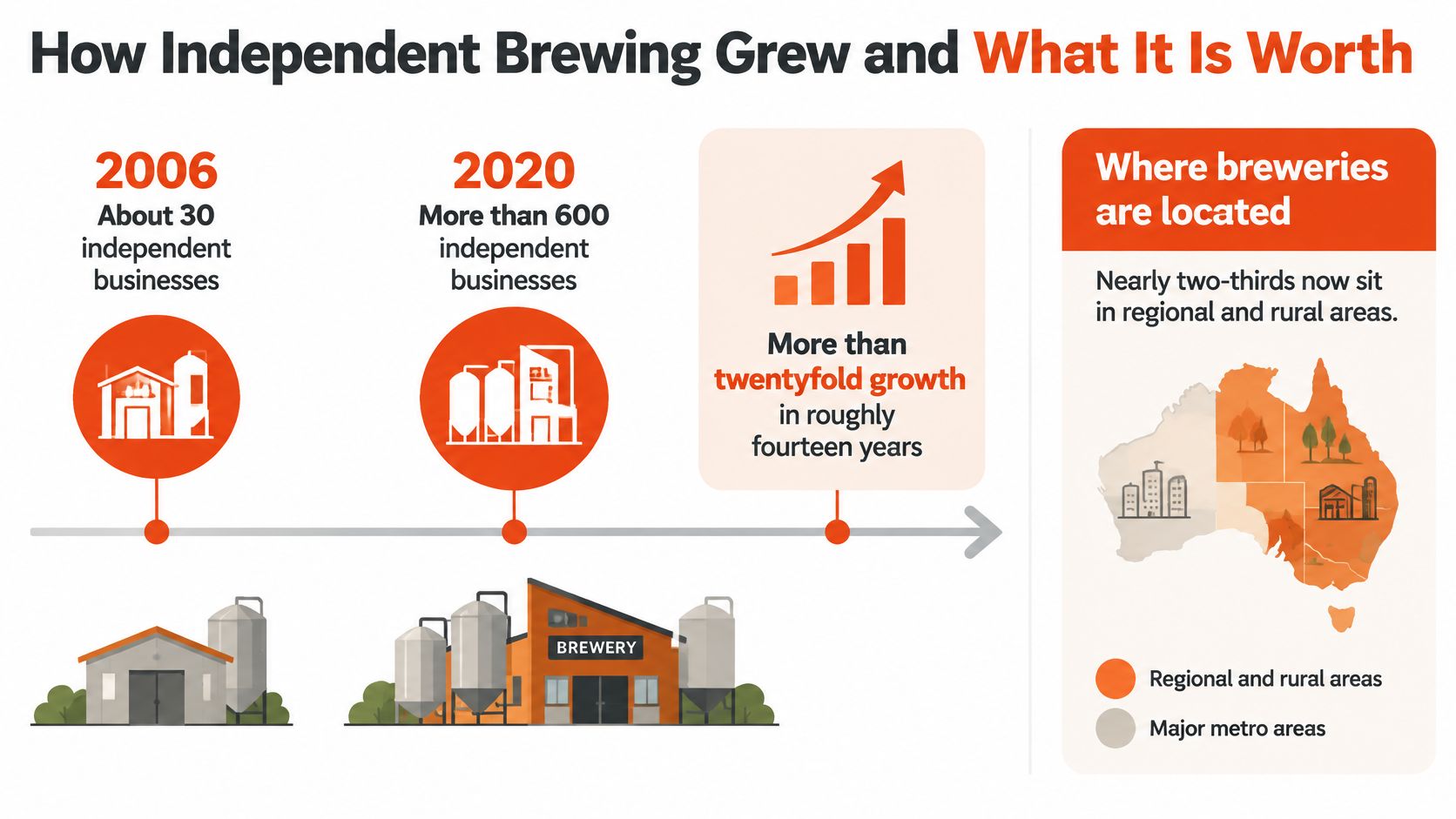
Australia's independent-brewing sector expanded from approximately 30 businesses in 2006 to more than 600 by 2020, more than twentyfold growth in roughly fourteen years, according to the IBA's supporting document lodged with Treasury. That document placed nearly two-thirds of those businesses in regional and rural Australia and recorded independent brewers accounting for 47% of beer-industry employment in 2019, equivalent to just over 3,080 full-time-equivalent positions.
Those figures describe more than a growing choice of cans on bottle-shop shelves. A regional brewery needs ingredients, packaging, refrigeration, transport and somewhere to serve or sell its beer. Its purchases can create work beyond the brewhouse.
Activity, Employment and Investment Measure Different Things
The IBA's Treasury submission describing its 2021 economic-impact assessment reported approximately $1.93 billion in annual economic activity, 35,000 jobs supported, 10,000 direct jobs and more than 25,000 indirect positions. It also recorded approximately $263 million invested in financial year 2020, with around 72%, or $189 million, directed to production.
That submission also described Queensland's historical position: nearly 90 independent craft brewers by September 2018, spanning Port Douglas to Burleigh Heads, with craft-brewing revenues growing at an average annual rate of 9.7% between 2013 and 2018, compared with 2.1% for beer manufacturing overall.
These measures answer different questions:
- Revenue describes sales within the assessed sector.
- Economic activity captures a broader contribution, rather than money received by breweries.
- Direct employment concerns jobs within brewing businesses.
- Indirect employment includes supported work elsewhere, such as agriculture, manufacturing, distribution and hospitality.
- Investment describes spending to build capability, not operating profit.
A large industry contribution doesn't tell you whether an individual brewery can cover its next production run.
Read Historical Estimates Carefully
The earlier assessment and the newer assessment summarised above use different dates and measures. They shouldn't be added together, and the headline totals alone don't establish a like-for-like trend in employment or profitability.
These are industry-commissioned estimates, not guarantees for a particular business. A brewery still needs to know what remains after ingredients, packaging, freight, labour and other costs.
For Queensland operators such as Carbon 6, the useful lesson is operational: track what each sales channel contributes, rather than treating growth in orders as proof of a healthier business. A direct online sale and a wholesale order can produce very different returns after fulfilment.
Our Australian craft beer movement guide provides broader context for how this manufacturing sector connects with local venues and beer buyers.
How to Check Whether a Beer Is Truly Independent
Local and independent aren't interchangeable. A beer can be brewed nearby yet belong to an externally owned company. An independently owned brewery can also sell interstate without losing its independence.
The IBA's news and advocacy material raises concerns about large retailers' control of shelf access and market information. That makes it useful to investigate the business behind the label, rather than treating availability in a familiar shop as evidence of ownership.
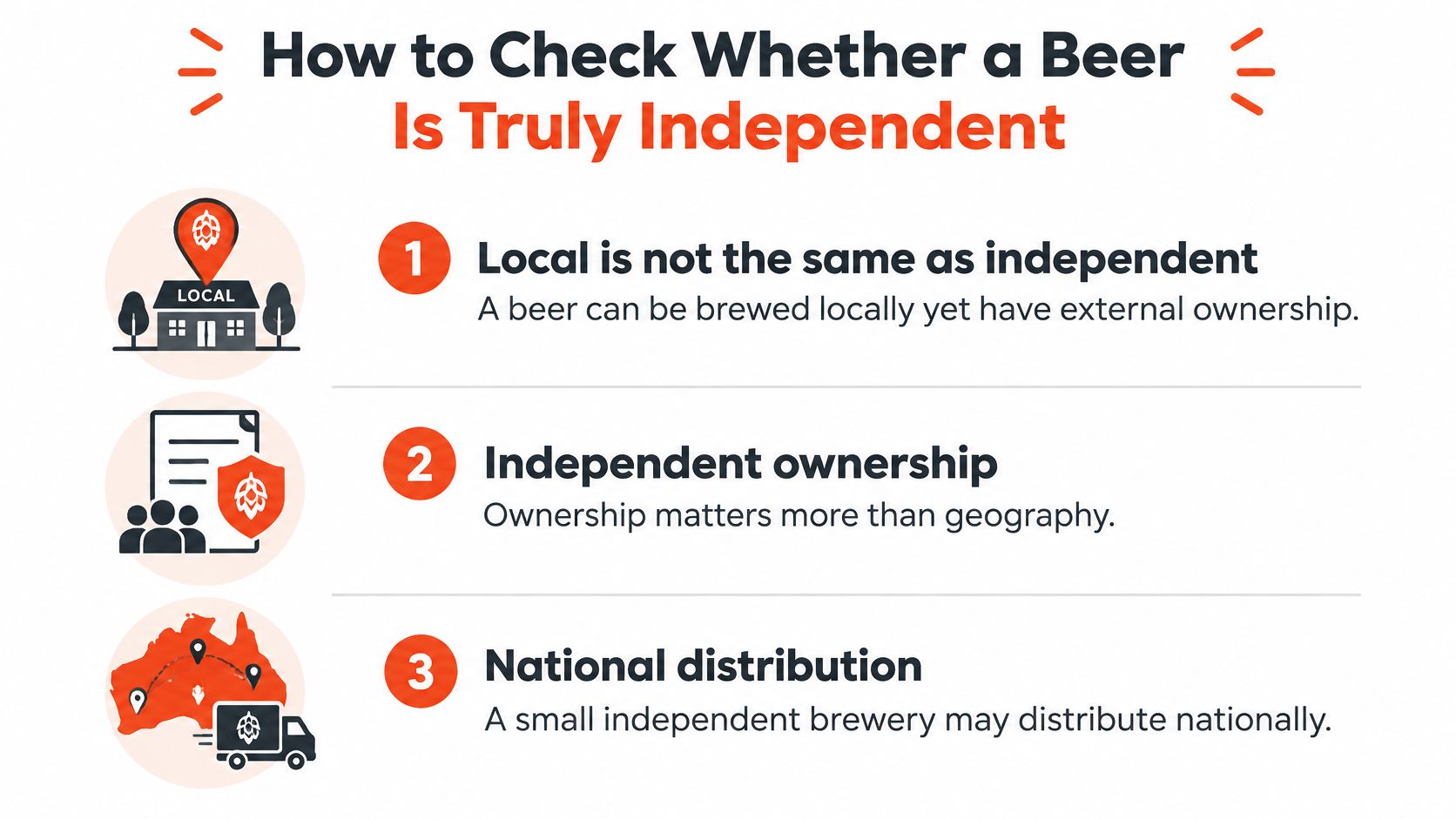
Independence Checks and Where to Look
| Check | What a Clear Answer Looks Like | Warning Sign |
|---|---|---|
| Ownership | Named owner of the brewery company on its website or packaging | Owner is an unnamed larger group behind a local-looking label |
| Production location | Named brewing address and brewed-on-site statement | Brewing is contracted out with no named facility |
| Contract brewing | Brewer states clearly whether any beer is made under contract | Vague wording about where a product is made |
| Venue ownership | Taproom or bar ownership is stated | Venue is owned by a larger group and not disclosed |
| Retail concentration | Clear statement of which channels sell the beer | Only sold through a large retailer with no direct brewery contact |
| Membership | Brewery listed on the IBA members page | Membership claimed with no listing to confirm it |
Contract brewing isn't automatically evidence against independence. It describes a production arrangement, while ownership describes control. Likewise, a venue's owner may differ from the owner of the beer it pours.
Apply the Checks Without Filling in Gaps
Our explanation of what makes a craft brewery is a useful starting point for separating production language from ownership claims. At Carbon 6, we brew in small batches, not big factories, and every batch is brewed from scratch in our Stapylton brewery.
Those statements answer production questions. They don't, by themselves, name the owners of the brewery company or explain every distribution relationship. If a page doesn't answer a particular check, leave that item unconfirmed rather than assuming the answer.
A clear production statement is evidence about production, not automatic proof of every independence claim.
Vague answers warrant caution. Clear answers give you something concrete to verify.
What IBA Membership Includes and Who Can Join
There are distinct routes for breweries and businesses that supply them. Brewery membership concerns independent craft breweries, while associate membership brings supply-chain businesses into the industry network.
The IBA's brewery-members information describes state-based brewery listings and an associate programme with three membership levels, with benefits linked to the level of investment. It also identifies the association's Brisbane headquarters, giving Queensland businesses a local connection to a national organisation.
Choose the Route That Matches Your Business
- Identify your role. A brewery and a packaging supplier shouldn't assume they're applying through the same membership route.
- Check current criteria. Review the brewery requirements or associate levels before committing.
- Match benefits to your goals. Compare the available support with the time and money your business can reasonably invest.
- Confirm your listing after joining. Make sure customers and other industry participants can identify the correct business.
- Keep membership claims accurate. Use current status and approved wording, rather than implying broader endorsement.
A larger supplier may consider a higher associate tier, but a higher investment isn't automatically the right choice. A smaller business should identify which benefits it can use, whether that's industry connections, relevant resources or participation in the network.
What a Listing Can Establish
A public listing helps confirm that a business appears within the association's membership structure. It doesn't tell a buyer how recently a particular carton was packaged, how a retailer stored it or whether every marketing claim is substantiated.
At Carbon 6, we display IBA certification from the Independent Brewers Association. Readers can distinguish that credential from separate statements about our brewing process.
Current fees, eligibility details and tier inclusions should be checked with the association before applying. Don't budget from an old screenshot or another brewery's arrangement.
A membership claim is only as useful as its verification. Check the current listing first, and ask the association to clarify any mismatch before relying on it.
How Advocacy and Industry Services Work for Brewers
The IBA's work extends beyond a logo on packaging. Its economic assessments help frame arguments to government, while its resources give operators material they can use in everyday decisions.
For a brewer, those functions serve different needs. Advocacy concerns the conditions under which businesses operate. Business guidance concerns how an operator manages the brewery, communicates with customers and reviews risk.

Treat Marketing Review as Routine Work
The IBA's business and marketing resources identify the ABAC Code as relevant to marketing communications, including advertising that references or flows from an alcohol product or producer. They include the ABAC Responsible Alcohol Sponsorship Best Practice Guide, Digital Marketing Best Practice Guide and Alcohol Marketing Content Checklist.
That scope matters. A social post, sponsorship announcement or promotional landing page shouldn't escape review because it isn't a conventional advertisement.
Before publishing, check the complete communication against the current ABAC Code and guidance, including copy, imagery, the people depicted, placement and targeting. Platform requirements need their own review too.
- Assign an approver. Make one person responsible for checking the finished communication.
- Review the whole campaign. Include captions, creative, landing pages and promotional mechanics.
- Keep a record. Save the approved version and the checklist used.
- Recheck changes. New imagery or wording can change the meaning of an approved promotion.
Practical rule: Review what the customer will actually see, not just the draft headline.
Responsible communication can explain flavour, provenance and production without suggesting alcohol will solve emotional problems or deliver social success. The useful motivation is an informed preference, not pressure to drink more.
How Gold Coast Drinkers and Brewers Can Get Involved
Queensland's independent-brewing community stretches well beyond a single city. For Gold Coast readers, the practical starting point is to identify nearby businesses, then separate what each one makes from what its branding suggests.
A local purchase can support a brewery and connected businesses, but the route matters. Buying at a venue, through a bottle shop or directly online involves different operators. Ask who brews the beer and who fulfils the order.
Actions for Adult Beer Buyers
- Search the IBA brewery-members directory for Queensland. Start with a manageable shortlist near home rather than relying on social-media recommendations alone.
- Apply the independence checks. Record what you can confirm and leave unanswered questions visible.
- Visit a local taproom or bottle shop. Ask where the beer was brewed, how it reached the venue and how it has been stored.
- Follow association news and local event announcements. Check the organiser's current details before travelling or booking.
Supporting a regional business doesn't require buying a bigger carton than you want. Choose a quantity and style that suit your preferences, budget and plans.
Look Beyond the Transaction
At Carbon 6, we support other small businesses and pour our beer at local events. Those activities show how a brewery can participate in its community, but they remain separate from questions about ownership and certification.
Our guide to choosing a local brewing company offers another way to assess that relationship. Look for specific information about production and participation rather than assuming every local label contributes in the same way.
For brewery operators, the membership decision starts with eligibility, benefits and business goals. Once listed, keep the public-facing information accurate so prospective customers and trade partners can identify the right company.
For suppliers, involvement may mean supporting the businesses behind the beer rather than selling beer themselves. Ingredients, equipment, packaging and logistics all belong in that conversation.
Confirm Independence Before You Choose Your Next Beer
Independence is a claim to verify, not a visual style. A suburb name, handmade-looking label or small taproom can create an impression without identifying who controls the company.
The strongest buying decision combines evidence with preference. You can care about ownership, appreciate a well-made beer and still decide a particular style or delivery option isn't right for you.
Make the Next Decision Concrete
- Beer buyers can choose a nearby brewery and compare its company information, production statement and current IBA listing before ordering.
- Brewers can decide whether membership addresses a real business need, then give the next campaign a documented responsible-marketing review.
- Supply-chain businesses can assess whether associate membership matches their role and which benefits they would use.
Don't treat missing information as proof of wrongdoing. Treat it as a reason to seek clarification. Equally, don't replace an unanswered question with a favourable assumption just because you like the artwork.
Use a Real Brand as Your Test Case
Carbon 6 is one option for applying the checklist. Compare our production statements and displayed credential with the questions that matter to you, and distinguish confirmed details from anything still needing clarification.
We also offer a Beer Swap Guarantee: if a customer's first sip tastes like disappointment, we'll swap the beer for a better one, with no questions and no forms. That policy addresses satisfaction with the beer, not ownership verification, and it shouldn't replace checking provenance.
Choose a brewery, confirm what you can and make a considered decision about whether to try something unfamiliar. There's no need to buy more or drink more to support independent brewing. Drink responsibly.
Carbon 6 Brewing Pty Ltd offers small-batch beer brewed from scratch in Stapylton, with direct online sales and local wholesale distribution. Visit Carbon 6 Brewing Pty Ltd to explore our brewery information, apply the independence checks and choose a beer that suits your taste.