Craft Beer Wholesale: How It Works in Australia
Oct 30, 2026
A year's sales mix shows why venues need to assess the beer and the landed cost, not just the number of suppliers. According to the ABS Australian industry tables, full-strength beer accounted for 69% of sales volume in 2021, down from 80% in the 1990s. Craft made up about one-seventh of full-strength beer that year, a calculation from the figures reported in the tables.
Australia's operating breweries more than doubled, from approximately 360 in 2015 to 740 in 2019, while craft beer remained a minority of beer volume. For a venue, more suppliers mean more choice, but a carton's headline price does not show its full cost. Excise varies with alcohol strength and pack size; freight and expected wastage also affect what each sale leaves behind.
What Craft Beer Wholesale Really Means
A worker rolls a pallet off the brewery dock, the truck holds the cold chain, and the venue cool room takes the stock before service. That trip is the whole job.
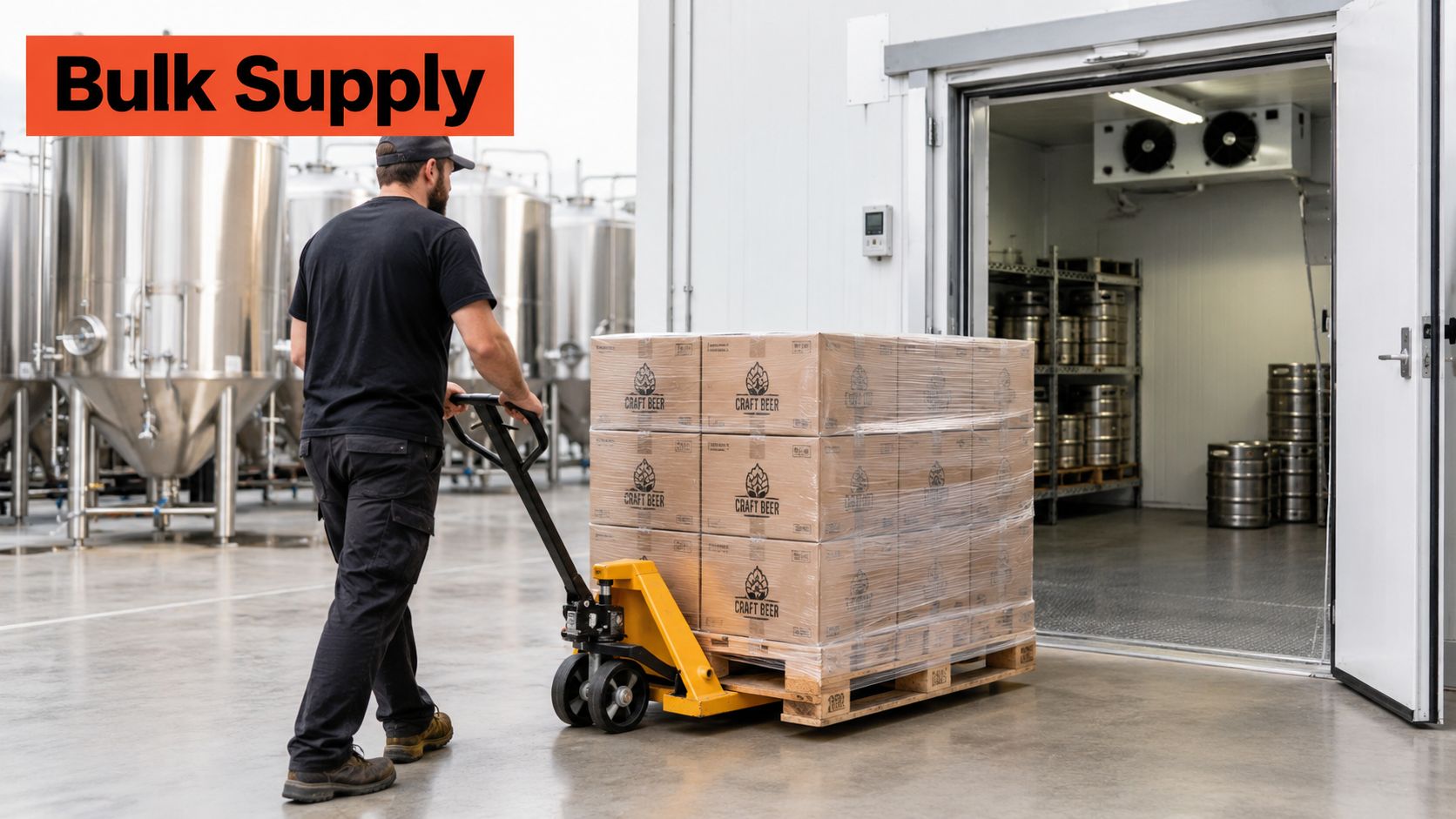
Craft beer wholesale means selling beer in bulk to a business that resells it. Pubs, restaurants, independent bottle shops, bottle-o chains and distributors are the buyers. They purchase to pour or to shelve, not to drink the delivery themselves.
The shop counter makes the split obvious. Direct-to-consumer is the brewery staffing its own till and keeping the retail dollar. Wholesale hands the beer to a retailer who sells it in their own name, to their own regulars, at a price they set.
Queensland venues fit this because guests still ask for local provenance and a list that turns. Craft doesn't beat the big brewers on sheer litres. It wins on portfolio breadth and rotating seasonals a national tap already doesn't carry.
A wholesale deal locks in more than a headline case price.
- Trade price: What the venue pays per carton, keg or mixed case.
- Minimum order: The smallest drop the brewery or carrier will run.
- Duty: Excise on alcohol above the statutory threshold, which should already sit inside that trade price.
- Delivery terms: Who freights it, the arrival window, and who carries transit risk.
- Deposits: What comes back on a keg or packaging, and what you lose if it doesn't.
Treat the drop like a retail special and you'll over-order. A plain stock view, such as wholesale stock control from UI Lib, keeps par levels honest so a seasonal doesn't die in the fridge.
A cheap case that sits for six weeks is dearer than a beer that sells in ten days.
Working Out Excise and Landed Cost per Carton
At $63.75 per litre of alcohol, excise adds about $1.20 to a 375 mL can of 5.0% beer. The Australian Taxation Office's beer excise rates list that rate for packaged beer above 3.5% ABV in individual containers under 8 litres, for 2 February to 2 August 2026. Rates change, so check the current figure before quoting a trade price.
Duty on a single can
A 375 mL can at 5.0% ABV contains 0.01875 litres of alcohol. At $63.75 per litre, that works out to about $1.20 per can, or $28.57 for 24 cans, before GST, packaging, freight or margins.
Can size and strength both affect the result. A 440 mL can at 4.6% ABV contains 0.02024 litres of alcohol, producing about $1.29 in excise per can and $30.97 per 24-can case at the listed rate.
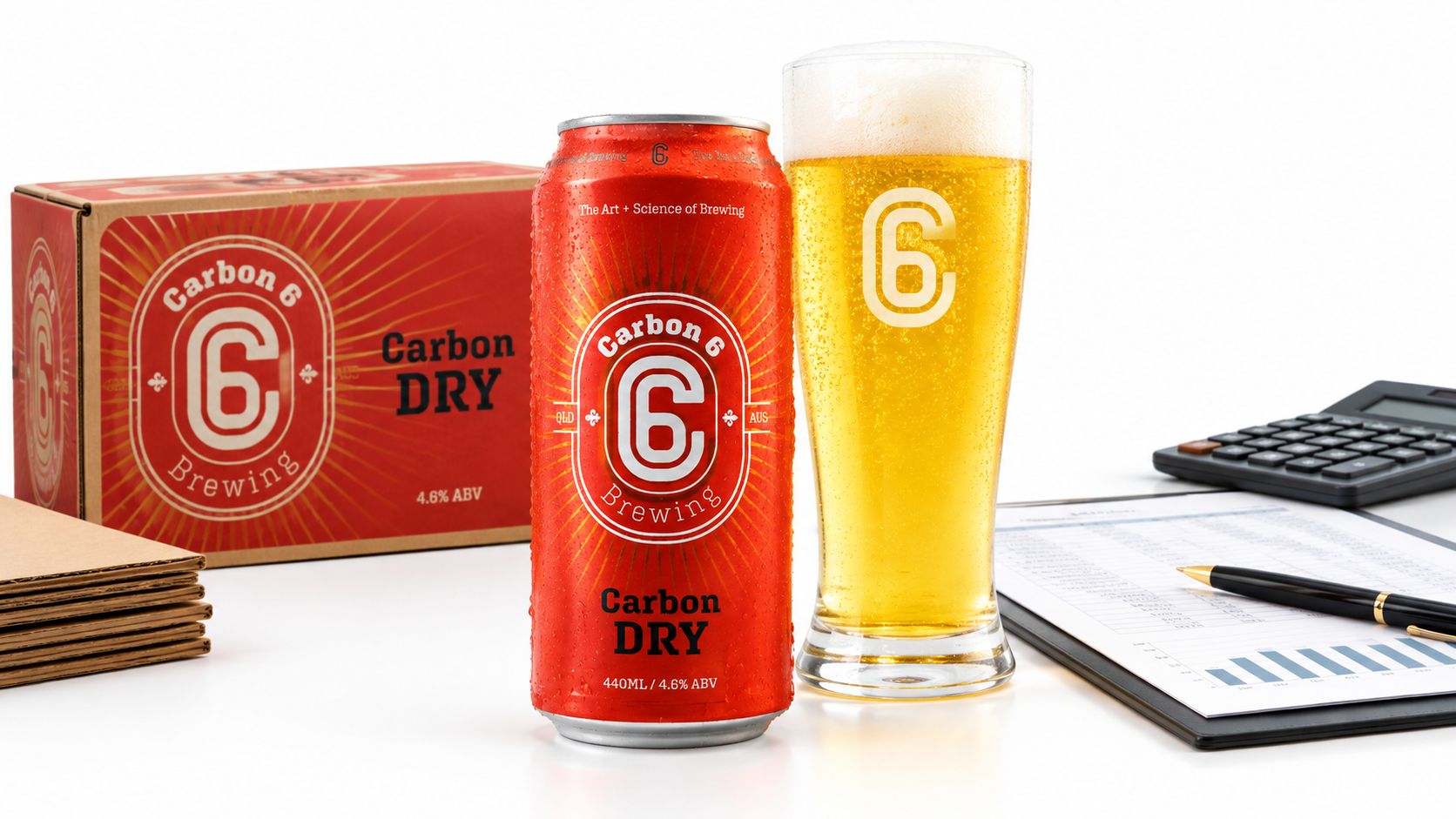
The Carbon Dry Lager 4.6% ABV 440mL can illustrates the calculation: 0.440 litres multiplied by 4.6% gives 0.02024 litres of alcohol. Multiply that by $63.75 to get about $1.29 per can. This is the duty component, not the full trade price.
A 440 mL can at 7.2% ABV contains 0.03168 litres of alcohol. Excise at the listed rate is about $2.02 per can, or $48.47 per 24-can case.
| Pack | ABV | Excise per can | Excise per 24-can case |
|---|---|---|---|
| 375 mL can | 5.0% | about $1.20 | about $28.57 |
| 440 mL can, Carbon Dry Lager | 4.6% | about $1.29 | about $30.97 |
| 440 mL can, Peach & Mango Oat Cream IPA | 7.2% | about $2.02 | about $48.47 |
Kegs and other draught containers need a separate calculation. Larger or draught-configured packs can attract a different rate, so don't apply the small-pack figure to a 50-litre keg.
Costs the venue actually feels
Excise should already be included in the brewery's trade price. Add the costs that follow to calculate what the carton costs your venue:
Landed cost per carton = trade price (including duty) + your share of freight + any unrecovered deposit + wastage allowance.
Then calculate gross margin using prices excluding GST:
Gross margin = (shelf or pour price − landed cost) ÷ shelf or pour price.
Keep GST on a separate line so it does not distort the margin calculation. For example, if freight adds a few dollars per case and one can is lost to wastage, include both in the carton cost. A lower-priced beer can cost more in practice if it ties up stock or creates more waste. Compare each SKU using its strength, pack size, freight share and expected wastage, not just the trade price.
Wholesale Versus Direct-to-Consumer Sales
A brewery that sells online and to venues is running two businesses on the same tanks. The beer can be identical. The buyer, the price, the truck and the risk are not.
| Factor | Direct-to-consumer | Wholesale |
|---|---|---|
| Buyer | Individuals ordering online | Venues, bottle shops and retailers |
| Price basis | Brewery sets the retail price | Trade price; venue or retailer sets its own shelf price |
| Duty handling | Brewery accounts for excise on the sale | Brewery accounts for excise on dispatch; buyer confirms it is in the trade price |
| Order size | Mixed packs and cartons to justify shipping | Cases, kegs or pallets sized to the trade account |
| Logistics | Parcel delivery or collection at the brewery | Bulk freight to the venue, keg handling and cool-chain storage |
| Stock and payment risk | Brewery carries it per order | Shared with fewer, larger trade accounts; venue carries wastage |
| Typical margin | Kept in the brewery's own retail price | Set in each trade agreement, after duty and freight |
Who carries the risk
Online buyers are people ordering for home. They take mixed packs or a carton because shipping a single can rarely makes sense. The brewery sets that retail price, pays the excise on the sale, and wears the stock until the order is picked. Parcel delivery or cellar-door collection is the logistics. If you want the mechanics of that online path, the brewery's note on direct-to-consumer e-commerce sets out how a packaged order leaves the site.
Wholesale buyers are venues and retailers. They take cases, kegs or pallets sized to the account. You set the shelf or pour price. The brewery still accounts for excise when the beer is dispatched, and your job is to confirm that duty is already in the trade price, not added again on your invoice. Freight is bulk, kegs need handling, and the cool room has to be ready. Teams that optimize warehouse-to-customer workflows treat pick, dispatch and delivery as one chain. A late truck is a missed service, not a tracking curiosity.
Wholesale moves more litres through fewer accounts, and you give up some of the retail margin to get that. Direct sales keep more of each dollar, then spend it on marketing and delivery. The useful question is which channel pays for the packaging run, and which one builds the brand a venue will still want in two years.
If the online shop can't fund the canning run, the trade account has to. If the trade account is your only voice, the brand gets thin.
Licences and Supplier Checks Before You List
The split is simple, and venues blur it. Beer manufacturers generally need an excise licence, must follow the licence conditions, and must lodge an excise return and pay duty when excisable beer is delivered for home consumption, as the Australian Taxation Office sets out. Venues and retailers need their own liquor licence and their own purchasing controls. One doesn't replace the other.
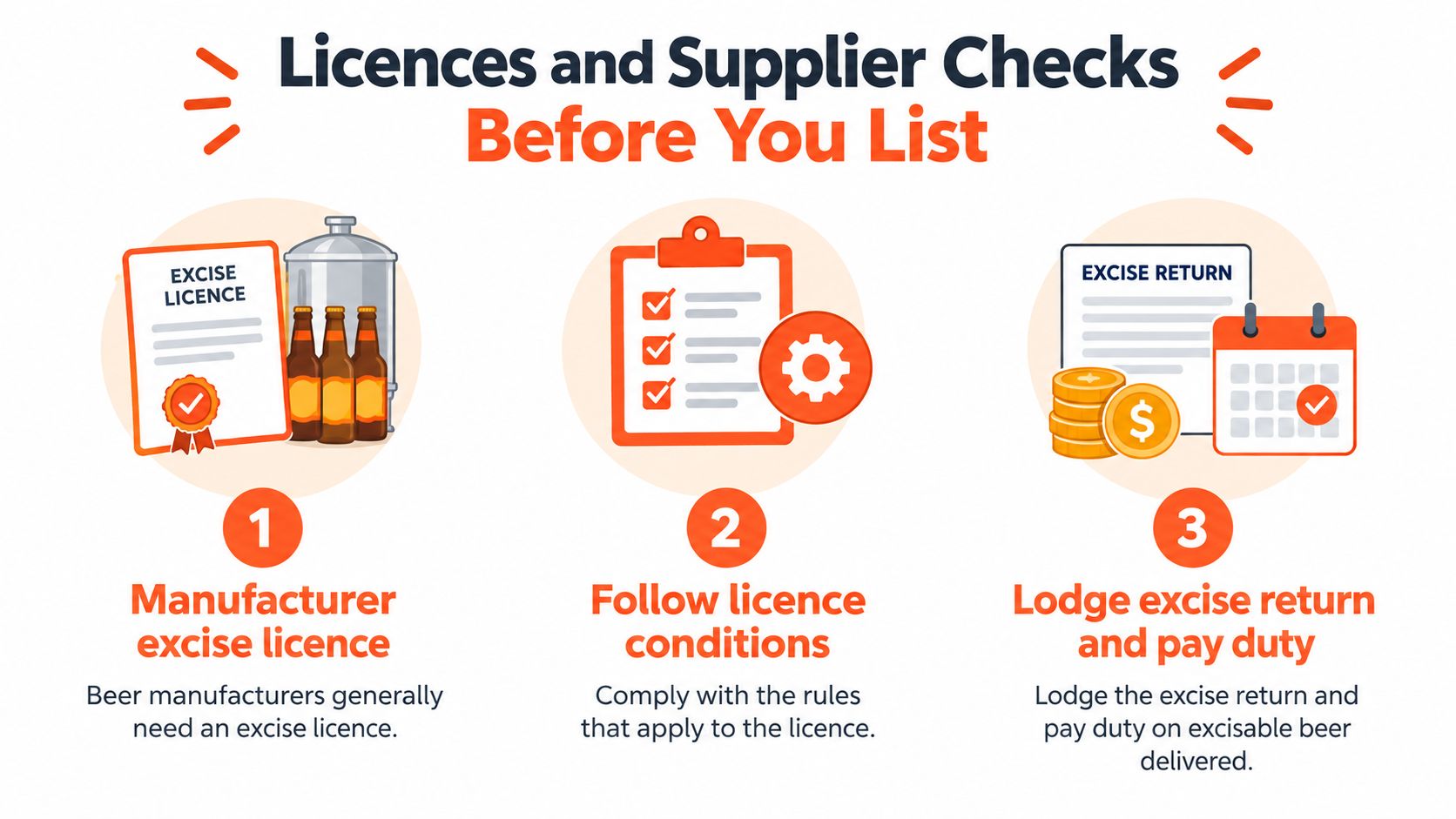
The risk that catches buyers is this. Distributors and retailers can commit an offence by purchasing and reselling illicit alcohol, even if they did not know duty had not been paid. "Local" or "independent" on the can is not evidence. Documents are.
What to ask before the first delivery
Collect this before you list the beer, not after the first busy weekend.
- Legal entity and ABN: The supplier's registered name, not just the brand on the tap badge.
- Tax invoice: A compliant invoice on every delivery, filed with that order.
- ABV and pack: Strength and container on the invoice, matching the can you will pour.
- Who pays duty, and who delivers: Written confirmation of excise responsibility and delivery responsibility.
- Your own licence: A current Queensland liquor licence for the premises. If you're still sorting that, start with how to obtain a Queensland liquor licence.
File the pack with the order: entity details, invoice PDF, ABV sheet, and the delivery note. A Gold Coast bottle shop with staff turnover can still show an auditor who supplied the beer and that duty was the supplier's job. Informal "mate's rates" text messages will not do that.
Stop the listing if there's no invoice, no licence details, or a price that looks too low to contain duty. A deal that can't survive a paperwork check isn't a bargain. It's a stock problem with a compliance problem attached.
Label and Marketing Rules for Wholesale Beer
A carton with the wrong label data gets rejected at the back door or pulled for relabelling. Either way you lose time and margin, and the tap you promised on Friday is empty.
Food Standards Australia New Zealand ties the declarations to alcohol concentration. Beverages of at least 0.5% ABV must declare alcohol information and the number of standard drinks. Above 1.15% ABV, alcohol content must be stated as ABV or millilitres per 100 mL, and the product needs the prescribed pregnancy warning label, with set design and legibility rules. Energy statements are mandatory for most packaged alcoholic beverages, per serving and per 100 mL.
| ABV band | Alcohol information | Standard drinks | Pregnancy warning | Energy statement |
|---|---|---|---|---|
| At least 0.5% and up to 1.15% ABV | Required | Required | Not required | Required for most packaged alcoholic beverages |
| Above 1.15% ABV | Required (ABV or mL per 100 mL) | Required | Required | Required (per serving and per 100 mL) |
One file per SKU
Each retail SKU needs a controlled technical file: verified ABV, the standard-drink calculation, serving volume, energy value, allergen and ingredient data where they apply, and approved artwork. Cans, cartons, the online listing and the venue sell sheet should say the same thing. If you're building that artwork, a practical walk-through of a custom label beer shows how the pack has to carry the facts, not just the brand.
What the sell sheet must not say
The ABAC Responsible Alcohol Marketing Code covers sell sheets, social posts, trade advertising, packaging and paid Facebook ads, not only TV. ABAC guidance prohibits marketing that shows or treats as amusing consumption above the Australian guidelines, more than 10 standard drinks a week or more than 4 on any one day. It also bars rapid drinking, misuse, drinking games and dares.
The ABAC Code also bans strong or evident appeal to minors, a minor shown drinking or serving, and any claim that alcohol causes personal, business, social, sporting or sexual success. Don't show drinking before or during driving, boating, operating machinery or swimming. Facebook creative aimed at adult beer drinkers should use clearly adult imagery and language. Talk about flavour, provenance, freshness and hospitality. Don't talk about how much someone should sink.
A Gold Coast Venue Listing From First Call to First Order
Say a Gold Coast bistro has 12 taps and a small bottle fridge, and wants two local beers. The fear isn't "will guests like flavour". It's dead stock, a tap that sits, and a supplier you can't defend if someone asks for the paperwork. Work in buying order.
The checks in buying order
- First call. Ask the trade contact for pricing and minimums. Send your liquor licence, expected monthly volume by SKU, pack preference (keg, carton or mixed case), delivery address and access hours.
- Compliance pack. Take the entity name, ABN, a sample tax invoice, ABV and pack data, and written word on who pays excise and who owns delivery. No pack, no listing.
- Label file. Match each SKU to the declarations for its ABV band, including standard drinks, the pregnancy warning where it's required, and the energy statement. If the sell sheet and the can disagree, don't pour it.
- Landed cost. Rebuild the carton or keg on a spreadsheet: trade price with duty in, freight, unrecovered deposit, a wastage allowance, then your expected gross margin. Do this before you fall for the headline case price.
- Trial, not a bunker. I would start with mixed 4-packs of two beers, or a single keg, rather than a full carton of each. You learn sell-through without filling the fridge.
- Restock trigger. After a month, set the reorder off what sold. If a tap hasn't moved, take it off. Don't "give it another fortnight" out of politeness.
Where the margin leaks
Confirm in writing, before you sign, who pays excise, who holds delivery risk, and what happens to unsold stock. A handshake on returns becomes an argument the week a keg is still half full.
Two habits lose venues money. Ordering a month of stock for a beer you've never poured, and leaving a beer on the line long after guests have moved on. Freshness is the product. A tired keg trains people not to order that tap again.
Carbon 6 Brewing, in Stapylton on the northern Gold Coast, sells into this local trade as well as online. Packs include 4-packs and 16-packs, with single 440 mL cans available onsite. There is no trade price on this page, and you shouldn't invent one from a menu photo. Send the enquiry through Carbon 6 Brewing with your licence and your volumes, and cost the answer the same way you would any other supplier.
Carbon 6 Brewing Pty Ltd brews in Stapylton and supplies packaged beer to Queensland venues alongside its online shop, with the duty, label and pack details a buyer can check. If you're costing a first order rather than chasing the cheapest case, start with a trial quantity and a landed-cost line for each SKU. Visit Carbon 6 Brewing Pty Ltd and send your licence, pack preference and monthly volume to the trade contact.