Strange Love Ginger Beer: An Aussie Craft Favourite
Oct 17, 2026
You're at the bottle shop, the fridge door's still open, and you've got a cold bottle of Strange Love Ginger Beer in your hand while the bloke behind you is clearly waiting for his turn. It looks like a premium soft drink, smells like a proper ginger hit, and sits awkwardly between mixer territory and something you'd happily sip on its own. That's where shoppers get stuck, because the label tells part of the story, but not the whole thing.
What Strange Love Ginger Beer Actually Is
The first thing to know is that StrangeLove started in Byron Bay, New South Wales, and the business began in 2012 with its first drink released in 2013 as an Organic Ginger Beer Energy Elixir (StrangeLove's brand history). That origin matters, because this wasn't built as a sugary supermarket chug. It was developed as an adult-oriented soft drink, with a strong ginger profile and functional ingredients like green tea and yerba mate.
If you crack one open at home, the drink tends to land somewhere between a serious mixer and a grown-up soft drink. It's built for people who want ginger to taste like ginger, not like a whisper hiding behind cane sugar. If you're comparing styles, a useful way to shop is to look at a premium organic option such as Saporia's Belvoir ginger beer selection, then decide whether you want something more classic or more distinctly modern in the glass.
The texture and flavour cue the same answer: this isn't a kid's lemonade with ginger on the label. It's a non-alcoholic drink with adult positioning, and that gives it two jobs, a standalone refresher and a mixer. If you're buying for a barbecue, a dinner party, or a fridge staple that won't feel ordinary, that's the lane it's aiming for.
Alcoholic or Non-Alcoholic and Why the Line Matters
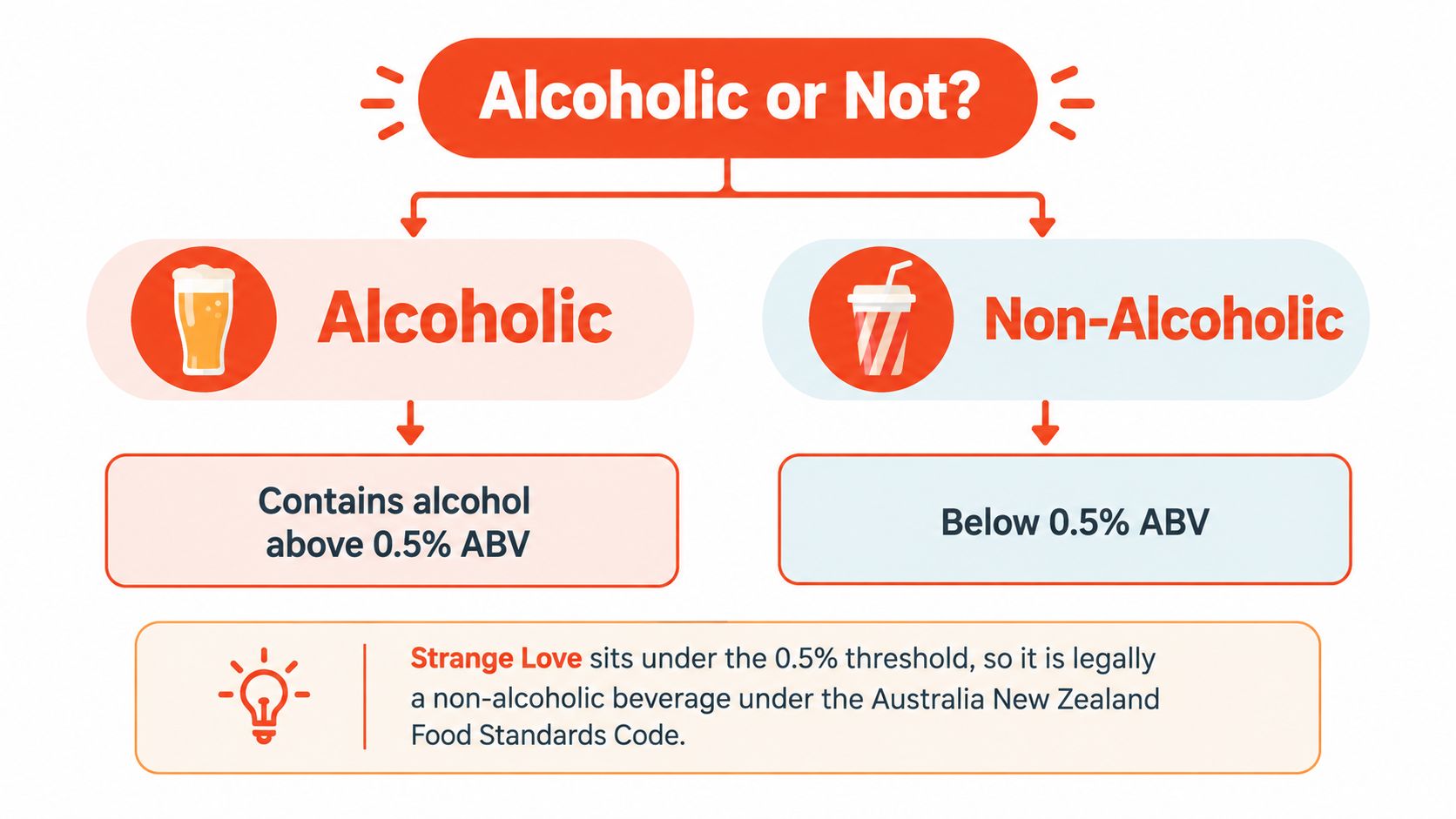
Australian ginger beer can be hard to pin down because the category lives between soft drink and alcohol. Under the Australia New Zealand Food Standards Code, a fermented brewed soft drink is made from water, sugar and fruit or vegetable extracts or infusions, and it must stay at no more than 1.15% alcohol by volume to remain in that category (FSANZ and food regulation guidance). Once a drink moves past that line, it falls into the alcoholic-beverage framework.
That matters on the shelf and on the label. If a ginger beer is fermented, the alcohol level still has to be measured, controlled and declared properly. The same guidance says beverages at 0.5% ABV or above need an alcohol-content statement, so a drink that tastes light and fizzy still cannot be handled casually from a compliance point of view.
Practical rule: the category follows the alcohol content, not the front label.
For Strange Love, the practical takeaway is straightforward. The drink is presented as a non-alcoholic soda, not a fermented alcoholic ginger beer, and that places it on the soft-drink side of the line. That classification affects shelf placement, online listings and how venues describe it to customers. It also helps explain why batch control matters. Even small changes in fermentation can shift a product across the threshold if nobody is watching closely.
If you are stocking a fridge for mixed audiences, a host's non-alcoholic Bellini choice like Cipriani's alcohol-free Bellini shows how the non-alcoholic shelf is organised around the same ABV line.
The confusion usually comes from flavour. Big ginger, sharp spice and a dry finish can feel beer-adjacent. They are still not the same thing, and in Australia that difference decides whether a drink is treated as a soft drink or an alcoholic beverage.
The Byron Bay Roots and Aussie Growth Story
The origin story is already on the table. What matters next is how StrangeLove turned a local idea into something hospitality buyers wanted to pour.
The first real step was place. The brand grew out of Byron Bay, then found traction in venues where bartenders and chefs could judge it on taste, not branding. That matters with ginger beer, because the flavour either holds up beside food and spirits or it gets lost in the mix.
A restaurant link with chef Kylie Kwong gave the brand early credibility, and by the end of 2014 it was appearing in Sydney and Melbourne restaurants and bars (brand history). That is a familiar Australian path for a craft drink. Local interest first, venue support next, wider recognition after that.
The range kept changing as the company grew. In 2015, StrangeLove moved toward a low-calorie adult-soft-drink position and added flavours such as blood orange and chilli (brand history). The company also says the original recipe carried so much ginger that it clogged a borrowed bottling line. That detail says plenty about the style they were chasing, sharp, assertive, and built for people who like ginger bite.
By 2022, the brand had been acquired by Asahi Beverages (brand history). The local story still matters, though. It shows how an Australian beverage can move from a regional start to a national shelf presence without losing the make-it-here identity that helped it stand out in the first place. The company also notes that Double Ginger Beer is made in Australia from at least 93% Australian ingredients and contains 55 calories per serve (product page).
Flavour Profile and Food Pairings Worth Trying
The clearest way to think about StrangeLove Double Ginger Beer is this. It comes in with a proper ginger snap, then settles into warmth rather than harsh burn. The sweetness sits underneath the spice, and the finish stays clean instead of syrupy. That's why people reach for it when they want something lively rather than sugary.
What to eat with it
A ginger beer like this works because it behaves like a palate reset. It cuts through salt, handles spice and keeps richer food from feeling heavy. If you're building a drinks menu for a casual table, that's the part that matters.
| Food | Why It Works | Occasion |
|---|---|---|
| Grilled prawns | The ginger lifts the sweetness in seafood without flattening it | Backyard lunch |
| Spicy Asian-style noodles | The spice echoes the dish instead of fighting it | Friday night takeaway |
| Cured meats | The carbonation cleans the palate between salty bites | Share board with mates |
| Curry | Ginger keeps the heat feeling bright, not muddy | Dinner with friends |
For a broader sense of pairing logic, the Carbon 6 beer and food pairing guide is useful reading if you like matching drinks to actual meals rather than guessing at the bottle shop. And if you're planning a business tasting or a catered drinks kit, a Moscow Mule kit for corporate clients shows how ginger-forward flavour can be packaged for events without turning the whole thing into a cocktail lecture.
Fresh ginger character is doing most of the heavy lifting here. If you like drinks that finish crisp and don't sit like cordial, this is the point of difference.
You could even place it beside a straightforward, easy-drinking lager such as Carbon Dry Lager when you're mapping out a mixed drinks fridge. The lager is built for a different role, but the comparison helps because both are about refreshment, just through different flavour tools.
The Lo-Cal Promise on the Label Explained
A lot of shoppers read “lo-cal” and assume it means low sugar. It doesn't. On the Double Ginger Beer Lo-Cal label, the product contains 12 g of sugar and 55 calories per 300 ml serve, and it uses sugar rather than stevia or erythritol (product information). That keeps it lighter than many ginger beers, but it is still a proper sweetened drink.
What that means in practice
The label is doing a specific job. It signals a lower-calorie pour without pretending the bottle is basically flavoured water. If you track sugar for health, training, or simple preference, the serve size matters just as much as the front-of-pack wording.
Taste follows the same logic. Sugar gives the ginger a rounder shape, so the finish stays fuller and less sharp than many zero-sugar formulas. That suits drinkers who want bright ginger bite without the thin, metallic edge some sweeteners can leave behind.
The wider aisle context matters too. Non-alcoholic options still make up the bulk of category revenue, which shows how strongly soft-drink habits shape ginger-beer buying in Australia. StrangeLove should not be sold as health food, and the label does not try to do that. It gives you a lighter-leaning option that still tastes like ginger beer, not a fizzy compromise.
How It Stacks Up Against Other Aussie Craft Ginger Beers
The simplest way to compare ginger beers is to stop asking which one is “best” and start asking which one fits the moment. StrangeLove sits in the sharper, lower-calorie corner of the Aussie craft ginger-beer world. Some rivals lean sweeter, some lean more syrupy, and some are built mainly as mixers.
| Brand | Style | Calories per 300 ml | Ginger Intensity |
|---|---|---|---|
| StrangeLove Double Ginger Beer Lo-Cal | Adult soft drink | 55 | High |
| Another Australian craft ginger beer | Premium mixer style | Not stated here | Medium |
| A classic sweet ginger beer | Sweet soft drink | Not stated here | Low to medium |
If you want a broader comparison point, the Carbon 6 brown snake ginger beer note is a handy read for understanding how flavour-first ginger beers are often discussed in Australian craft circles. The main thing to notice is that StrangeLove tends to go for bite and balance rather than a sugary finish.
That makes it a good fit for people who want ginger to feel vivid, not sticky. If you're after a sweeter pour for dessert-like sipping, another style may suit you better. If you want a brighter, drier edge that still reads like ginger beer, StrangeLove makes sense.
Where to Buy It in Australia and What Marketers Should Know
Most Australian adults will find StrangeLove Ginger Beer through a few familiar routes. The most direct is the brand's own DTC online store, which suits people ordering cartons or mixed drinks for home delivery. You'll also see it in major supermarket bottle aisles, independent bottle shops and selected venues, especially where premium soft drinks and mixers are already moving well.
If you're shopping online, the practical test is simple. Check whether the retailer stocks the specific variant you want, whether it's sold as a drink-on-its-own or a mixer, and whether delivery rules suit your state or postcode. For a broader buying model, the Carbon 6 online bottle shop guide is a useful reference for how adult beverage shoppers usually approach online purchase options in Australia.
For marketers, the bigger issue is compliance. The ABAC framework applies to alcohol marketing across websites, email, search, influencer content and social platforms such as Facebook (ABAC code overview). That means a ginger beer straddling the alcohol conversation can't be handled casually just because it tastes like a soft drink.
On platforms without effective age controls, ABAC's digital guidance requires the communication to sit where the audience is reasonably expected to be at least 80% adults (ABAC digital guidance). ABAC also says controlled websites and social pages should include responsible-drinking messaging and point to an appropriate responsible-drinking website such as DrinkWise (ABAC digital best practice). In plain English, that means audience controls, responsible messaging and careful product framing all matter, even when the drink itself sits on the non-alcoholic side of the shelf.
The Short Verdict for Curious Aussie Drinkers
StrangeLove Ginger Beer is an Australian-grown, adult-leaning ginger beer that started in Byron Bay and grew by doing the basics well, strong ginger flavour, clear positioning and enough bite to feel grown up. It's a non-alcoholic, lower-calorie option that works as a mixer, a fridge drink or a sharper alternative when you don't want something sugary and flat.
If you like drinks that taste lively, not syrupy, it suits a long lunch, a Friday curry or a bar fridge stocked for mates who want something with personality. It's not trying to be a beer, and that's exactly why it works. For Australian drinkers who want ginger with proper character, that's a fair trade.
If you're building a range of drinks for home, venue or retail use, Carbon 6 Brewing Pty Ltd works with Australian adults who want flavour-led options and straightforward online ordering. Have a look at Carbon 6 Brewing Pty Ltd if you want to explore local craft beverages, food-friendly drinks and the kind of premium choices that suit a proper Aussie fridge.