

Craft Beer Glassware Guide: Shape, Aroma, and Style
Oct 18, 2026
Your mixed-pack delivery is on the kitchen bench, the cans are heading into the fridge, and you're looking through the cupboard. There's a sturdy pub glass, a wine glass from dinner and a tall glass that barely fits in the dishwasher. Which one should you use?
Craft beer glassware doesn't need to become another expensive hobby. A useful glass helps you notice what the brewer put into the beer, suits the serving you've chosen and survives ordinary life. For a Queensland household, that last bit matters just as much as a handsome silhouette.
Why the Glass in Your Hand Actually Matters
Say you've chosen a hop-forward pale ale from the pack. You want to understand its aroma, not perform a tasting ceremony at the kitchen bench. Reaching for a glass with a gently curved bowl is a sensible starting point, but reaching for a clean everyday glass isn't a mistake.
The distinction is between changing the beer and changing your experience of it. Glassware doesn't rewrite the recipe or alter the alcohol strength. Its shape affects how the beer is presented as you smell and sip it, which is why different vessels can make the same beer seem different.
There's a practical side, too. A glass that's awkward to hold, difficult to wash or too large for your preferred serving can be a poor choice even if its shape looks technically impressive. You shouldn't need to reorganise the kitchen just to enjoy an occasional IPA.
Start with your actual habits
Before buying anything, think about the beers you reach for and how you serve them.
- Mostly mixed packs: Choose a versatile shape rather than a separate glass for every label.
- Usually aromatic ales: Give a curved bowl and a manageable opening priority.
- Often entertaining: Look closely at stability, storage and how easily you can replace a broken glass.
- Prefer smaller servings: Choose useful capacity rather than assuming a pint is the default.
The purchasing question isn't whether your cupboard looks like a brewery tasting room. It's whether a new glass solves something you've noticed: awkward pours, poor storage, fragile stems or difficulty appreciating the aroma.
Practical rule: Buy for the beer you actually serve and the washing-up you actually do.
For brewery-produced content, glassware advice also sits within alcohol marketing responsibilities. The ABAC Responsible Alcohol Marketing Code covers packaging, point-of-sale material and digital communications, not just conventional adverts. Describing flavour appreciation is appropriate; suggesting that a particular vessel makes drinking necessary for a good time isn't.
That's the approach here: clear Australian terminology, metric serving volumes and recommendations based on appreciation rather than quantity.
Anatomy of a Beer Glass
Put a glass on the bench and look at it side-on. Instead of asking what style it belongs to, look at where it widens, where it narrows and how it stands. Those features tell you more than the branding printed on the front.
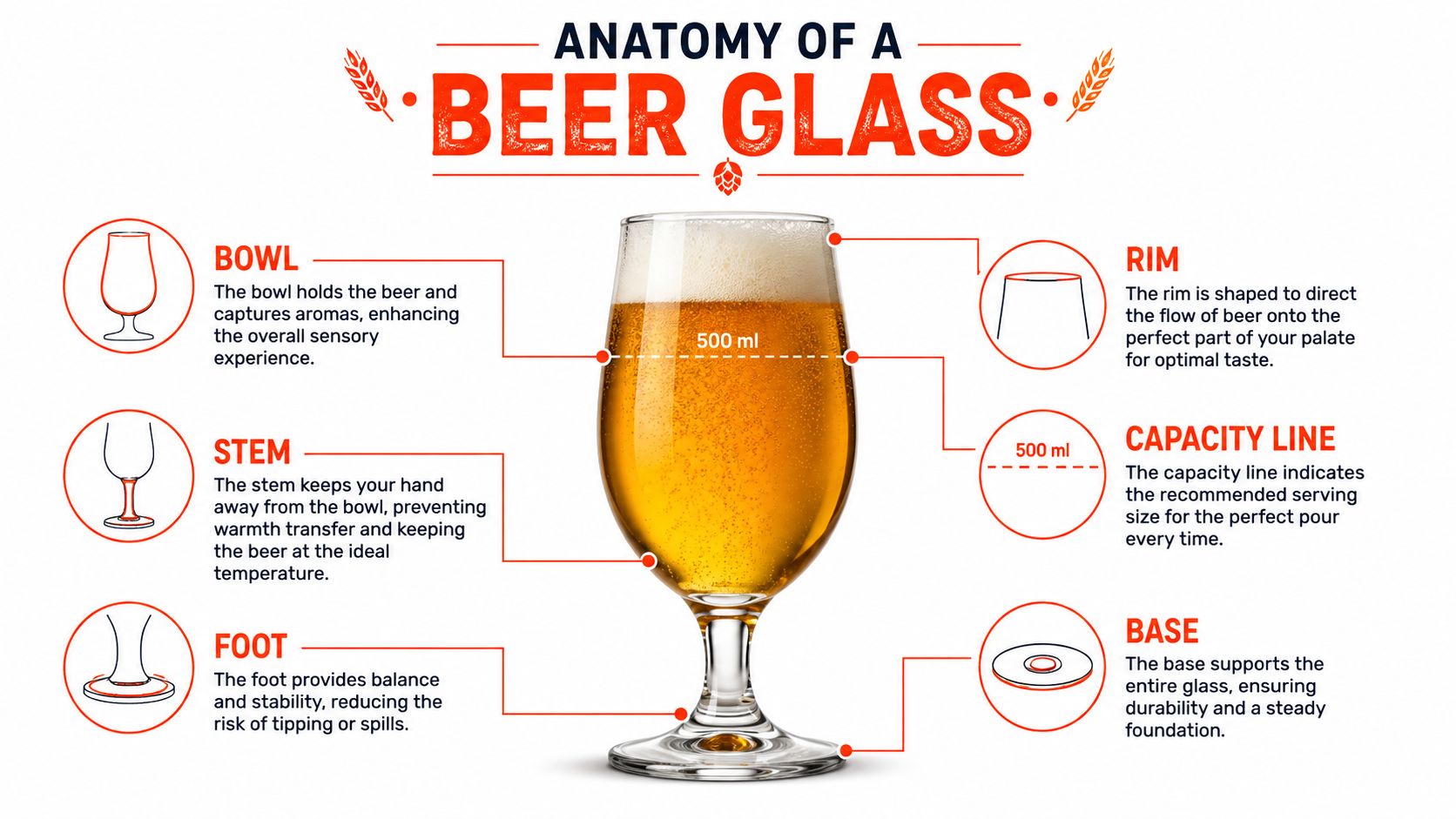
Read the glass from top to bottom
The rim is the opening you drink from. Notice whether it's broad, narrowed or flared outwards, and whether it feels comfortable against your lip. A dramatic shape isn't much use if you dislike drinking from it.
The bowl holds the beer and leaves space above it. Think of the upper bowl as a loose funnel for aroma, not a sealed container: its shape influences the space between the liquid and your nose.
- Stem: A separate grip below the bowl lets you hold the glass without wrapping your hand around the beer.
- Foot: The spread-out platform beneath a stem helps the glass stand securely.
- Base: On a stemless glass, this is the bottom that supports the vessel directly.
- Capacity line: A marked serving level distinguishes the intended measure from whatever the glass can hold right up to its brim.
That last distinction matters commercially. The National Measurement Institute's rules for selling alcohol explain that tap beer is usually served in an approved batch-tested glass or jug, with its volume displayed in millilitres or litres and capacity defined at the brim or a marked line. A decorative logo isn't a measurement mark.
Describe the shape before naming it
A straight-sided vessel has relatively little change in width. A curved vessel swells through the bowl, while an inward-tapered upper section narrows towards the opening. A flared rim opens outwards.
Stemmed describes the support and grip arrangement, not the bowl shape. A stemmed glass can still have a broad bowl, narrow opening or flared lip.
Try that vocabulary on the wine glass already in your cupboard. It might have exactly the curved bowl and narrowed opening you're looking for, even though nobody sold it as beer equipment. Don't confuse a useful design feature with a requirement to buy another product.
How Shape Changes Aroma and Flavour
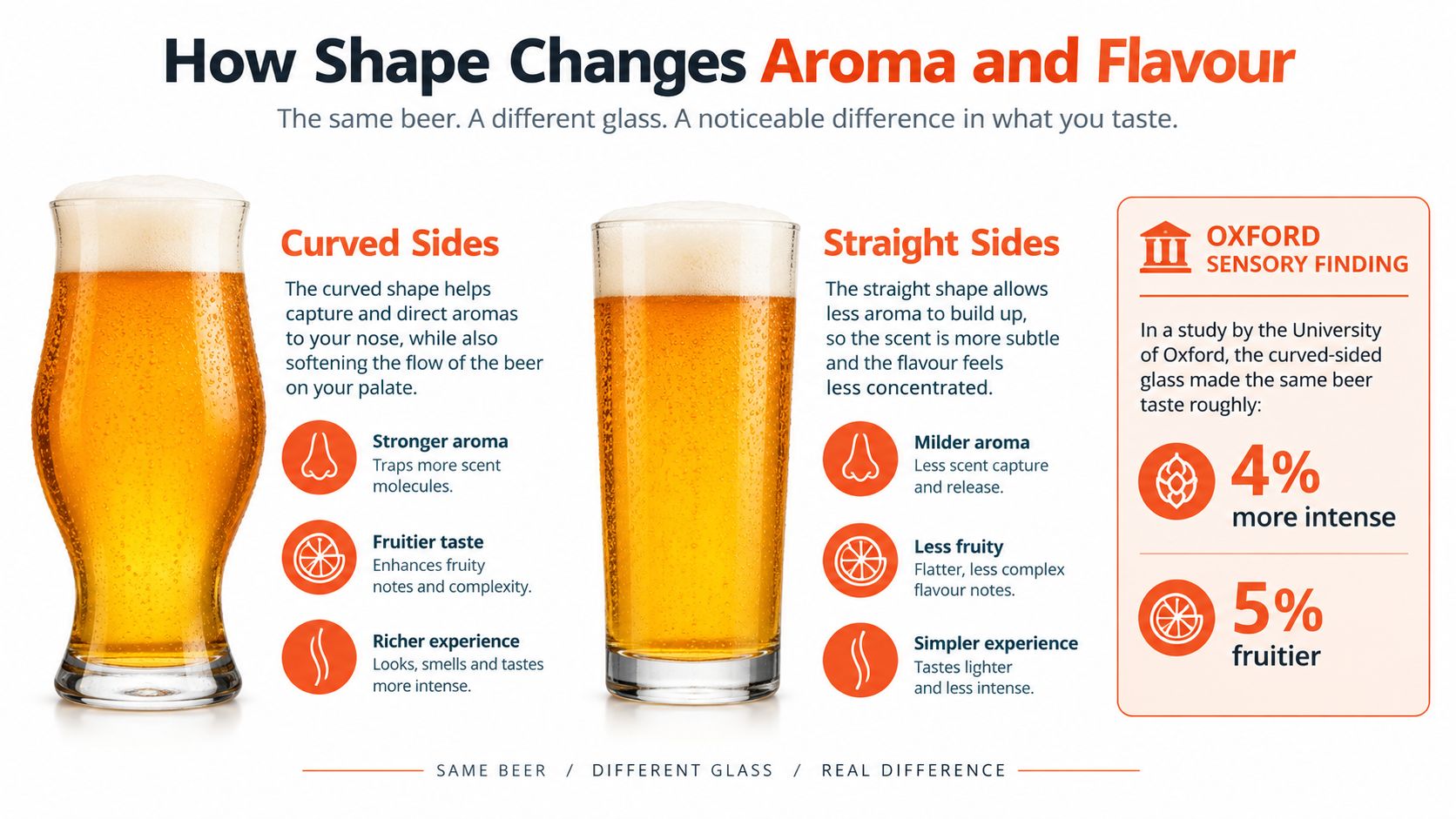
The strongest reason to care about shape is sensory evidence, not tradition. In controlled testing, beer in a curved-sided glass was perceived as approximately 4% more intense and 5% fruitier than the same beer in a straighter-sided vessel, as reported in the Oxford-hosted beer glass sensory research.
Those are perceptual differences. They don't mean the glass created more fruit flavour, increased hop content or produced a universal improvement for every drinker and beer.
What curvature is likely doing
The likely explanation involves volatile compounds, the compounds that move from the beer into the air and contribute to what you smell. Curvature changes the exposed liquid surface and the space above it, potentially concentrating those compounds where your nose encounters them.
That matters because tasting isn't only what happens on your tongue. When you describe an IPA as peachy, tropical or citrus-led, aroma is part of the experience. A suitable glass can make those existing characteristics easier to notice without changing the liquid.
For a concrete example, Peachquency Hazy IPA beer is a NZ-style IPA featuring Peacherine, Motueka and Riwaka hops, with peach, passionfruit and zesty lime flavour descriptions. A curved, inward-tapering glass is a reasonable serving choice for exploring that aromatic profile, not a promise that every drinker will perceive it identically.
Turn the evidence into a useful specification
For aromatic Carbon 6 styles, including Oat Cream IPAs and tropical pale ales, my practical recommendation is a curved bowl, a gently narrowed opening and room above the serving for foam. You don't need an extreme silhouette or a fragile stem to meet that specification.
- Choose usable bowl space: Allow room for the beer and its head rather than selecting a glass that only just accommodates the liquid.
- Avoid brim-filling: Overfilling removes the headspace you selected the glass to provide.
- Treat foam as part of presentation: An appropriate head provides a more repeatable smelling and tasting interface.
- Keep expectations realistic: Shape supports perception; it doesn't repair a beer you don't enjoy.
The glass is a way to notice the beer, not a way to turn it into a different beer.
If your existing curved glass feels comfortable and gives you enough room, use it. The evidence supports paying attention to geometry, not collecting every specialist design.
Matching Glassware to Beer Styles
A style-pairing chart is useful as a starting point, provided you don't mistake it for a rulebook. These are practical recommendations based on bowl shape, opening and headroom, not claims that each style has a scientifically proven exclusive vessel.
If the names on your mixed pack are unfamiliar, Carbon 6's guide to types of craft beer can help you distinguish the beer styles before choosing a glass.
Glass Style and Best Beer Match
| Glass | Best Beer Styles | Why It Works |
|---|---|---|
| Nucleated pint | Sessionable pale ales and lagers | A practical everyday format when you want familiar presentation; don't confuse nucleation with aroma-focused bowl geometry. |
| Shaker pint | Everyday pale ales, lagers and mixed-pack pours | Its straightforward shape makes it an uncomplicated general-purpose choice, though it offers little inward taper. |
| Tulip | Hop-forward IPAs and Belgian saisons | The curved bowl and narrowed upper section suit aromatic beers while leaving useful room for head. |
| Goblet | Stronger abbey ales and barleywines | A broad bowl makes it easy to present a modest serving without filling the vessel. |
| Snifter | High-ABV beers served in small portions | A rounded bowl and tighter opening suit deliberate aroma assessment with a smaller pour. |
| Pilsner flute | Crisp lagers, including a West Coast Pilsner | The tall, slender format suits a clear visual presentation and a controlled pour. |
| Weizen glass | Wheat beers | The tall body and wider upper area provide space for the style's characteristic head. |
Choose between neighbouring options
Tulip or snifter? For an IPA, I'd usually reach for the tulip because it offers a practical balance of bowl space and drinking comfort. For a stronger beer served in a modest portion, a snifter can be useful, but alcohol strength isn't a reason to choose or promote a beer for its intoxicating effect.
Goblet or tulip? Look at the actual opening. A goblet with a very broad mouth presents differently from a tulip that narrows above the bowl, so the name alone doesn't settle the choice.
Pilsner or weizen? Both may be tall, but they aren't interchangeable in proportions. Check whether the upper section gives you the headroom you need, particularly when pouring wheat beer.
Where the everyday pint fits
There's nothing embarrassing about a shaker pint. If it's comfortable, clean and suited to your serving, it remains a useful option for the kitchen bench or a seated backyard meal.
For nucleated glasses, ask the supplier what the treatment is intended to do and how to care for it. Don't assume an etched base gives you the same benefit as a curved bowl, or that the word “pint” tells you the serving volume.
Branded accessories are a separate buying decision. If you're organising custom can covers for an event, Power Print's beer cozy minimums explained is a relevant ordering resource, but can accessories shouldn't determine which glass suits the beer.
Your most useful pairing is the one you can repeat without fuss. Start with the table, then favour comfort and your own observations over strict style etiquette.
Pouring and Serving Technique at Home
A sensible pour begins before you open the can. Check that the glass is clean, undamaged and ready to use, then choose the amount you intend to serve. Don't let a large vessel make that decision for you.
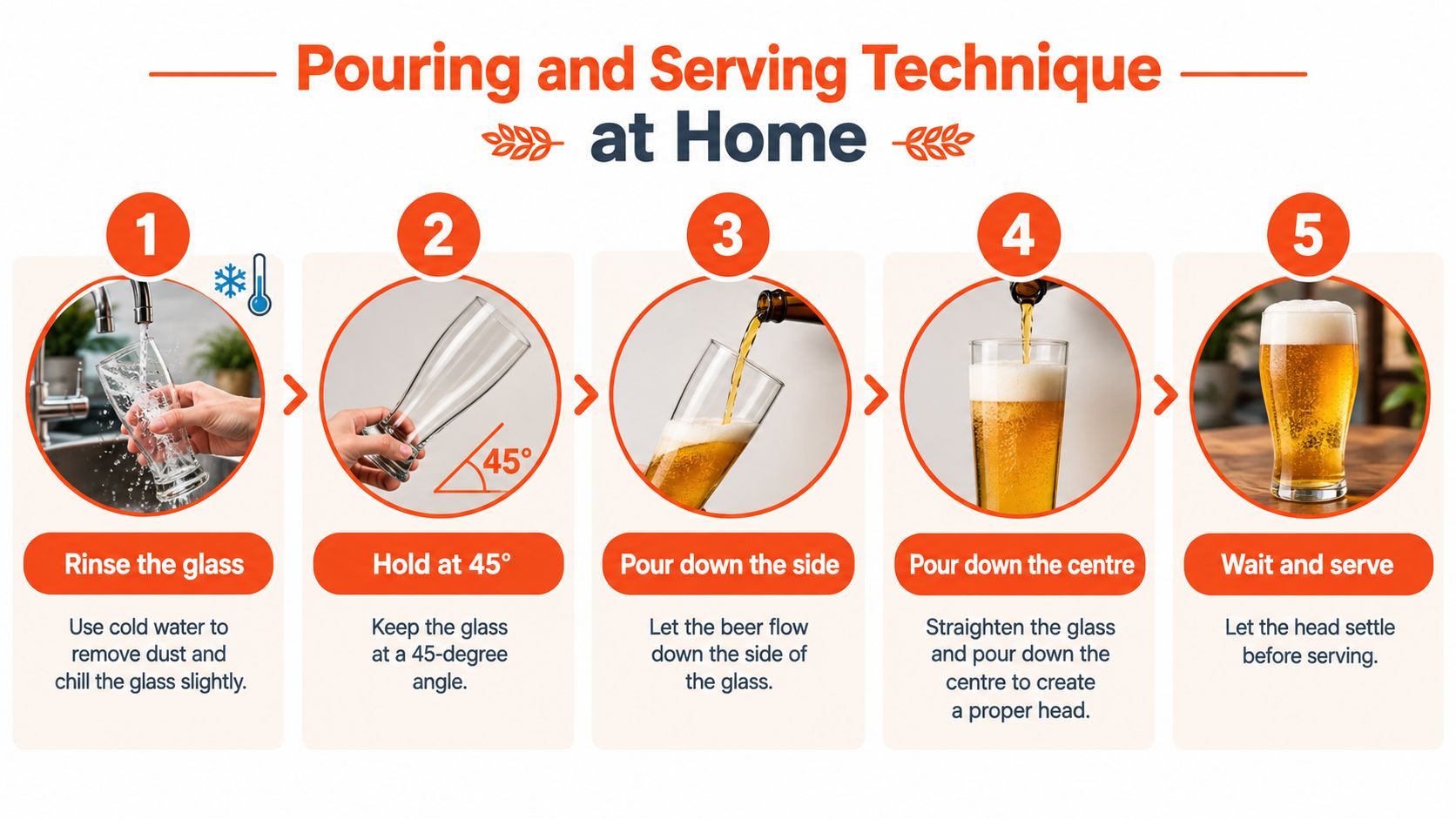
A repeatable bench routine
- Rinse after washing: Use cold water to remove any settled dust and briefly cool the glass. A rinse isn't a substitute for proper cleaning.
- Begin at an angle: Hold the glass on a slant and pour steadily down the inside wall.
- Straighten as you pour: Bring the glass upright as the head develops, adjusting the flow rather than tipping the can abruptly.
- Leave a sensible foam allowance: Roughly two finger-widths is a useful starting cue, not a calibrated requirement. Finger sizes and beer behaviour vary.
- Pause before serving: Let the head settle enough to judge the presentation and serving level.
For a closer look at cleaning and pouring together, use Carbon 6's beer-clean glass guide for a better pour.
Handle temperature without chasing a number
Follow the brewer's serving advice where it's available. As a practical starting preference, serve lagers cool, keep pale ales and IPAs cool without assuming colder is always better, and allow strong dark beers a little time after fridge storage if you find their aroma difficult to assess.
Sours cover too much ground for a single temperature rule. Start cool, then notice whether the balance becomes more appealing as the serving changes temperature.
In Queensland heat, avoid leaving an empty glass baking on an outdoor table before filling it. Brief cooling can be useful, but there's no need to freeze the glass or turn service into a stopwatch exercise.
At the bench: Adjust the pour to the beer in front of you. A foam-heavy wheat beer and a quieter dark ale won't necessarily behave alike.
Aim for a consistent routine rather than a theatrical pour. Cleanliness, control and an appropriate serving are the useful habits.
Choosing Glassware That Survives Real Life
The most specialised glass isn't automatically the best buy. If you're unloading mixed packs, running the dishwasher and squeezing glasses between lunch containers, a delicate tasting set may solve the wrong problem.
Australian food-contact expectations provide a sensible foundation: equipment should be appropriate for its intended use, withstand reasonable handling and remain clean and protected from contamination, as outlined in Food Standards Australia New Zealand's Safe Food Australia guidance.
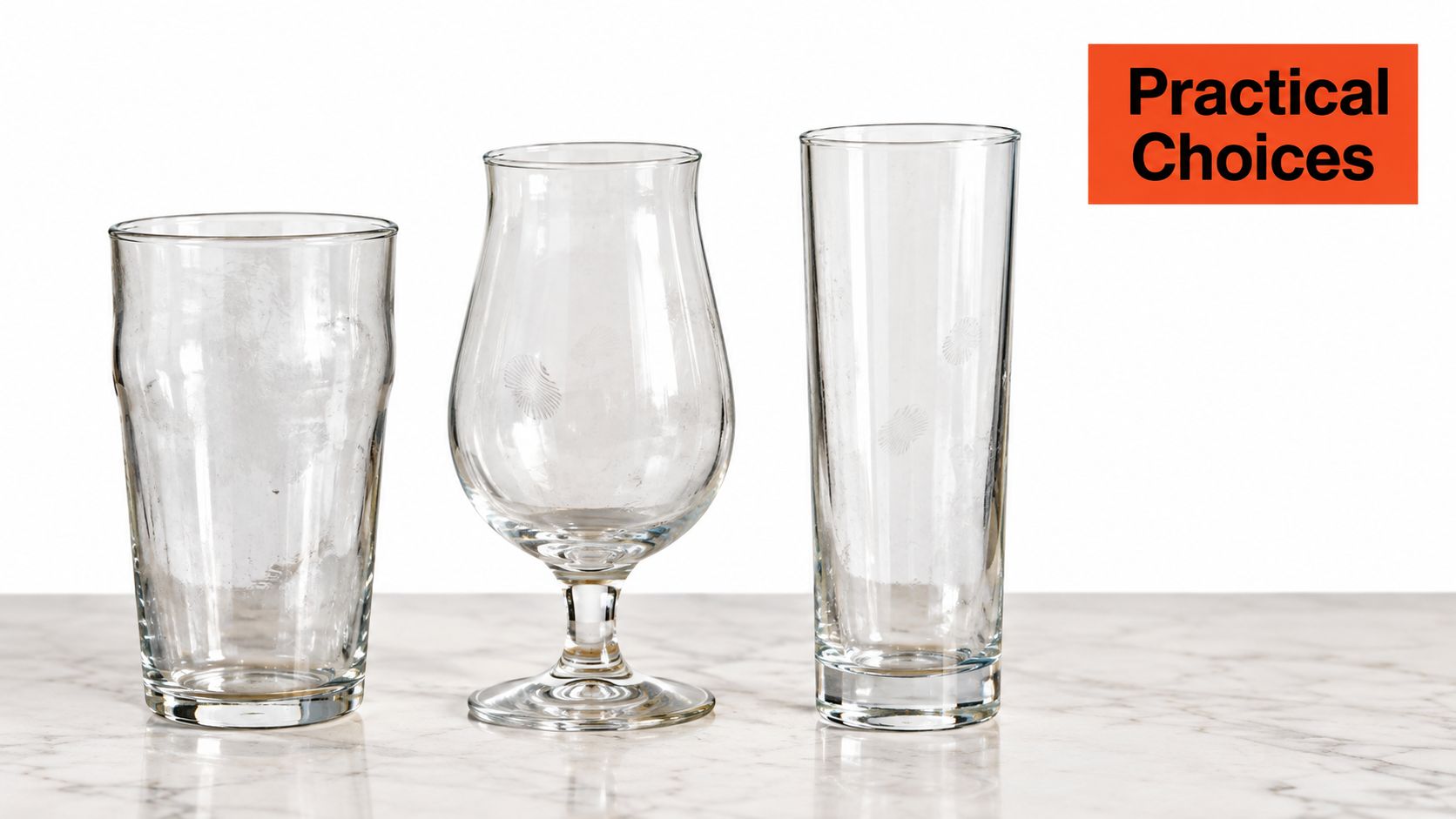
Match the setup to the household
| Setup | Practical advantage | Trade-off |
|---|---|---|
| An all-purpose everyday glass | Simple storage, familiar handling and fewer replacement decisions | Less flexibility in presentation |
| A tulip plus a sturdy everyday glass | An aromatic option alongside a general-purpose workhorse | Different washing and storage needs |
| A full tasting set | More shapes to explore across beer styles | Greater cupboard demand and more replacement decisions |
Check the boring details first
- Dishwasher suitability: Follow the manufacturer's care instructions rather than assuming all glassware can handle the same cycle.
- Storage: Check shelf height and whether the glass can be stored safely without precarious stacking.
- Replacement: Consider the cost and effort of replacing a single breakage before committing to a matching set.
- Outdoor safety: Keep breakable glass away from pool areas, and keep alcohol separate from swimming or other activities requiring alertness.
If you're buying for an occasion, Get Spliced's resource to compare bridal champagne flutes is relevant to the separate question of event glassware. Don't assume an attractive occasion glass will also make the most practical everyday beer vessel.
My default recommendation is a sturdy, comfortable glass you'll use regularly. Add a specialist shape only when you can name what it adds to your routine.
Responsible Service, Sizing and Sustainability
State the volume, not just the nickname. Queensland schooners are generally 425 mL and Australian pints 570 mL, while South Australian schooners are generally 285 mL and pints 425 mL, according to this Australian beer glass size guide. These describe the beer measure, not necessarily brim capacity; Carbon 6's Queensland beer glass sizes guide provides local context.
Australia defines a standard drink as 10 grams of pure alcohol; a 285 mL serving of 4.8% ABV beer contains approximately 1.1 standard drinks, compared with 1.6 in 425 mL, under the Australian Government's standard drinks guidance. Counting glasses alone isn't a reliable consumption measure.
Keep the recommendation responsible
The ABAC content rules prohibit encouraging excessive or rapid consumption and unsafe activity. Brewery publishers should also apply available age-restriction controls under ABAC's digital placement guidance.
Sustainability needs the same restraint. An Australian parliamentary submission discussing beverage-glass recycling identifies a 60% recycled-content target for beverage-glass production by 2025, not proof that it was achieved or that every reusable glass is environmentally preferable.
- Use what lasts: Actual reuse matters more than a premium label.
- Check disposal locally: Don't assume broken drinking glasses belong in the same stream as beverage containers.
- Start this week: Assess your cupboard, keep a sound everyday glass and add a curved option only if it fills a genuine gap.
Good glassware is about getting more from the beer, not more of it.
Carbon 6 Brewing Pty Ltd offers independently brewed craft beer from Stapylton on the northern Gold Coast through direct online sales and local wholesale distribution. Visit Carbon 6 Brewing Pty Ltd to explore the beer range, then choose a style that interests you and serve an appropriate portion in a glass that suits your home.